Retour à la Fruitpedia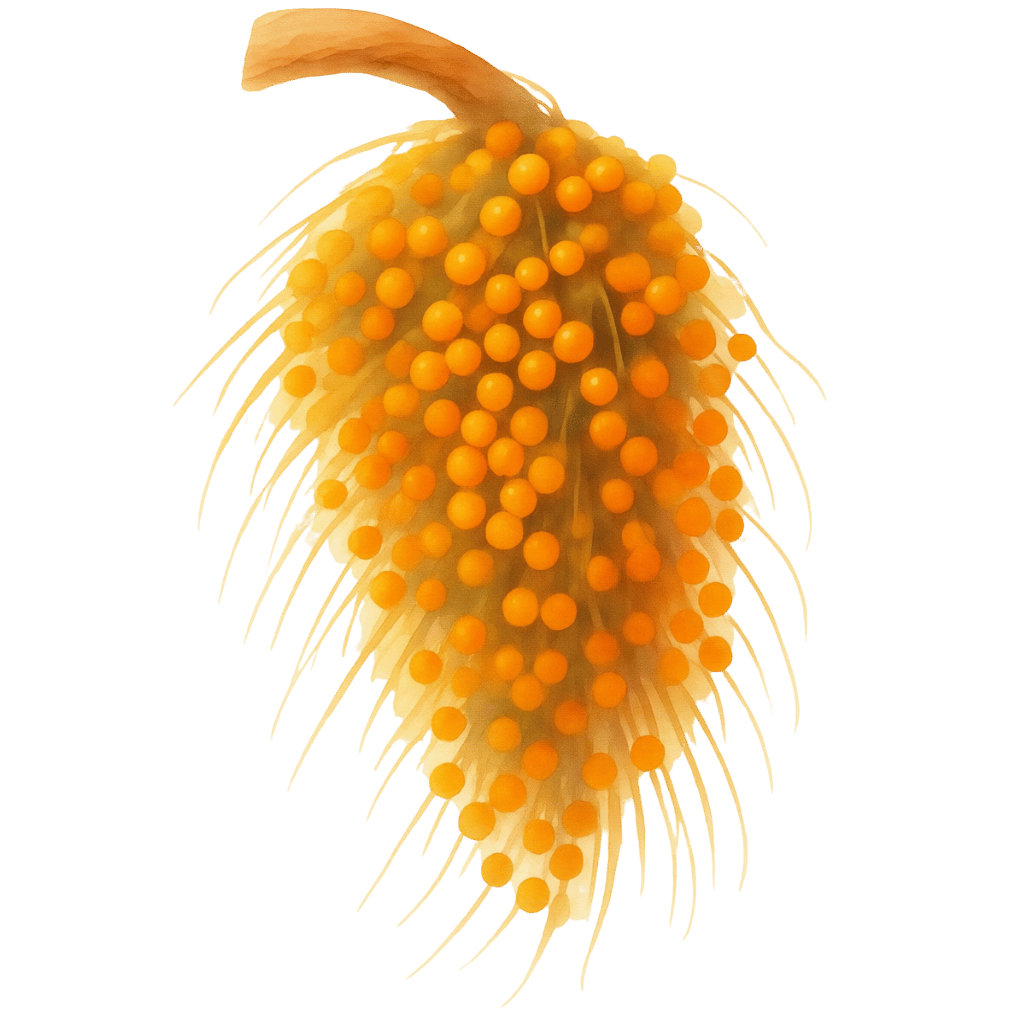
Jerivá
Syagrus romanzoffianaVue Botanique
- Leaves are alternate, pinnate, arching, and can reach up to 5 m in length, with narrow leaflets inserted in several planes along the rachis, giving the crown a plumose appearance. The petiole is broad and expanded at the base into a fibrous, glabrous-margined sheath. Leaflets show characteristic potassium-deficiency symptoms in cultivated, poorly fertilized specimens (necrotic spotting and frizzled tips).
- The trunk (stipe) is solitary, cylindrical, and essentially smooth, of nearly uniform diameter (8-15 inches / roughly 20-40 cm), clearly marked with ring-like scars left by fallen petiole bases. The outer bark (rhytidome) is greyish and finely fissured with leaf scars giving a distinctive appearance; the inner bark is cream-greenish with a fibrous, interwoven texture. Wood is dense (apparent density ~0.812 g/cm3), hard and fibrous, brownish in color.
- As in all palms, the root system is entirely adventitious, arising from a root-initiation zone at the stem base rather than from a taproot; palm roots lack root hairs and a vascular cambium. In S. romanzoffiana the system is notably superficial and profusely branched, which favors relatively easy transplanting (including of large, mature individuals) and makes the species well suited for planting along riverbanks and other periodically flooded margins.
- The inflorescence is interfoliar, 1-1.5 m long, initially enclosed by a woody, glabrous, longitudinally ridged and furrowed spathe. It develops into a branched panicle of spikes (rachillae) borne on a long peduncle. Numerous small, unisexual, three-petaled flowers are distributed along the rachillae: male flowers (~10 mm) occur one to two per rachilla, and smaller female flowers (~5 mm) are interspersed, roughly one female flower between every two males, concentrated toward the base.
- Syagrus romanzoffiana is monoecious, bearing separate unisexual male and female flowers together on the same inflorescence, with female flowers restricted to the proximal portion of the rachillae and outnumbered by male flowers. As is typical for the genus Syagrus, flowering shows pronounced protandry (staminate flowers open and shed pollen well before the pistillate flowers on the same inflorescence become receptive), which promotes outcrossing.
- Pollination is essentially entomophilous, carried out mainly by bees of numerous species, which visit the flowers for pollen and abundant nectar (the species is considered melliferous and of strong apicultural value). Studies of related Syagrus species also record flower-visiting beetles among the pollinator assemblage, with wind playing at most a minor supplementary role.
- In its natural range the species grows on soils of both high and low chemical fertility, including sandy outcrops, and is considered an indicator of poorer, sandier soils in northwestern Paraná. It tolerates dry, organic, seasonally flooded, or permanently waterlogged ground, which together with its superficial fibrous roots makes it well suited to riparian restoration plantings. In ornamental cultivation, however, it performs poorly on alkaline soils, where high pH reduces micronutrient availability and aggravates potassium and magnesium deficiencies.
- In cultivated landscape settings the species is frequently potassium-deficient, and periodic application of a controlled-release palm fertilizer formulated with extra potassium and magnesium (e.g., an 8-2-12+4Mg analysis) is recommended to prevent chronic leaflet necrosis. It is comparatively undemanding in its native habitat, thriving across a wide fertility gradient without supplementation, but responds poorly to alkaline, nutrient-locking soils regardless of irrigation. No specific irrigation regime is reported as essential once established; the species tolerates both drier sites and temporary waterlogging.
- Propagation is exclusively by seed; no vegetative propagation method has been reported for the species. Ripe fruit is harvested and the pulp removed manually (a hand vice/spatula is recommended), since depulping is known to accelerate germination; phenolic compounds inhibiting germination have been detected in whole-fruit extracts. Seeds are sown in large polyethylene bags or large polypropylene tubes with a moist, sandy substrate. Germination is hypogeal (cryptocotylar) and notoriously slow and uneven, typically taking 90-180 days (other sources cite up to 3-6 months), with germination capacity generally above 60%; seedlings reach plantable size roughly 12 months after sowing, and the seedling-to-juvenile transition can exceed 400 days.
- Fruit and seed size are notably variable and strongly correlated with each other: in a biometric study, fruits averaged about 21.7 mm in longitudinal diameter and 19.7 mm in polar diameter, with a fresh mass around 5.6 g and pulp making up roughly 59% of fruit mass; seeds averaged about 19-20 mm in length by 13-14 mm in width. The endocarp bears three germination pores near its base. Seed yield is reported as 140 to 220 seeds per kilogram. Seeds show orthodox storage behavior, remaining viable for up to about 4 months in storage and tolerating partial desiccation to moisture contents as low as 12.7%, which is unusually drought-tolerant for a palm seed.
- No formally registered horticultural cultivars are documented for this species; it is propagated almost exclusively from wild or naturalized seed sources rather than as named clonal selections, and trunk form/size varies with the seed source used. A RAPD marker study of seed-tree (matrix) populations found high genetic divergence, with 81.7% polymorphism detected among mother trees, indicating substantial untapped genetic variability that could support future seed-source selection or tree improvement, though no such formal breeding program or cultivar has yet resulted from it.
- No formal domestication or cultivar-breeding program is documented for this species; planting stock is derived from wild-collected or naturalized seed rather than selected clonal lines. Genetic-diversity screening using RAPD markers on seed-source (matrix) trees revealed high polymorphism (81.7%), pointing to strong standing genetic variability that remains largely unexploited for tree improvement. Long valued and locally semi-managed by indigenous and rural communities in Brazil and Paraguay (e.g., Guarani use of the fruit as a food staple, and southern Brazilian farmers maintaining stands, "cocais," near pig pens for fruit fodder), the species has since been widely introduced as an ornamental "queen palm" in tropical and subtropical regions worldwide, where it has naturalized and in some areas (e.g., Florida) is classified as a Category II invasive species.