Back to Fruitpedia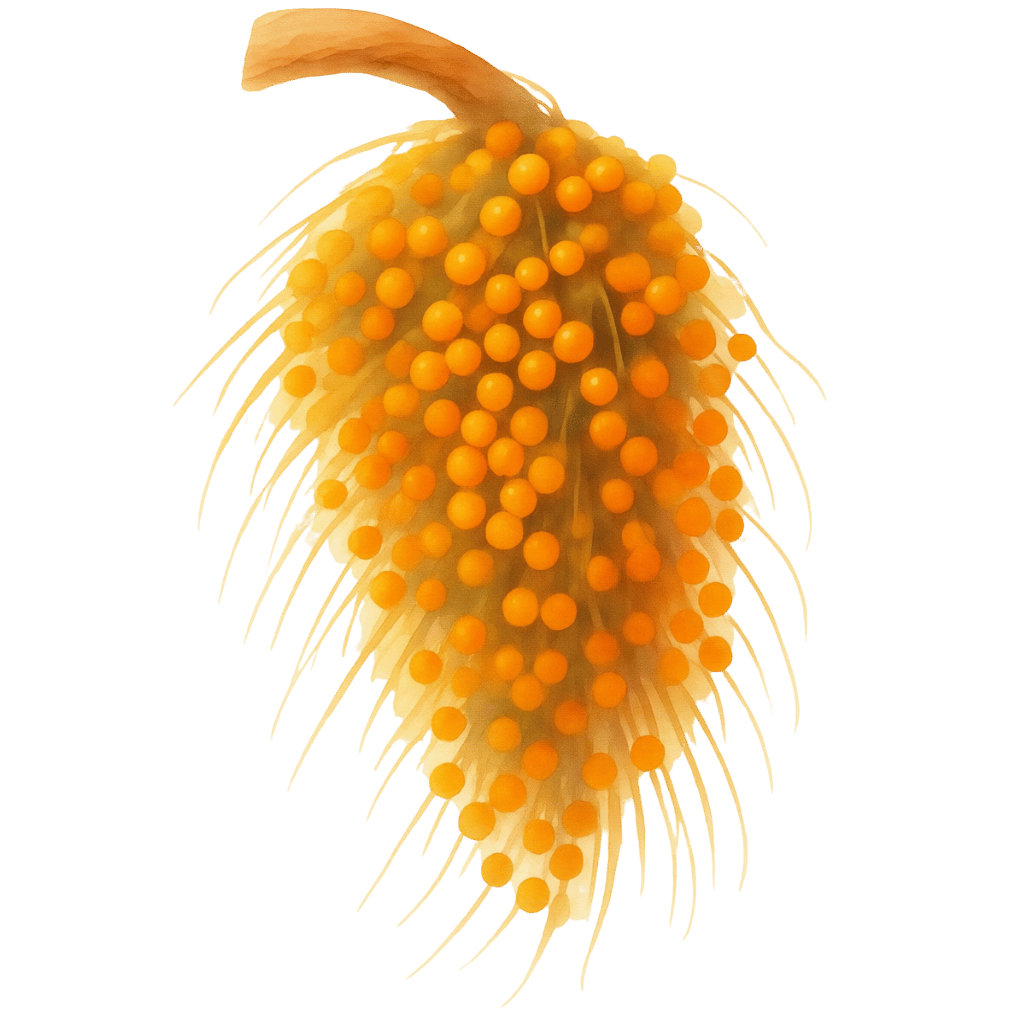
Jeriva fruit
Syagrus romanzoffianaBotanical View
- Folhas alternas, pinadas, arqueadas, medindo até 5 m de comprimento, com folíolos estreitos dispostos em vários planos ao longo da ráque. O pecíolo é expandido, com bainha de margens fibrosas e glabras. (Carvalho, Espécies Arbóreas Brasileiras vol. 2, Embrapa Florestas, 2008)
- Estipe único (não perfilha), cilíndrico, essencialmente liso, marcado por cicatrizes anelares deixadas pelas bases das bainhas foliares. O ritidoma (casca externa) é acinzentado e finamente fissurado; a casca interna é creme-esverdeada, fibrosa, de estrutura entrelaçada. A madeira é dura e fibrosa, de cor parda, com densidade aparente média de 0,812 g/cm³. (Carvalho, Espécies Arbóreas Brasileiras vol. 2, Embrapa Florestas, 2008, citando Paula & Alves, 1997)
- Sistema radicular superficial e bastante ramificado, o que confere boa tolerância ao transplante — inclusive de indivíduos adultos, com alto índice de pegamento — e torna a espécie indicada para plantio em margens de rios e em áreas de solo permanentemente encharcado, na restauração de ambientes ripários. (Carvalho, Espécies Arbóreas Brasileiras vol. 2, Embrapa Florestas, 2008)
- Inflorescência interfoliar, medindo de 1 a 1,5 m de comprimento, protegida por espata lenhosa e glabra, longo-cilíndrica a fusiforme, profundamente sulcada e estriada externamente, com pedúnculo longo; formada por uma panícula de espigas (ramificação de 1ª ordem). As flores são numerosas e unissexuais, com três pétalas: as masculinas medem cerca de 10 mm e ocorrem em número de 1 a 2 por ramificação; as femininas medem cerca de 5 mm e ficam dispostas na porção basal das ramificações, entre pares de flores masculinas (arranjo em tríade, típico de Arecaceae). (Carvalho, Espécies Arbóreas Brasileiras vol. 2, Embrapa Florestas, 2008)
- Espécie monoica, com flores masculinas e femininas separadas, porém reunidas na mesma inflorescência (Leite, 2001, citado em Carvalho, Embrapa Florestas, 2008). A reprodução é sexuada, por sementes; não há registros de reprodução vegetativa/clonal natural na espécie.
- Polinização essencialmente entomófila, realizada por abelhas de diversas espécies. As flores são melíferas, com grande potencial apícola, produzindo pólen e néctar. (Pirani & Cortopassi-Laurino, 1993, citado em Carvalho, Embrapa Florestas, 2008)
- Ocorre naturalmente em solos de fertilidade química tanto alta quanto baixa, inclusive em afloramentos de arenito, sendo considerada indicadora de solos mais pobres e arenosos no noroeste do Paraná. Vegeta em terrenos secos, orgânicos, sujeitos a inundação temporária ou temporariamente encharcados. Em cultivo, tende a apresentar melhor desempenho em solos ácidos, já que solos alcalinos reduzem a disponibilidade de micronutrientes como ferro, manganês e boro. (Carvalho, Espécies Arbóreas Brasileiras vol. 2, Embrapa Florestas, 2008, citando Hatschbach & Moreira Filho, 1972 e Klein, 1969, 1985; University of Florida IFAS Extension, ENH-767/ST609)
- Não há prescrição formal de adubação/irrigação para a espécie em condições nativas ou de restauração florestal na literatura consultada. Em cultivo ornamental, é comum a deficiência de potássio, que causa manchas alaranjadas e necrose nas pontas dos folíolos; recomenda-se adubação regular com fertilizante formulado para palmeiras (ex.: 8-2-12+4Mg, com nitrogênio, potássio e magnésio de liberação controlada). Tolera solos secos a temporariamente encharcados, mas não há dados quantitativos publicados sobre lâmina ou frequência de irrigação. (University of Florida IFAS Extension, ENH-767/ST609)
- Propagação exclusivamente por sementes; não há relato de multiplicação vegetativa. Os frutos maduros são colhidos e o invólucro é quebrado com cuidado, retirando-se as sementes manualmente do endocarpo com auxílio de morsa e espátula; o despolpamento acelera a germinação. Rendimento de 140 a 220 sementes por quilo. A semeadura é feita em sacos de polietileno ou tubetes grandes de polipropileno; a germinação é hipógea (criptocotiledonar), lenta e desuniforme, ocorrendo entre 90 e 180 dias, com poder germinativo superior a 60%. As mudas atingem porte adequado para plantio cerca de 12 meses após a semeadura. Recomenda-se ainda embeber as sementes limpas em água por cerca de dois dias antes de semear, sob temperaturas elevadas (32 a 35 °C), podendo a germinação levar de seis semanas a seis meses. (Carvalho, Espécies Arbóreas Brasileiras vol. 2, Embrapa Florestas, 2008, citando Vallilo et al., 2001, Lorenzi, 1992 e Leite, 2001; University of Florida IFAS Extension, ENH-767/ST609)
- As sementes apresentam taxa de germinação média e baixa velocidade de emergência, sugerindo mecanismo de dormência; foram detectados indícios de compostos fenólicos inibidores da germinação no extrato de sementes de jerivá. Quanto à conservação, são consideradas de comportamento ortodoxo, não perdendo viabilidade até 4 meses de armazenamento, embora a durabilidade da semente em condições naturais seja de apenas cerca de 15 dias. Avaliação da divergência genética entre matrizes de jerivá com uso de marcadores RAPD detectou 81,7% de polimorfismo, indicando alta variabilidade genética entre árvores matrizes. (Carvalho, Espécies Arbóreas Brasileiras vol. 2, Embrapa Florestas, 2008, citando José et al., 2000; Longhi et al., 1984; e Leite, 2001)
- Não foram encontradas cultivares comerciais formalmente descritas e registradas para Syagrus romanzoffiana; a propagação comercial e paisagística é feita majoritariamente por sementes de matrizes não selecionadas geneticamente, havendo alta variabilidade genética natural entre matrizes (81,7% de polimorfismo detectado por marcadores RAPD). (Carvalho, Espécies Arbóreas Brasileiras vol. 2, Embrapa Florestas, 2008, citando Leite, 2001)
- Não há programas formais de melhoramento genético documentados para a espécie; os estudos disponíveis tratam da caracterização da diversidade genética natural entre matrizes. Avaliação da divergência genética entre matrizes de jerivá com marcadores RAPD detectou 81,7% de polimorfismo, indicando alta variabilidade genética. A espécie foi originalmente descrita por Adalberto von Chamisso como Cocos romanzoffiana, a partir de material coletado durante expedição russa de 1815 (custeada pelo Conde N. Romanzoff, chanceler do Império Russo, a quem o epíteto homenageia), e posteriormente recombinada por Glassman no gênero Syagrus, em Fieldiana: Botany 31: 382, 1968. (Carvalho, Espécies Arbóreas Brasileiras vol. 2, Embrapa Florestas, 2008, citando Leite, 2001; Reitz, 1974; Marchiori, 1995)