Retour à la Fruitpedia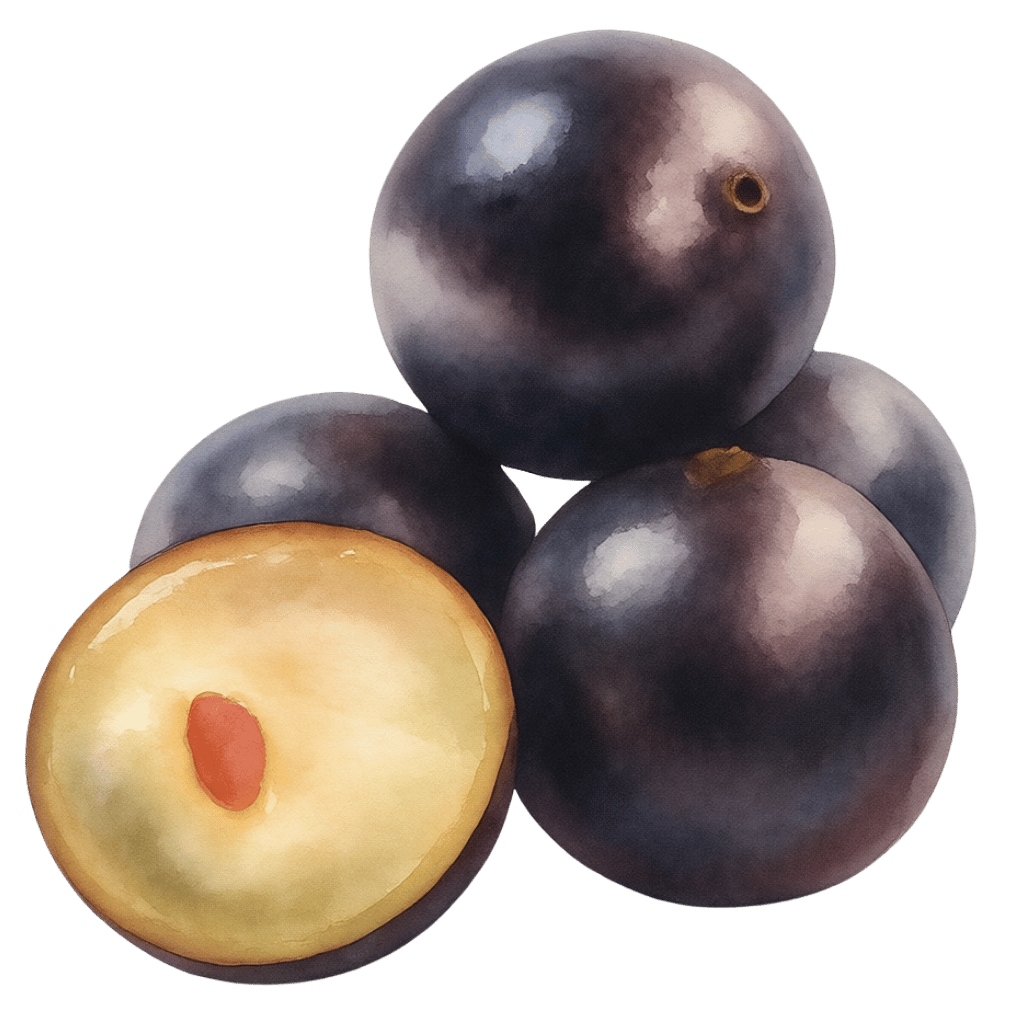
Jabuticaba
Plinia caulifloraVariétés
Jabuticaba Sabará
Jabuticaba Paulista (Açu-Paulista)
Jabuticaba Rajada
Jabuticaba Ponhema
Vue Botanique
- Leaves are opposite, simple, entire, lanceolate to elliptic, 2.5-10 cm long and under 2.5 cm wide, glossy and leathery (coriaceous) with a dark green upper surface; new flush is often coppery-pink to bronze before maturing to green. Petioles are short. Foliage forms a dense evergreen canopy.
- The trunk is typically single or branches profusely near the base, with ascending branches; smooth, thin, grayish-brown to cinnamon bark exfoliates in irregular flakes or patches (a texture compared to crepe myrtle), exposing lighter-colored underbark. The defining structural trait is cauliflory: flower clusters and fruit are borne directly on the woody bark of the trunk and older, leafless branches rather than on new growth.
- The root system is shallow and fibrous, with fine, hairlike feeder roots concentrated mainly in the top 30-45 cm (about 12-18 in) of soil. This shallow habit makes the tree sensitive to soil compaction, drought, and careless transplanting, and it benefits from heavy organic mulching that mimics the leaf-litter floor of its native forest habitat.
- Flowers are borne in small clusters (fascicles) directly on the bark of the trunk and older branches, following a mass "big-bang" flowering pattern. Individual flowers are small (under about 1 cm), tetramerous, with four hairy white petals and roughly 60 stamens about 4 mm long; flowers typically open in the very early morning (around 3 a.m.).
- Reproductive behavior differs among jaboticaba species: P. cauliflora shows a markedly greater stigma-anther distance (herkogamy) than the related P. trunciflora and P. jaboticaba, which impedes passive self-pollination; in pollinator-exclusion (bagging) trials, P. cauliflora set essentially no fruit, indicating that effective fruit set depends on insect-mediated pollen transfer even though the flowers are not strictly self-incompatible. Pollen viability peaks roughly six hours after anthesis. Seeds are frequently polyembryonic; where polyembryony arises via apomixis, part of the resulting seedlings are genetic clones of the mother plant, while sexually formed (zygotic) embryos give genetically distinct offspring.
- Africanized honeybees (Apis mellifera) are the principal pollinators, visiting the mass-flowering trunk clusters mainly to collect pollen, since the flowers offer little nectar and what nectar is present has low sugar content; other bees and flies also visit the flowers. Peak bee activity coincides with peak pollen viability in mid-morning.
- The species prefers deep, rich, moist, well-drained soils high in organic matter, with an acidic to slightly acidic pH (generally below 6.0, optimally around 5-6). Because of its shallow root system it benefits strongly from organic mulch. It can be grown, with soil acidification and nutrient amendment, in calcareous soils, though these are not ideal.
- Consistent soil moisture is important: the shallow root system dries out quickly and the tree tolerates drought poorly, so irrigation (drip, micro-emitters, or bubblers) is recommended, particularly around flowering and fruit development, since water availability strongly affects both flowering intensity and final fruit size. No single official regional fertilizer recommendation exists; growers commonly use balanced or moderately nitrogen-limited formulations (e.g., NPK 14-14-14 has been trialed in Florida; 6-6-6 or 8-8-8 applied quarterly is used in Hawai'i), often supplemented with calcium, magnesium, and sulfur. Trees are prone to nitrogen-burn/over-fertilization injury and tolerate comparatively higher phosphorus and potassium levels.
- Propagation is traditionally by seed, but jaboticaba seeds are recalcitrant (desiccation-sensitive) and lose viability within about 10 days at room temperature once moisture content drops near 10%, so they must be sown fresh soon after extraction; germination takes roughly two weeks to two months. Seedling (zygotic) trees have a long juvenile period, often not fruiting for 8-18 years. Vegetative propagation — grafting (including top-cleft grafting onto P. cauliflora rootstock), air-layering, cuttings, inarching, and tissue culture — shortens the juvenile phase to a few years but has historically shown variable and often limited success (rooted-cutting success around 10%); grafting is generally considered the most reliable method for propagating named cultivars true-to-type.
- Jaboticaba seeds are commonly polyembryonic, with reported rates ranging from 0 to as much as 75% depending on the tree and species. Where polyembryony results from apomixis, part of the seedlings produced from a single seed are genetic clones of the mother plant, while sexually derived (zygotic) embryos yield genetically distinct offspring. This mixed reproductive mode, together with fragmentation of native populations, tends to produce low genetic diversity within a given site but comparatively higher diversity between separate sites, and complicates clonal-selection breeding programs.
- Named jaboticaba selections associated with this species complex include 'Sabará' (small, thin-skinned, sweet fruit, medium-sized tree, heavy and frequent bearer, the most widely planted type in Brazil), 'Paulista' (much larger fruit, up to about 7-8 cm/3 in in diameter, with thick, leathery skin; vigorous, highly productive tree that generally bears a single main crop per year), and other Brazilian forms including 'Rajada', 'Roxa', 'Ponhema', 'Mineira', 'Branca', and 'Coroa' (jaboticaba-coroada, occurring mainly in São Paulo). Interspecific selections such as 'Red Hybrid' (P. cauliflora × P. aureana) have also been developed for earlier fruiting.
- Jaboticaba has long been grown and informally selected in Brazilian home gardens and local markets; it was first mentioned in European literature by the Dutch in 1658, and was introduced to California in 1904 and to Florida in 1908, with grafted selections being sold in Florida nurseries by the 1940s. Formal breeding has been limited, historically consisting mainly of selection among seedling trees followed by clonal propagation (grafting) of superior types, such as 'Sabará' and 'Paulista', rather than structured hybridization programs; commercial-scale production remains concentrated in Brazil, while cultivation in the United States, Australia, and elsewhere is largely at hobbyist or small-orchard scale. More recent breeding work has produced interspecific hybrids, such as 'Red Hybrid' (P. cauliflora × P. aureana), aimed at reducing the long juvenile period and improving fruiting precocity.