Back to Fruitpedia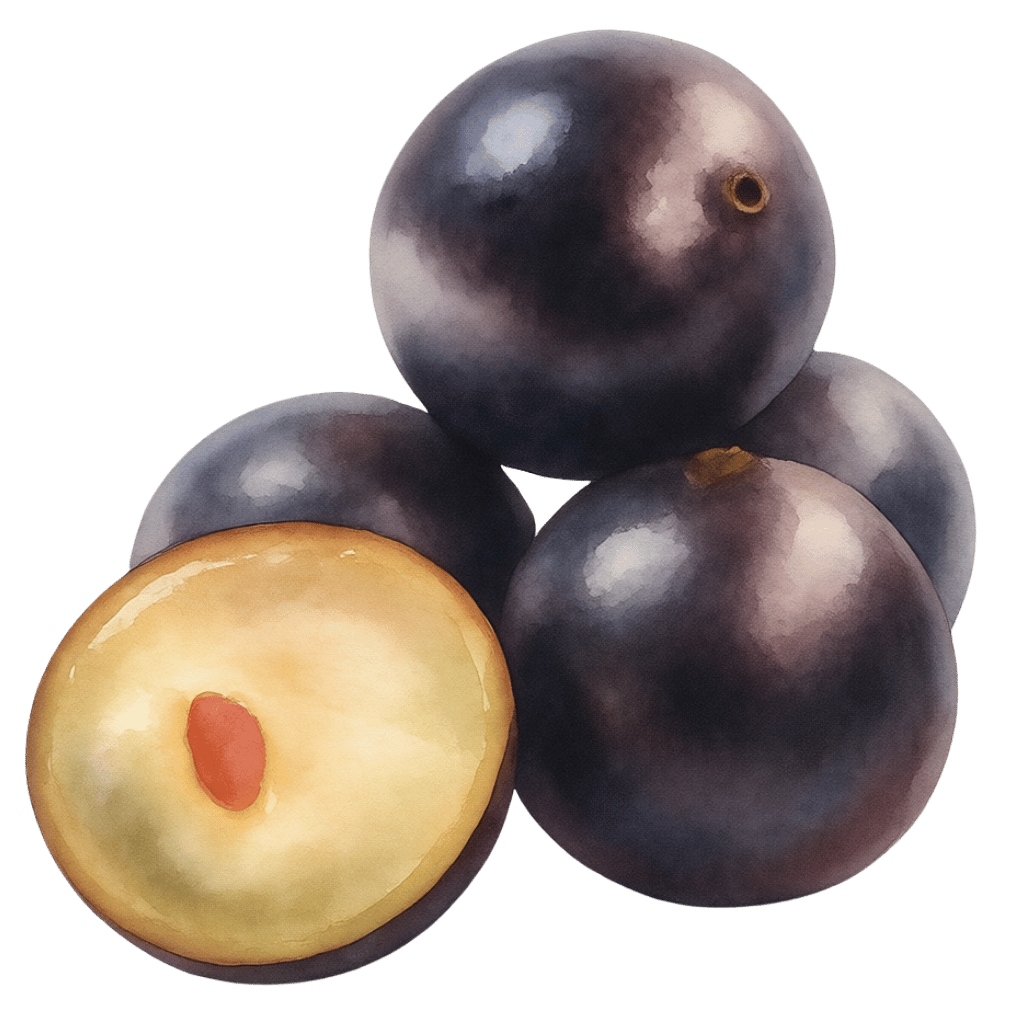
Brazilian grape
Plinia caulifloraVarieties
Sabará
Paulista
Rajada
Ponhema
Botanical View
- Folhas simples, opostas, de margem inteira, lanceoladas a elípticas, medindo aproximadamente entre 2,5 e 10 cm de comprimento por 1,3 a 2 cm de largura, com pecíolo curto. São de textura coriácea, verde-escuras e brilhantes quando maduras, e de coloração salmão/bronzeada quando recém-brotadas; a folhagem é perenifólia (persistente).
- Tronco geralmente único e de ramificação baixa, podendo também formar-se com múltiplos troncos; ramos numerosos e ascendentes, formando copa densa, arredondada ou em forma de taça. A casca é fina, pardo-avermelhada, e se desprende em placas irregulares, revelando por baixo uma casca lisa e multicolorida (de tom creme a acinzentado), lembrando a da goiabeira. É sobre essa casca do tronco e dos ramos principais que nascem as flores e frutos (caulifloria).
- As fontes consultadas trazem pouca informação detalhada sobre a arquitetura radicular específica desta espécie. Sabe-se que a planta tolera alagamento periódico do solo por algumas semanas sem dano sério (característica associada a sistema radicular adaptável), e que, no plantio, recomenda-se não incorporar matéria orgânica diretamente na cova, cobrindo com mulch a área além da projeção das raízes.
- As flores nascem em pequenos grupos (fascículos), tipicamente de cerca de quatro flores, inseridas diretamente sobre a casca do tronco, dos ramos principais e, por vezes, sobre raízes superficiais expostas — fenômeno da caulifloria. São flores pequenas, brancas a branco-amareladas, com numerosos estames e pouco vistosas isoladamente, embora a floração em massa sobre o tronco seja ornamentalmente marcante. Sob condições favoráveis, a planta pode florescer de forma intermitente diversas vezes ao ano.
- Flores hermafroditas (bissexuais). A espécie frutifica mesmo a partir de um único exemplar isolado, indicando capacidade de autopolinização, mas a polinização cruzada tende a melhorar a taxa de pegamento dos frutos. O desenvolvimento do fruto, da antese à maturação plena, é rápido — geralmente entre 20 e 25 dias.
- A polinização é realizada principalmente por insetos, sobretudo abelhas, atraídas pelas flores brancas produtoras de pólen. Não foram encontrados, nas fontes prioritárias consultadas, estudos específicos sobre a comunidade de polinizadores nativos desta espécie no Brasil.
- Adapta-se a ampla variedade de solos, mas se desenvolve melhor em solos profundos, férteis, ricos em matéria orgânica, de textura arenosa a franca, levemente ácidos (pH abaixo de 6) e bem drenados, com boa retenção de umidade. Tolera solos arenosos litorâneos mais alcalinos desde que irrigada e adubada adequadamente. Apresenta baixa tolerância à salinidade, podendo sofrer danos com água de irrigação a partir de cerca de 600 ppm de sólidos dissolvidos totais.
- Recomenda-se adubação cerca de três vezes ao ano com fertilizante completo (NPK) e reposição de micronutrientes; em solos de pH elevado pode ser necessário aplicar ferro quelatizado para corrigir clorose. No plantio, não se recomenda misturar matéria orgânica diretamente na cova. A implantação exige irrigação frequente (cerca de três a quatro vezes por semana) durante o primeiro e segundo ano, até o pegamento completo da muda; em plantas já estabelecidas, a irrigação deve manter o solo úmido sem encharcamento, já que a falta de água é apontada como causa de queda de flores e frutos.
- Pode ser propagada por sementes (germinação em cerca de 30 dias) e por métodos vegetativos: alporquia (mergulhia aérea), estaquia de ramos foliosos e enxertia. Em ensaios de enraizamento de estacas apicais foliosas de Myrciaria cauliflora, obteve-se até 60% de enraizamento em ambiente parcialmente fechado e sombreado (cerca de 50% de sombra), com quatro cortes longitudinais na base da estaca, tratamento com ácido indolbutírico (AIB) a 1.000 ppm e substrato de areia mais turfa (1:1), sem necessidade de poda drástica prévia da planta matriz. A enxertia por garfagem em fenda cheia é outro método vegetativo empregado em jabuticabeiras, com índices de pegamento relatados entre 75 e 85%.
- Cada fruto contém geralmente de uma a cinco sementes ovoides e achatadas. Diferentemente de outras mirtáceas nativas do Brasil (como o araçazeiro, que apresenta apomixia), não há relatos de apomixia nesta espécie, de modo que a propagação por sementes gera plantas com variabilidade genética — resultando em heterogeneidade de porte, produtividade e qualidade dos frutos entre plantas-filhas. Por esse motivo, pesquisas brasileiras já caracterizaram diferentes "grupos" ou tipos dentro do complexo Myrciaria/Plinia cauliflora, recomendando a propagação vegetativa para a manutenção de clones superiores.
- Não foram localizadas, nas fontes governamentais, acadêmicas e botânicas consultadas, cultivares formalmente registradas e amplamente documentadas especificamente para esta espécie. A denominação popular mais associada a Plinia cauliflora é "jabuticaba-paulista" (também chamada de ponhema ou açu), distinta da "jabuticaba-sabará" (Plinia jaboticaba, a mais cultivada comercialmente no Brasil) e da "jabuticaba-de-cabinho" (Plinia trunciflora). Estudos de pós-graduação brasileiros caracterizaram diferentes grupos/tipos dentro do complexo Myrciaria/Plinia cauliflora para fins de propagação vegetativa por enxertia, mas sem formalização em cultivares registradas.
- Não há registro de programas formais de melhoramento genético historicamente dedicados a esta espécie. O cultivo no Brasil originou-se, em grande parte, do extrativismo de árvores nativas e de pomares domésticos/de quintal, com pouca domesticação sistemática. Os bancos de germoplasma de jabuticabeiras restringem-se a pequenas coleções em instituições de pesquisa, e a diversidade genética da espécie vem sendo reduzida pela fragmentação do bioma Mata Atlântica. Pesquisadores brasileiros (Revista Brasileira de Fruticultura, 2010) apontam a necessidade de desenvolver estudos de biologia floral e reprodutiva, caracterização de germoplasma e propagação vegetativa como base para futuros programas de seleção de clones superiores, ainda incipientes para esta espécie.