Retour à la Fruitpedia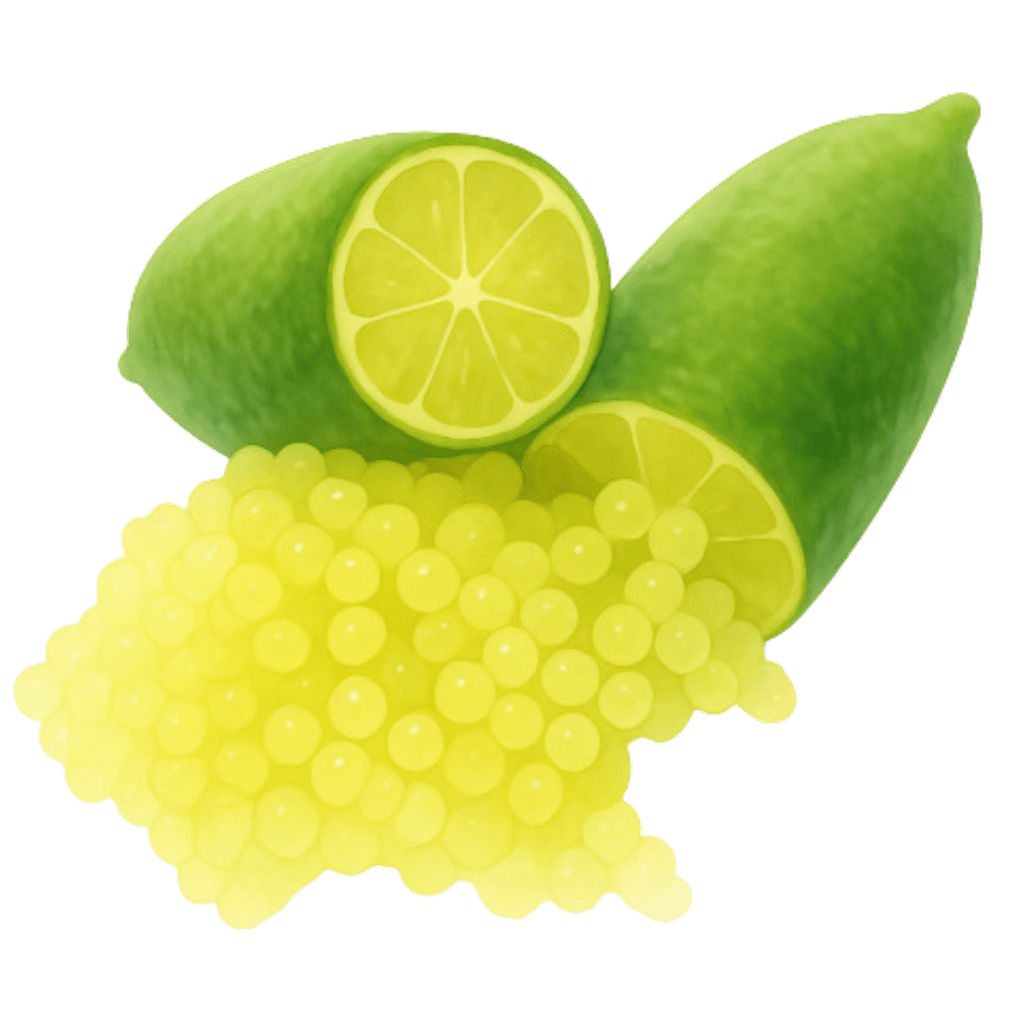
Limão-caviar
Citrus australasicaVariétés
Limão-caviar 'Alstonville'
Limão-caviar 'Judy's Everbearing'
Limão-caviar 'Rainforest Pearl'
Limão-caviar 'Durham's Emerald'
Limão-caviar 'Pink Ice'
Limão-caviar 'Blunobia Pink Crystal'
Vue Botanique
- Leaves are small and simple, broadly elliptical to oval, roughly 2-4 cm long, with very short, narrowly winged to wingless petioles and numerous aromatic oil glands that give the foliage a citrus scent. Foliage is evergreen and borne along thorny stems.
- A large shrub to small tree, generally 3-6 m tall, with a compact to straggling, multi-stemmed habit. Stems bear stiff axillary spines 10-25 mm long. Plants have a notably short juvenile (non-flowering) phase compared with many other citrus.
- Detailed root-system studies specific to C. australasica are not available in the botanical literature consulted. In its native habitat it grows on well-drained soils of volcanic (basalt) origin in rainforest and rainforest margins; cultivated plants are reported to need free-draining soil, being sensitive to waterlogging.
- Flowers are small (about 10 mm in diameter), borne solitary or in small axillary clusters rather than large panicles. Early taxonomic descriptions (Swingle, 1915) note free (unfused) stamens and a very short style/pistil relative to other Citrus species.
- Flowers are predominantly self-compatible/self-fertile, so isolated trees can set fruit without a second tree. Unlike most cultivated citrus, C. australasica reproduces mainly through true (zygotic) sexual embryony rather than nucellar (apomictic) embryony, meaning seedlings are genetically variable and do not come true to the parent type.
- Fruit set can occur through self-pollination alone, but native bees, honey bees and hoverflies visiting the flowers improve pollen transfer and fruit set; gentle air movement or shaking of branches during bloom is also used in enclosed/greenhouse production to aid pollen dispersal.
- Prefers moist, well-drained, slightly acidic soils high in organic matter, reflecting its native occurrence on basalt-derived rainforest soils of naturally low fertility. In cultivation, deep loamy soils with reliable moisture are considered ideal.
- A vigorous grower with correspondingly high nutrient demand. Recommended practice is a balanced, soil-applied fertiliser programme (commonly cited N-P-K ratios around 3-1-2 or 2-1-2) supplemented with foliar sprays to improve fruit quality; excess nitrogen is avoided as it can reduce fruit quality, while potassium and calcium are used to improve fruit size and peel integrity. Consistent irrigation (e.g., drip) is important for fruit size and retention, with drought stress avoided, particularly around flowering and fruit set; as a relatively new commercial crop, formal fertigation research is still limited.
- Propagated by seed, stem cuttings, and grafting/budding. Seed-grown plants are genetically variable (true zygotic seed, not nucellar) and notably slow to reach maturity/fruiting. Semi-hardwood cuttings can be rooted with hormone treatment. Commercially, chip budding onto seedling citrus rootstocks (e.g., Volkamer lemon, sour orange, Cleopatra mandarin, and trial rootstocks such as UFR-5 and US-802) is preferred, bringing trees into production within about 2-3 years.
- Because C. australasica reproduces mainly by zygotic (sexual) rather than nucellar (apomictic) embryony, its seeds are not clonal: seedlings segregate genetically and differ from the mother plant, which is valuable for breeding new hybrids but means seed-raised plants are unpredictable for fruit and peel traits and must be evaluated individually or vegetatively propagated to preserve a selected type.
- More than 30 named cultivars are grown in Australia, selected mainly for pulp colour, seed content and yield, including 'Alstonville', 'Byron Sunrise', 'Rainforest Pearl', "Judy's Everbearing", 'Pink Ice'/'Pink Pearl', 'Chartreuse', 'Collette' and "Durham's Emerald". Red-fleshed forms trace to Citrus australasica var. sanguinea F.M.Bailey (1892, Tamborine Mountain, Queensland), used in "blood lime" hybrids. University of Florida IFAS has released HLB-tolerant hybrid cultivars 'UF SunLime' and 'UF RedLime' for production in citrus-greening-endemic regions.
- Because of its disease tolerance, C. australasica has become a key parent species in modern citrus breeding programmes targeting Huanglongbing (citrus greening) tolerance. University of Florida IFAS breeders (led by Manjul Dutt) crossed finger lime with other citrus to produce the hybrid cultivars 'UF SunLime' and 'UF RedLime', aimed at HLB-endemic growing regions, and antimicrobial peptides isolated from finger lime (branded MaSAMP) are being investigated for HLB suppression. In Australia, selection of wild-collected finger lime forms since the 1990s by growers and nurseries has produced the more than 30 named cultivars now in commercial use for fresh "citrus caviar" production.