Back to Fruitpedia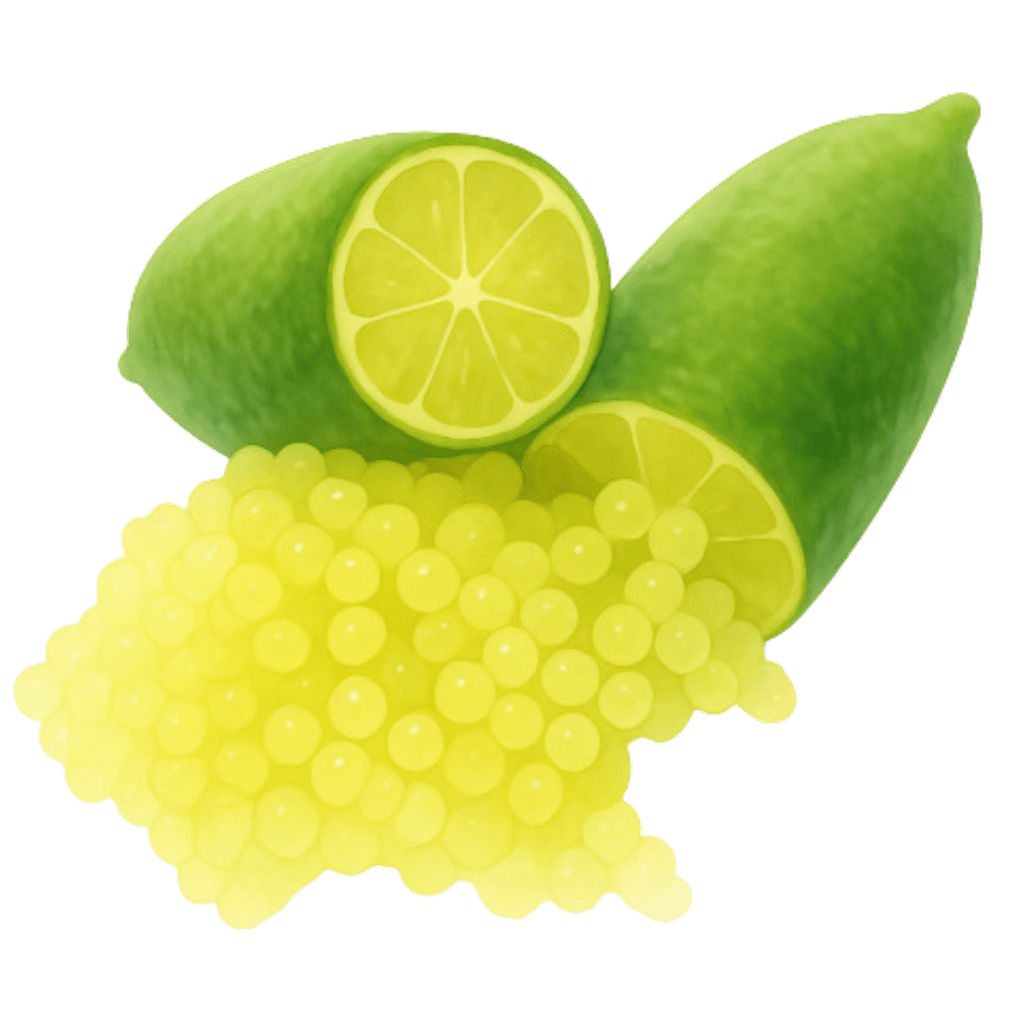
Finger lime
Citrus australasicaVarieties
Alstonville
Judy's Everbearing
Rainforest Pearl
Durham's Emerald
Pink Ice
Blunobia Pink Crystal
Botanical View
- Folhas simples, alternas ao longo dos ramos, de coloração verde-clara, de formato obovado a rômbico, geralmente com até 2,5 cm de largura por até 2,5 cm de comprimento (podendo alcançar 5 cm), com margem levemente crenada (recortada) próximo ao ápice. Como em outras espécies do gênero Citrus, possuem numerosas glândulas de óleo essencial e são aromáticas quando maceradas.
- Caule lenhoso e ramificado, portando espinhos agudos de até 2,5 cm de comprimento nas axilas foliares — característica típica de plantas em estado selvagem e de indivíduos jovens. Sob cultivo comercial, a planta assume hábito de arbusto denso a pequena árvore, com 2 a 4 m de altura, podendo atingir maior porte (até cerca de 10 m) quando não conduzida.
- Não foram localizadas, em fontes botânicas confiáveis, descrições detalhadas da morfologia e arquitetura do sistema radicular da espécie em estado natural. O que está documentado na literatura fitopatológica é que seleções de C. australasica apresentam resistência à podridão-de-raiz causada por Phytophthora citrophthora e P. parasitica, característica que tem sido utilizada como fonte genética em programas de melhoramento de porta-enxertos cítricos tolerantes a patógenos de solo. Em cultivo comercial, a espécie é tipicamente enxertada sobre porta-enxertos de outras espécies de Citrus, que passam a definir o desenvolvimento radicular da planta.
- Flores solitárias ou dispostas aos pares, sustentadas por pedúnculos curtos (cerca de 3 mm de comprimento); sépalas minúsculas (~1,5 mm) e pétalas brancas de até 9 mm de comprimento, com fragrância. Dessas flores desenvolvem-se os frutos alongados e cilíndricos característicos da espécie, de 30 a 120 mm de comprimento por 10 a 15 mm de largura.
- Como as demais espécies do gênero Citrus, apresenta flores hermafroditas (bissexuadas), com potencial de autopolinização. É comum no gênero Citrus o fenômeno da poliembrionia nucelar — uma forma de apomixia esporofítica em que embriões adicionais, geneticamente idênticos à planta-mãe, se desenvolvem a partir do tecido nucelar do óvulo ao lado do embrião zigótico resultante da fecundação —, o que tende a atenuar a variabilidade genética de plantas propagadas por semente. Não foram localizados, em fontes confiáveis, dados quantitativos específicos sobre o grau de poliembrionia ou eventual autoincompatibilidade floral em C. australasica.
- A polinização é predominantemente entomófila, com abelhas (incluindo Apis mellifera) como principais agentes polinizadores das flores brancas e perfumadas, além de outros insetos visitantes ocasionais. Como ocorre de modo geral no gênero Citrus, a espécie também apresenta capacidade de autopolinização, sendo comum em cultivo protegido o uso de polinização manual (com pincel) para garantir a frutificação quando a atividade de polinizadores é reduzida por condições climáticas desfavoráveis.
- Prefere solos bem drenados e ricos em matéria orgânica. Fontes de extensão universitária recomendam, para cultivo comercial, locais com solo bem drenado, livres de encharcamento, e protegidos de ventos predominantes e de geadas.
- Pesquisas da Universidade da Flórida (UF/IFAS) indicam que o limão-caviar apresenta taxa de crescimento elevada e demanda programas de adubação robustos, combinando fertilização via solo — método primário, para fornecimento balanceado de nutrientes — com pulverizações foliares complementares voltadas à melhoria da qualidade do fruto. O nitrogênio é essencial ao crescimento vegetativo, mas seu excesso tende a reduzir a qualidade dos frutos; pulverizações foliares de potássio favorecem o tamanho do fruto, enquanto potássio e cálcio contribuem para a integridade da casca. A irrigação adequada é apontada como fator crítico para o tamanho e a retenção dos frutos na planta, sendo o estresse hídrico (déficit de água no solo) uma preocupação relevante em cultivo comercial, inclusive associado a queda de frutos próximo à colheita em cultivares aparentadas.
- A propagação comercial é realizada majoritariamente por enxertia sobre porta-enxertos de outras espécies/híbridos de Citrus — como o citranger 'Troyer', limão 'Volkamer', 'UFR-5', 'US-802', laranja-azeda, 'C-22' e tangerina 'Cleópatra' —, escolhidos conforme o vigor e o porte desejados para a copa; recomenda-se a aquisição de mudas em viveiros certificados, garantindo material livre de doenças. A propagação por sementes também é possível, mas plantas assim obtidas demoram mais para florescer e frutificar (podendo levar vários anos) e, por estarem sujeitas a polinização cruzada com outras espécies de Citrus, não necessariamente reproduzem fielmente as características da planta-mãe.
- Como ocorre de forma geral no gênero Citrus, é comum a poliembrionia nucelar, fenômeno em que múltiplos embriões — a maioria geneticamente idêntica à planta-mãe (de origem nucelar/assexuada) e, eventualmente, um embrião zigótico (sexual) — se desenvolvem dentro da mesma semente. Isso tende a reduzir, mas não eliminar, a variabilidade de mudas propagadas por semente. Sementes de plantas cultivadas a partir de semente podem não reproduzir fielmente as características da planta-mãe devido à possibilidade de polinização cruzada com outras espécies de Citrus próximas, sendo por isso a enxertia o método preferido para propagação comercial fiel de cultivares selecionadas.
- Entre as principais seleções e híbridos derivados de C. australasica estão: 'Rainforest Pearl', seleção de C. australasica var. sanguinea de polpa rosada, selecionada por viveiro especializado no norte de Nova Gales do Sul; 'Australian Blood Lime', híbrido com o limão Rangpur (Citrus × limonia), de casca e polpa vermelho-intensas, obtido pelo CSIRO em 1990; 'Australian Sunrise Lime', híbrido derivado de um "faustrimedin" (cruzamento entre C. australasica e um calamondin), de casca dourada, também selecionado pelo CSIRO em 1990; e, nos Estados Unidos, os híbridos patenteados 'UF SunLime' e 'UF RedLime', desenvolvidos pela Universidade da Flórida. No Brasil, o Instituto Agronômico (IAC) registrou a variedade nacional 'Faustrime', desenvolvida no Centro de Citricultura de Cordeirópolis (SP). Existe ainda a variedade botânica de ocorrência natural C. australasica var. sanguinea, de polpa e casca em tons de rosa a vermelho/roxo/preto, contrastando com a forma típica de polpa verde-amarelada.
- Após a reclassificação taxonômica de 1998, que reincluiu a espécie no gênero Citrus, teve início um período de melhoramento estruturado. O CSIRO (Austrália), na estação de Merbein (Victoria), selecionou em 1990 as cultivares híbridas Australian Blood Lime (cruzamento com o limão Rangpur) e Australian Sunrise Lime (seleção de um "faustrimedin", híbrido de C. australasica com um calamondin obtido originalmente na Califórnia em 1911). No Brasil, o Instituto Agronômico (IAC), por meio do Centro de Citricultura Sylvio Moreira, em Cordeirópolis (SP) — que mantém um dos maiores bancos de germoplasma de citros do mundo —, desenvolveu e registrou junto ao Registro Nacional de Cultivares a variedade nacional 'Faustrime', a primeira cultivar brasileira de limão-caviar. Nos Estados Unidos, o programa de melhoramento de citros da Universidade da Flórida (UF/IFAS) lançou e patenteou os híbridos 'UF SunLime' e 'UF RedLime'. Paralelamente, desde a década de 1970 seleções de C. australasica resistentes a Phytophthora citrophthora vêm sendo incorporadas a programas de melhoramento de porta-enxertos cítricos, e mais recentemente seu genoma vem sendo estudado como fonte de genes de resistência ao huanglongbing (HLB).