Volver a Fruitpedia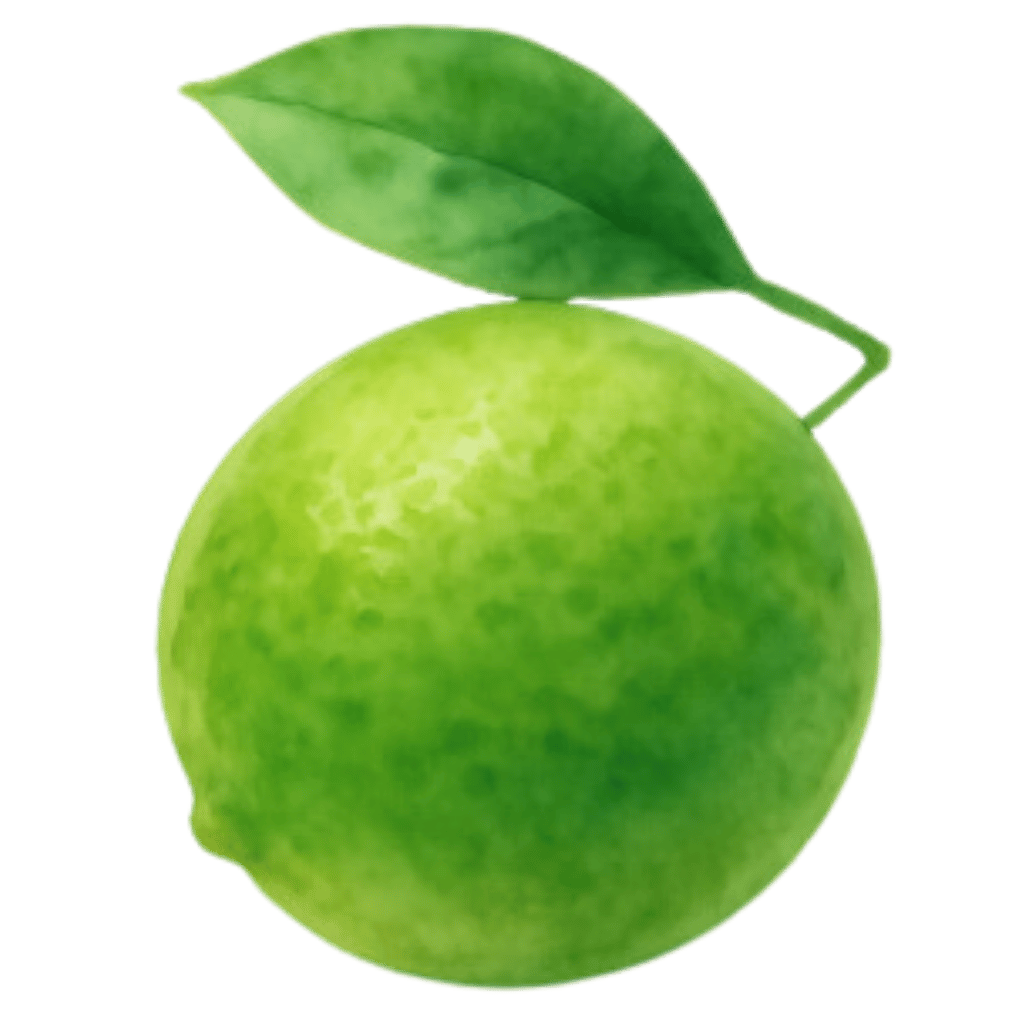
Limão verde
Citrus limonVariedades
Limão Eureka
Limão Lisboa
Limão Verna
Limão Interdonato
Limão Femminello Siracusano
≥6° BrixLimão Sfusato Amalfitano
Visión Botánica
- Leaves are alternate, reddish when young and maturing to dark green above and lighter green below, oblong to elliptic or long-ovate, about 6-11 cm long, finely toothed (serrate) along the margin, with a petiole bearing a narrow, slender wing (Morton, J., 1987, Fruits of Warm Climates, Purdue University NewCROP; Crane, J.H., UF/IFAS EDIS HS402, "Lemon Growing in the Florida Home Landscape").
- The trunk and branches are covered in light-brown bark, and young growth typically bears stiff, sharp thorns, though thorniness is much reduced in some cultivars (e.g., 'Eureka', 'Bearss'). The tree has a moderately vigorous, upright-to-spreading, somewhat open canopy, reaching about 3-6 m (10-20 ft) in height (Morton, J., 1987, Fruits of Warm Climates, Purdue University NewCROP; Crane, J.H., UF/IFAS EDIS HS402, "Lemon Growing in the Florida Home Landscape").
- Citrus limon develops a taproot during seedling germination, but in field-grown trees the mature root system is dominated by a network of woody lateral roots radiating from the trunk, from which abundant fine fibrous roots arise; these fibrous roots are the primary site of water and nutrient absorption and tend to be concentrated closer to the soil surface than in some other citrus species (Ford, H.W., 1977, "Root System Characteristics of Citrus Rootstocks," Proc. Fla. State Hort. Soc. 90:39-44, journals.flvc.org). Roots commonly form associations with arbuscular mycorrhizal fungi, which enhance water and phosphorus uptake, particularly in low-fertility soils.
- Flowers are borne solitary or in small axillary clusters of two or more. Each flower is mildly fragrant, with 4-5 petals about 2 cm long, white on the inner (upper) surface and purplish on the outer (lower) surface, surrounding 20-40 or more stamens with yellow anthers fused at the base (Morton, J., 1987, Fruits of Warm Climates, Purdue University NewCROP; Crane, J.H., UF/IFAS EDIS HS402, "Lemon Growing in the Florida Home Landscape").
- Lemon flowers are hermaphroditic (perfect) and predominantly self-compatible, able to set fruit without cross-pollination, though some flowers abort at the pistil and are functionally sterile. Seed formation is complicated by nucellar polyembryony, a form of sporophytic apomixis in which additional embryos develop from maternal (nucellar) tissue alongside, or instead of, the sexually produced zygotic embryo; the proportion of polyembryonic seed is genotype-dependent (Continella, A. et al., 2022, "Reproductive Biology Factors Hampering Lemon [Citrus limon (L.) Burm. f.] Genetic Improvement," Agriculture 12(12):2020, doi:10.3390/agriculture12122020).
- Lemon flowers are largely self-fertile (self-compatible) and can set fruit without cross-pollination, but pollen must still be physically transferred from anther to stigma, a role filled mainly by honeybees (Apis mellifera) and other bees attracted to the fragrant, nectar-producing flowers; insect visitation improves fruit set compared with reliance on wind or self-pollination alone (Crane, J.H., UF/IFAS EDIS HS402, "Lemon Growing in the Florida Home Landscape").
- Lemon performs best on well-drained soils with a pH between about 5.5 and 6.5; on higher-pH, calcareous soils it is prone to iron deficiency chlorosis unless lime/pH is managed or resistant rootstocks are used, and the species is sensitive to waterlogged or poorly aerated soils, which favor root rot. Rootstock choice is matched to soil type — e.g., rough lemon rootstock for high-pH calcareous soils and Swingle citrumelo for sandy soils (Crane, J.H., UF/IFAS EDIS HS402, "Lemon Growing in the Florida Home Landscape"; Morton, J., 1987, Fruits of Warm Climates, Purdue University NewCROP).
- Fertilization follows a split, frequent-application program: young trees receive small, regularly increasing doses of balanced NPK fertilizer (e.g., a 6-6-6 formulation) applied about every 6-8 weeks in the first years, while mature bearing trees are fertilized 2-3 times per year with larger doses, plus periodic micronutrient (especially chelated iron, zinc, manganese) foliar sprays, since lemon is prone to iron deficiency chlorosis on high-pH/calcareous soils (Crane, J.H., UF/IFAS EDIS HS402, "Lemon Growing in the Florida Home Landscape"; UF/IFAS EDIS SS478, "Nutrition of Florida Citrus Trees"). Newly planted trees need frequent watering (every 1-2 days at first, then 1-2 times weekly for several months) to establish the root system; established trees are relatively drought-tolerant but yield and fruit quality improve with regular irrigation during dry periods, while overwatering and poor drainage predispose roots to Phytophthora rot, so irrigation is normally withheld from the trunk base and reduced in heavy or waterlogged soils (Crane, UF/IFAS EDIS HS402).
- Commercial lemon trees are propagated almost exclusively by budding (grafting) selected scion cultivars onto seedling rootstocks, typically budded 15-30 cm (6-12 in) above the soil line to reduce risk of Phytophthora foot rot; common rootstocks include rough lemon (for well-drained, sandy or calcareous soils), sour orange, Volkamer lemon, Swingle citrumelo, and trifoliate orange hybrids, chosen according to soil type and disease pressure. Some cultivars, such as 'Meyer', can also be propagated relatively easily from rooted cuttings (Morton, J., 1987, Fruits of Warm Climates, Purdue University NewCROP; Crane, J.H., UF/IFAS EDIS HS402, "Lemon Growing in the Florida Home Landscape").
- Because of nucellar polyembryony, seedlings grown from true-lemon seed are frequently not genetically identical to either parent when a zygotic (sexual) embryo dominates germination, but when a nucellar embryo dominates the seedling is a genetic clone of the maternal parent; the ratio of polyembryonic to monoembryonic seed varies strongly by cultivar (Continella, A. et al., 2022, Agriculture 12(12):2020, doi:10.3390/agriculture12122020). This nucellar (apomictic) trait is exploited in rootstock production, where seed of rootstock selections such as rough lemon reproduces true-to-type in roughly 96-100% of seedlings (Morton, J., 1987, Fruits of Warm Climates, Purdue University NewCROP).
- Major true-lemon (Citrus limon) cultivars include 'Eureka' (nearly thornless, everbearing, historically dominant in California), 'Lisbon' (large, vigorous, more cold- and heat-tolerant, fruit borne mostly inside the canopy), 'Villafranca' (formerly dominant in Florida), 'Bearss'/'Bearrs' (thornless, high juice content, used for processing), and 'Meyer' (a lemon x mandarin/orange hybrid, not a true C. limon, valued for cold tolerance) (Morton, 1987, Fruits of Warm Climates, Purdue University NewCROP; Crane, UF/IFAS EDIS HS402/HS1153, "Lemon Growing in the Florida Home Landscape"). In Brazil the true, yellow-peeled lemon is commercially known as "limão Siciliano"; Embrapa's citrus breeding program (Embrapa Mandioca e Fruticultura) maintains and certifies budwood of citrus cultivars, including true lemon selections, through its National Genetic Improvement Program for Citrus (Embrapa, embrapa.br/cultivar/limao).
- Citrus limon is an ancient, human-mediated hybrid rather than a wild species, so its "breeding history" begins with early hybridization events rather than deliberate crosses. Whole-genome/SNP studies (Curk et al., 2016, Ann. Bot.; Wu et al., 2018, Nature) place lemon as a second-generation hybrid: citron (C. medica) crossed with sour orange (C. aurantium), the latter itself an earlier hybrid of pummelo (C. maxima) and mandarin (C. reticulata). The precise geographic origin of the lemon is unresolved; Morton (1987, Fruits of Warm Climates, Purdue University NewCROP) notes it has been linked to northwestern India/the Assam region, with cultivation and hybridization likely refined further in the Mediterranean and Middle East. Arab agriculturalists spread lemon cultivation across the Mediterranean basin roughly 1000-1150 AD, and the fruit reached the Americas after Columbus's 1493 voyage. Because of high heterozygosity and nucellar (apomictic) seed reproduction, formal controlled breeding is difficult; almost all modern cultivars ('Eureka', 'Lisbon', etc.) arose as bud-sport or seedling selections rather than planned hybridizations (Morton, 1987; Continella et al., 2022, Agriculture, doi:10.3390/agriculture12122020). In Brazil, Embrapa Mandioca e Fruticultura coordinates the National Citrus Genetic Improvement Program, which maintains certified, virus-indexed budwood sources and releases new citrus cultivars (Embrapa, embrapa.br/cultivar/limao; embrapa.br/mandioca-e-fruticultura/cultivos/citros).