返回果实百科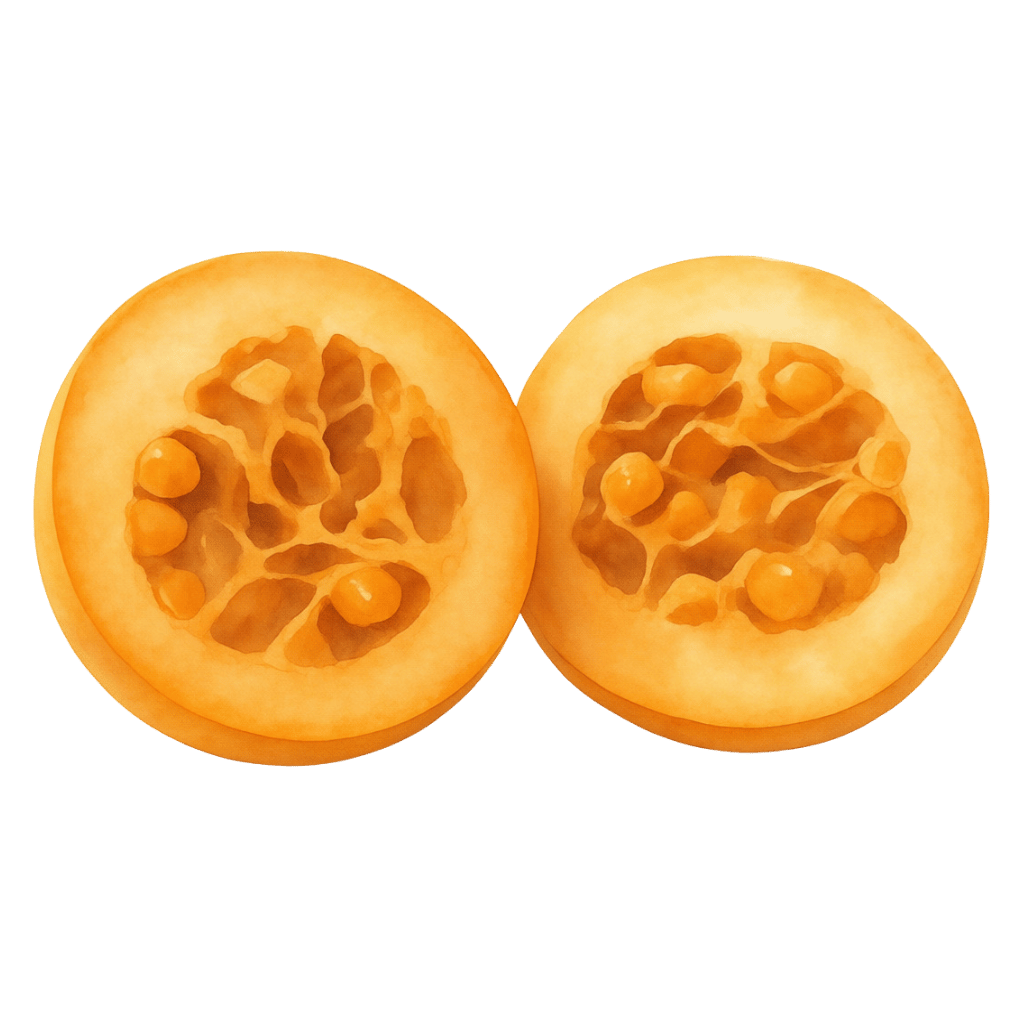
Jenipapo
Genipa americana植物学视图
- Leaves are simple, opposite, petiolate, and clustered toward the branch tips. The glossy dark-green blade is obovate to elliptic, 8-30 cm long by 3-17 cm wide (Purdue/Morton gives 10-33 cm x 4-13 cm), glabrous, with an entire (smooth) margin and well-marked, prominent midrib and veins. The tree is semi-deciduous (foliage is shed for a period each year, coinciding with a phase of low vegetative activity from roughly February to July, followed by leaf fall and new flushing) (EMBRAPA - Silva et al., Genipa americana; Purdue NewCROP/Morton, Genipap).
- The trunk is cylindrical and straight, with smooth, thick, grey-green bark marked with lighter grey patches. The wood is hard, flexible and easy to work, used in carpentry, tool-handle (e.g., axe-handle) and clog manufacture, rural construction, and for firewood/charcoal; when left untreated it is subject to attack by termites, wood-boring beetles and fungi. The bark is rich in tannin and is used for tanning leather. Under prolonged soil waterlogging, seedlings develop hypertrophied lenticels at the stem base as part of a flood-tolerance response (EMBRAPA - Silva et al., Genipa americana; Purdue NewCROP/Morton, Genipap; Mielke & Schaffer, "Leaf gas exchange, chlorophyll fluorescence and growth responses of Genipa americana seedlings to soil flooding," Environmental and Experimental Botany).
- Detailed field descriptions of the root architecture are scarce in the authoritative literature. What has been documented experimentally is the root's flood-adaptation physiology: in one-year-old seedlings subjected to prolonged waterlogging and total submersion (survived for more than 170 days), no adventitious roots were formed, but small amounts of cortical aerenchyma present near the root tips in well-drained plants increased under flooding, aiding internal aeration; abundant superficial roots were also observed during the waterlogging period (Mielke & Schaffer, "Leaf gas exchange, chlorophyll fluorescence and growth responses of Genipa americana seedlings to soil flooding," Environmental and Experimental Botany, cited via ScienceDirect). This flood tolerance is consistent with the species' natural occurrence in seasonally inundated riverine/gallery forest.
- Flowers occur in subcymose, terminal or subterminal inflorescences and release a characteristic mild fragrance. Individual flowers are white when newly opened, turning yellowish with age. The corolla is tubular, whitish-yellow, about 1.2 cm long, with 5 broadly spreading lobes; the calyx is green, tubular-cylindrical and lobeless. CABI additionally describes the flowers as large and showy. The fruit that follows is a globose to ovoid berry, 6-15 cm long by 4-9 cm in diameter (smaller, 6-10 cm, in Cerrado ecotypes), with thin, membranous, wrinkled brown skin, containing 50-160 seeds depending on ecotype (EMBRAPA - Silva et al., Genipa americana; CABI Compendium datasheet 25065).
- Reproductive-biology research by Crestana (1993, doctoral thesis, Universidade Estadual Paulista, cited in EMBRAPA - Silva et al., Genipa americana) found G. americana to be functionally dioecious, with diurnal anthesis, and reproducing predominantly by allogamy (outcrossing). Consistent with this, an isozyme-based population genetics study (Sebbenn, 1997, master's dissertation, ESALQ/USP) found high heterozygosity in natural populations, with 81.6% of seedlings in the reproductive cycle generated by cross-pollination (61.7% between unrelated individuals, 19.9% between related individuals). Local folk classification in Brazil also distinguishes fruit-bearing "jenipapo fêmea" from non-fruiting "jenipapo macho" (androgynous) trees, consistent with functional dioecy (Barros 1966; Xavier & Xavier 1979, cited in Prudente 2002 via EMBRAPA source).
- The species is melittophilous (bee-pollinated). Crestana (1993, cited in EMBRAPA - Silva et al., Genipa americana) identified large bees, Bombus morio and Epicharis rustica flava, as pollinators. The CABI Compendium datasheet likewise describes the large, showy flowers as bee-attracting.
- The species adapts to a range of soil textures, from sandy-loam to clay-silty, at pH 6.0-6.5 (Prudente 2002, cited in EMBRAPA - Silva et al., Genipa americana). The CABI Compendium describes it as easily grown in rich, humid, well-drained soil in full sun to partial shade, with an optimal pH of 5.5-7 (tolerated 5-8), and notes that it tolerates periodic flooding in its native habitat.
- Propagation is mainly by seed: seeds are sown directly into polyethylene nursery bags in an open-air nursery at about 2 cm depth soon after fruit processing, giving an average germination of about 75% within 25-30 days (Silva et al. 2001, cited in EMBRAPA - Silva et al., Genipa americana). The CABI Compendium adds that seeds are non-dormant and need no pretreatment, though soaking in running water for 1-2 days can speed germination, with germination rates of 65-100% within 1-4 weeks and seedlings ready for transplanting about 20 days after germination; early growth is slow, taking about 12 months to reach a transplantable size of 20-40 cm, and containerized seedlings are recommended because young plants are drought-sensitive. Field planting is done at the start of the rainy season in 40 x 40 x 40 cm pits spaced 6 x 6 m. Trees grown from seed begin fruiting after 5-10 years (about 5 years in the Federal District, 8-10 years in the Amazon per Souza et al. 1996). Preliminary Embrapa Cerrados trials using side-veneer or simple whip grafting ("garfagem lateral" / "inglesa simples") achieved 100% graft take and shortened the time to first fruiting to 2-3 years (Silva et al. 2001, cited in EMBRAPA source). Vegetative propagation by cuttings is also reported as possible, and grafting is used to propagate superior-fruit-quality selections (CABI Compendium datasheet 25065).
- Fruits contain 50-80 seeds on average (up to 120-160 in smaller-fruited Cerrado ecotypes), weighing 200-500 g of seed per fruit; individual seeds are about 8.5 mm long by 7 mm wide, fibrous, flattened, ellipsoid to discoid, and darken on drying, weighing around 8.5 g/100 seeds (about 5 g/100 seeds in the Cerrado ecotype) (Silva et al. 2001; Corrêa 1978; Lorenzi 1992; Villachica et al. 1996 - all cited in EMBRAPA source). Germination under natural conditions is slow and of the phanero-epigeal type (cotyledons are photosynthetic in the seedling despite being morphologically distinct from the first true leaves) (Silva et al. 2001, cited in EMBRAPA source). Seeds show intermediate storage behavior: they tolerate desiccation to around 10% moisture content but do not tolerate freezing (Carvalho & Nascimento, 2000, Revista Brasileira de Fruticultura). Seed lots at 11% moisture retained 85-90% germination after one year of storage at 5-15°C (Salomão & Mundim, 2001, cited in EMBRAPA source). Embryonic axes can be successfully cryopreserved in liquid nitrogen (-150 to -196°C) and regenerated in vitro (Sá et al., n.d.; Santos et al., 2005 - both cited in EMBRAPA source).
- No formally released, named commercial cultivars are documented. Traditional Brazilian folk classifications recognize several fruit-type variants: jenipapo-pequeno, -médio and -grande (small-, medium- and large-fruited), jenipapo com caroço and sem caroço (many-seeded vs. few-/no-seeded), jenipapo semperflorens (bearing fruit year-round), the fruit-bearing "jenipapo fêmea" versus the non-fruiting, androgynous "jenipapo macho," and "caruto-Schum" (treated in the literature both as a variety and as a distinct taxon) (Barros 1966; Xavier & Xavier 1979, cited in Prudente 2002, via EMBRAPA - Silva et al., Genipa americana). Ex situ conservation is limited: as of 2000 only 11 field-conserved accessions existed across 9 Latin American institutions, with just 2 accessions held in Brazil (at EBDA) (Knudsen 2000, cited in EMBRAPA source). In 2008, Embrapa Tabuleiros Costeiros established an active germplasm bank holding 163 accessions of G. americana plus 9 accessions of the related species G. infundibuliformis (Muniz et al., 2011, cited in EMBRAPA source), intended as a base for future selection rather than a source of released cultivars.
- No formal breeding program has yet produced released commercial cultivars. Foundational work has focused on characterizing wild genetic resources: Sebbenn (1997, master's dissertation, ESALQ/USP) used isozyme markers to study the genetic structure, mating system, spatial genetic distribution and gene flow of two natural G. americana populations, finding high heterozygosity and predominant outcrossing, and estimating a minimum viable area of 24.7 ha for in situ conservation, with recommendations that seed collection for future breeding draw from a larger number of randomly distributed mother trees. Embrapa Tabuleiros Costeiros established an active germplasm bank in 2008 (163 G. americana accessions plus 9 of G. infundibuliformis) as a genetic resource base (Muniz et al., 2011). Experimental grafting trials at Embrapa Cerrados (Silva et al., 2001) demonstrated 100% graft take and reduced juvenile period (fruiting after 2-3 years versus 5-10 years from seed), a step toward clonal propagation of superior material, but this has not translated into named, released cultivars. Prudente (2002) explicitly notes that the lack of selected varieties and seedlings, and of a complete cultivation technology package, remains a limitation to the species' commercial exploitation (all cited in EMBRAPA - Silva et al., "Plantas para o Futuro - Região Centro-Oeste," Genipa americana).