Voltar à Fruitpedia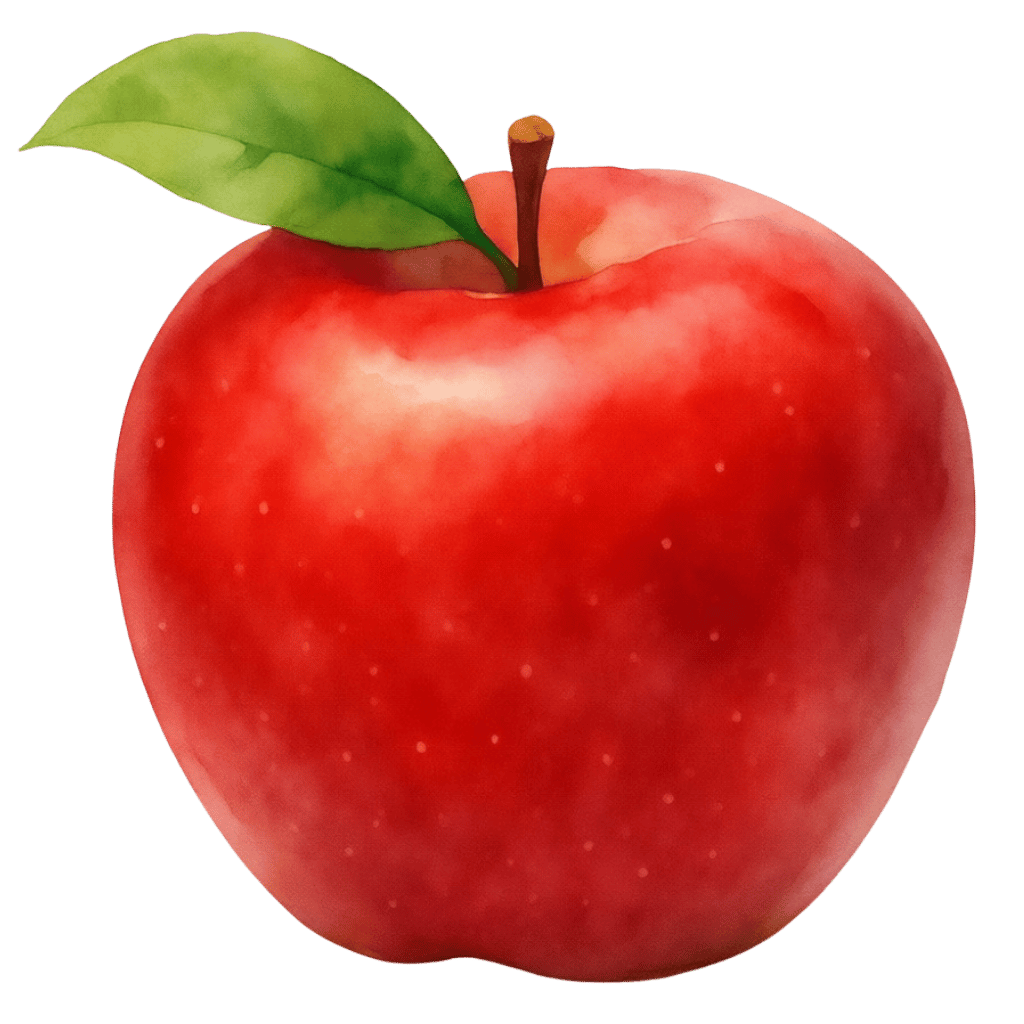
Maçã
Malus domesticaVariedades
Maçã Gala
Maçã Fuji
11–14° BrixMaçã Golden Delicious
12–14° BrixMaçã Granny Smith
11–13° BrixMaçã Honeycrisp
13–15° BrixMaçã Cripps Pink (Pink Lady)
Visão Botânica
- Leaves are simple, alternate and deciduous, with markedly variable shape and size depending on cultivar: elliptical to ovate, roughly 7–15 cm long and 2.5–8 cm wide, with an acute apex and a rounded to cordate base. Leaf margins may be serrate, crenate or undulate. The upper surface is dark green and essentially glabrous, while the lower surface is paler, often grayish, downy and has prominently raised veins (North Carolina State University Extension, n.d.).
- The trunk is comparatively short (50–100 cm) and functions mainly to support the canopy; it has light-gray, smooth bark marked by raised lenticels in young trees, becoming progressively rougher, fissured and scaly with age, while current-season shoots are brown-copper to gray-silver. From the trunk arise three to five primary scaffold limbs, from which secondary branches develop. Fruit is borne on specialized short shoots: one-year "brindles" (15–30 cm, usually with a single terminal flower bud, producing the best fruit quality), spurs of two years or more (up to 15 cm, with one or more flower buds, generally lower fruit quality than brindles), and short unbranched "dards" (4–6 cm) that yield small fruit (EMBRAPA, 2013; North Carolina State University Extension, n.d.).
- The root system consists of roots of varying age and thickness: older, thicker "principal" roots anchor the tree and conduct water and photosynthates, while finer, younger roots — about 75–85% of total root mass — carry out most water and nutrient absorption. Root architecture depends on propagation method: seedling (seed-derived) trees initially form a taproot with lateral branches, whereas vegetatively propagated (layered) rootstocks develop roots distributed around the base of the cutting that later consolidate into a dominant root as the tree matures. Development is further shaped by rootstock vigor, soil texture/structure/depth, water and nutrient availability, soil temperature and hormonal signaling from the shoot; roots concentrate mainly in the top 40–50 cm of soil, especially with dwarfing rootstocks (EMBRAPA, 2013).
- The inflorescence is a corymb, typically comprising five to seven flowers (most commonly six), borne terminally on spurs and brindles. The central "king" flower opens first and, when retained during fruit thinning, produces the largest fruit of the cluster (EMBRAPA, 2013).
- Flowers are hermaphroditic (perfect), bearing functional male and female organs, but most commercial cultivars are self-incompatible and require cross-pollination from a genetically compatible cultivar with an overlapping bloom period to set a commercial crop. A typical flower has five sepals, five petals, an inferior ovary with five locules each containing two ovules, five moist stigmas, and about twenty stamens with free filaments and longitudinally dehiscent anthers releasing smooth, three-grooved pollen that is poorly suited to wind dispersal, favoring insect-mediated pollination (EMBRAPA, 2013).
- Pollination depends on insects, chiefly the honey bee (Apis mellifera), with commercial orchards typically stocked at two to three hives per hectare (minimum 30,000 bees per hive) positioned in the orchard for the full bloom period; stingless bees (Meliponini), bumblebees and solitary bees also contribute. Where pollination is inadequate, corrective measures include top-working a pollinizer cultivar into the canopy, placing cut flowering branches ("bouquets") among the trees, or hand pollination (EMBRAPA, 2013).
- Apple grows in a range of soil textures — clay, loam or sandy soils — provided drainage is good and effective soil depth allows adequate root development; poorly drained, waterlogged sites favor root asphyxiation and disease. Brazilian technical guidance targets a soil pH (in water) of about 6.0, corrected with dolomitic limestone (or dolomitic-calcitic blends, to avoid inducing magnesium deficiency) together with balanced phosphorus, potassium, boron and zinc based on soil analysis performed at least three months before planting, to a depth of about 40 cm. North American extension sources describe the species as tolerant of a broader pH range, from neutral to alkaline (EMBRAPA, 2013; North Carolina State University Extension, n.d.).
- During the non-bearing formative years, nitrogen is typically the only nutrient applied, in doses scaled to tree age; once trees are in production, annual maintenance fertilization is guided by leaf and fruit tissue analysis, periodic soil testing, tree age, vegetative growth, prior fertilization history, yield history and visual deficiency symptoms. Nitrogen and potassium, required in the largest amounts, are normally soil-applied — about half the annual nitrogen dose post-harvest and the remainder at bud swell, with potassium applied largely post-harvest — while foliar sprays are reserved mainly to supplement calcium (reducing disorders such as bitter pit) and micronutrients such as boron and zinc. Orchards are irrigated by sprinkler or, increasingly, by localized (drip or micro-sprinkler) systems; trees generally require a minimum of about 700 mm of water per year, with irrigation scheduled to replenish roughly half of the plant-available water held in the effective root zone (approximately the top 40–50 cm of soil) (EMBRAPA, 2013).
- Commercial trees are propagated vegetatively, chiefly by grafting (bench/whip grafting in winter, or budding in spring or late summer) of the desired scion cultivar onto a clonal rootstock, which preserves cultivar identity. Rootstocks themselves are multiplied clonally, predominantly by stool-bed (mound) layering, with a few especially vigorous types (e.g., 'Marubakaido') also propagated directly from hardwood cuttings treated with auxins (indole-3-butyric or naphthaleneacetic acid); seed propagation of rootstocks is now largely restricted to breeding programs because it produces variable, non-uniform populations. Rootstocks are classified by the vigor they confer on the scion as dwarfing (e.g., M.9, M.26), semi-dwarfing (e.g., M.7, MM.106), semi-vigorous (e.g., MM.111) or vigorous (e.g., M.25, Marubakaido); dwarfing and semi-dwarfing types predominate in modern high-density orchards. In vitro meristem/tissue culture is also used, particularly to obtain virus-free planting material and rapidly multiply scarce elite genotypes (EMBRAPA, 2013).
- Apple shows pronounced genetic segregation: because most cultivars are highly heterozygous and self-incompatible, seeds arising from open or controlled pollination give rise to seedlings that differ substantially from both parents and from one another in vigor, disease resistance, fruit quality and other traits. Seed propagation therefore cannot reproduce a named cultivar true-to-type and is used only in breeding programs, where populations of about 500 to 1,000 seedlings per cross are typically raised to have a reasonable chance of recovering a genotype with desirable combinations of traits (EMBRAPA, 2013).
- Thousands of apple cultivars exist worldwide, but only about a dozen are grown commercially in Brazil, dominated by 'Gala' and 'Fuji' and their bud-sport color clones — including 'Royal Gala', 'Imperial Gala', 'Galaxy', 'Maxi Gala' and 'Baigent'/'Brookfield' in the Gala group, and 'Fuji Suprema', 'Fuji Mishima' and 'Fubrax'/'Kiku' in the Fuji group — which together account for roughly 90% of national production. Locally bred, lower-chill cultivars such as 'Eva', 'Condessa', 'Castel Gala', 'Daiane', 'Joaquina' and 'Monalisa' extend the harvest window and offer improved climate adaptation and disease tolerance; 'Golden Delicious' and 'Granny Smith', grown mainly abroad, are imported to supply the Brazilian market. Rootstocks are likewise selected as distinct clonal types graded by vigor (EMBRAPA, 2013).
- Apple has been cultivated and vegetatively propagated for more than 2,000 years, valued since antiquity by Egyptians, Greeks and Romans; it spread from its Central Asian center of origin along Eurasian migration and trade routes into Europe, Iran and northeastern India, and was later carried to the Americas from the 17th century onward and subsequently to Oceania and Africa. European colonists introduced the species to Brazil, where it remained largely a dooryard crop — apart from commercial orchards around Valinhos, São Paulo, from the 1940s to 1960s dominated by the cultivar 'Ohio Beauty' — until organized commercial pomiculture began in the 1960s in Fraiburgo, Santa Catarina, stimulated from 1969 by federal reforestation tax-incentive legislation that classified apple orchards as eligible plantings. Brazilian public breeding programs (Embrapa, Epagri and partner institutions) have since released numerous locally adapted, lower-chill cultivars, including 'Eva', 'Condessa', 'Daiane', 'Joaquina' and 'Monalisa'; classical breeding of a new cultivar — from controlled hybridization through seedling selection and multi-year, multi-site trialing — takes about 12 to 18 years, and remains, together with the identification and clonal fixation of spontaneous bud-sport mutations, the only route to new commercially released cultivars, complemented in research by biotechnological tools such as marker-assisted selection and, experimentally, genetic transformation for disease resistance (EMBRAPA, 2013).