Voltar à Fruitpedia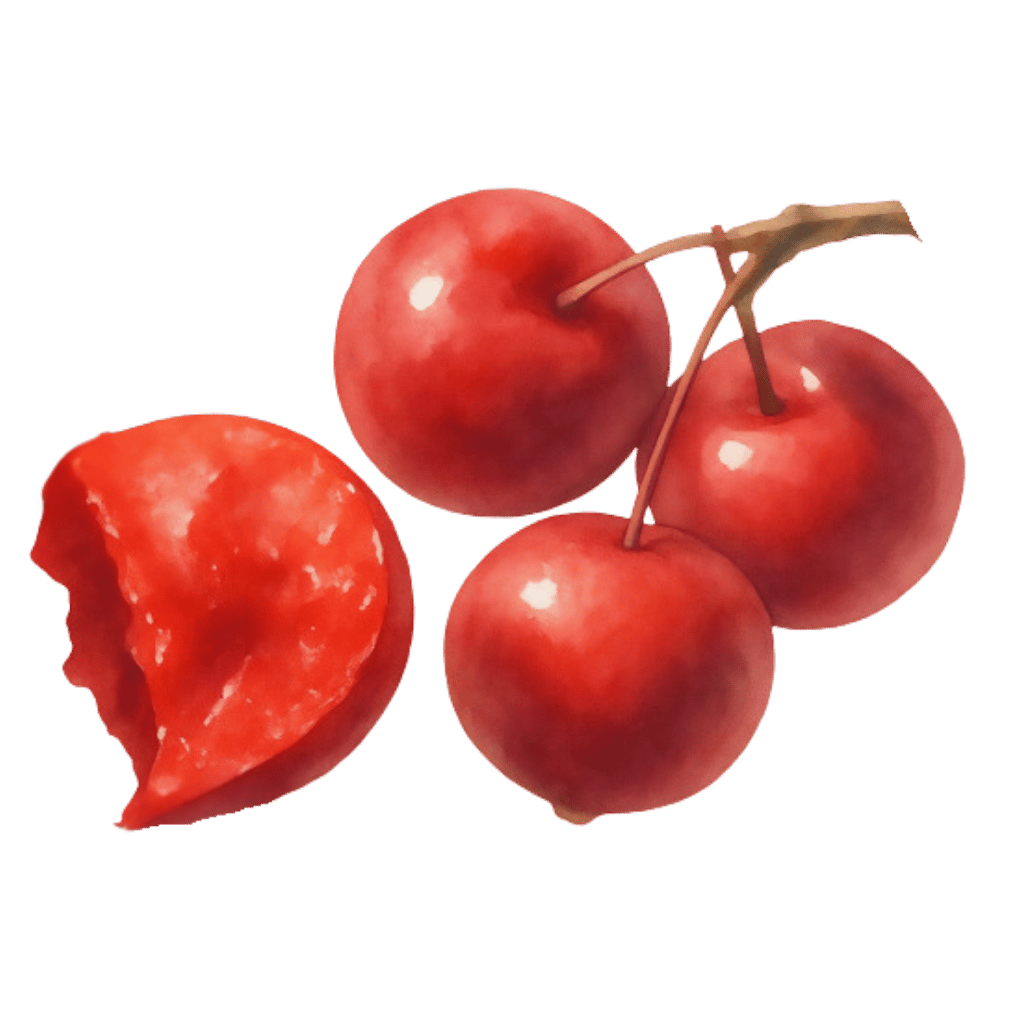
Maçã-silvestre
Malus sylvestrisVisão Botânica
- Leaves are simple, alternate and deciduous. Blades are ovate, elliptic or nearly circular (suborbicular), 3–11 × 2.5–5 cm, with a rounded to cuneate base and a shortly acuminate apex; margins are crenate to serrate. Young leaves bear short hairs along the veins on both surfaces but become glabrous (hairless) at maturity — mature glabrous leaves are a key character separating M. sylvestris from the closely related, more persistently tomentose-leaved M. domestica. Petioles are 1.5–4 cm long, finely hairy when young, becoming glabrous with age.
- Bark is grey to greyish-brown, becoming fissured or flaking into small plates with age; trunks and branches often become gnarled and twisted, especially on exposed sites. Young branchlets (twigs) are dark reddish-brown and glabrous to loosely hairy, and frequently bear spines (short, hardened spur shoots), a feature more pronounced in wild, unselected individuals than in cultivated apples. Trees may be single-stemmed or develop a multi-stemmed, shrubby habit; trunk diameter is usually 23–45 cm, occasionally exceeding 90 cm in old individuals, with trees commonly living 80–100+ years and senescence typically setting in after about a century.
- As a genus, Malus develops a fibrous, laterally spreading root system without a persistent dominant taproot in mature trees, allowing establishment across a range of soil textures. Detailed root-architecture studies specific to wild M. sylvestris were not found in the sources consulted; its ecology as a light-demanding pioneer able to colonize forest gaps, riverbanks and both unusually dry and unusually wet sites indicates a root system tolerant of variable moisture and soil conditions.
- Flowers are borne in small, few-flowered (roughly 3–6 flowers), umbel-like clusters (corymbs) on short spur shoots, opening with or just before the leaves. Each flower is 3–4 cm in diameter, hermaphroditic, with five white to pink-flushed petals 1.3–2 cm long and numerous stamens surrounding a inferior, five-carpelled ovary; the sepals are glabrous on the upper surface in M. sylvestris (versus hairy/tomentose in M. domestica), which is used to help distinguish the two taxa. The fruit is a small pome, globose, 2–3 cm in diameter, yellow-green (sometimes flushed red), with characteristically sour, hard flesh.
- Malus sylvestris bears perfect (hermaphroditic) flowers but is a self-incompatible, obligate outcrosser: fertilization is controlled by a gametophytic self-incompatibility (S-RNase-based) system that blocks self-pollen, enforcing cross-pollination between genetically distinct individuals. Fruit set therefore depends on cross-pollination, and seed dispersal in the wild occurs mainly via endozoochory — seeds pass through the digestive tracts of large mammals (wild ungulates, livestock) and are also spread by other animals, watercourses and human activity.
- The species is entomophilous (insect-pollinated), with bees (Apidae) and flies, particularly hoverflies (Syrphidae), reported as the predominant pollinators. Because of its abundant pollen and comparatively long, early bloom period, M. sylvestris is also valued in orchards as an effective pollinizer tree for cultivated apple cultivars.
- Grows on a wide range of soil types but performs best on moist, nutrient-rich, well-drained soils, as seen in vigorous floodplain hardwood forest populations; it also persists on shallower, drier terrace soils, though with reduced growth. General guidance for genetic conservation describes the species as favouring well-drained, fertile soils under full sun to partial shade.
- Malus sylvestris is a wild forest species, not a commercially cultivated fruit crop, and no standardized fertilization or irrigation regime for it was found in the authoritative sources consulted. In its natural range it relies on ambient soil fertility and rainfall; floodplain populations benefit from periodic flooding that renews soil nutrients and creates the open, competition-free gaps the species needs to regenerate, while genetic-conservation seed orchards are established on ordinary, well-drained fertile sites without special fertigation described in the guidelines reviewed.
- Propagated both by seed and vegetatively. Seed propagation requires cold stratification to break dormancy before germination; because the species is self-incompatible and highly heterozygous, seedlings are genetically variable and not true-to-type. Vegetative propagation is by grafting or budding (commonly whip-and-tongue grafting) onto rootstocks in late winter or early dormant-season spring; grafting of M. sylvestris is reported as straightforward, which is why ex situ conservation seed orchards built from grafted clones are recommended as the most practical genetic-conservation strategy for the species. Historically, seed-raised M. sylvestris (e.g., the strain known as 'Bittenfelder') was used as an apple rootstock, though this practice has largely been superseded by clonal rootstocks because of variability and excessive suckering.
- Because of obligate cross-pollination enforced by gametophytic self-incompatibility, seed-grown offspring show high heterozygosity and considerable phenotypic variability, and are not true-to-type. Population genetic studies of wild Rhine Valley stands found high genetic diversity within populations (observed heterozygosity of roughly 0.74–0.90) and only weak genetic structuring among groups, consistent with wide gene flow driven by insect pollination and long-distance endozoochorous seed dispersal.
- Malus sylvestris itself has little horticultural cultivar development and is generally grown as the wild-type species — chiefly for hedging, wildlife and amenity planting, and as a genetic resource — rather than for named ornamental or fruiting selections; one source notes it has "no importance in gardens except as a contributor to the [cultivated apple] gene pool." The seed strain 'Bittenfelder' is a historically used, non-clonal rootstock derived from M. sylvestris. (Note: many "crab apple" cultivars sold commercially, e.g. Malus × purpurea and other ornamental crabs, are hybrids or belong to other Malus species/hybrid groups, not true M. sylvestris.)
- Malus sylvestris is a wild, undomesticated species and has not itself been bred as a fruit crop. Its principal role in breeding history is as a secondary genetic contributor to the domesticated apple: M. domestica was originally domesticated from Malus sieversii in the Tian Shan mountains of Central Asia roughly 4,000–10,000 years ago and, as cultivation spread westward along early trade routes into Europe, hybridized and introgressed with local wild crab apples, principally M. sylvestris, which reshaped the genome of the modern cultivated apple. Because pure wild M. sylvestris populations are now rare, scattered and threatened by hybridization, habitat loss and changes in forest/river management, the European Forest Genetic Resources Programme (EUFORGEN) published Technical Guidelines (Stephan, Wagner & Kleinschmit, 2003) recommending ex situ conservation seed orchards, built from a minimum of about 50 grafted clones per orchard/region, as the most practical strategy for conserving the species' genetic diversity for future use, including as a resource for disease- and pest-resistance breeding in cultivated apple.