Voltar à Fruitpedia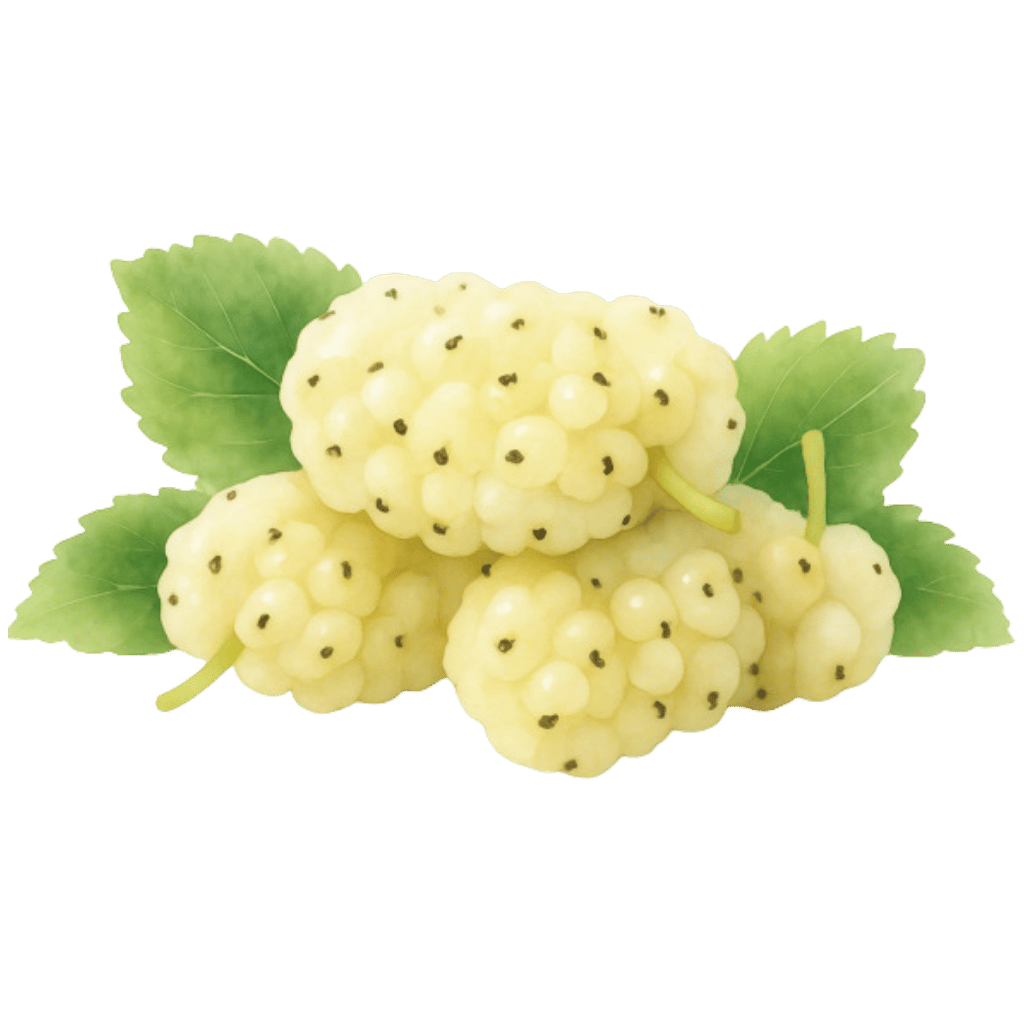
Amora-branca
Morus albaVariedades
Amora-branca 'Pakistan'
Amora-branca 'Sweet Lavender'
Amora-branca 'Beautiful Day'
Amora-branca 'Kokuso'
Amora-branca 'Shangri-La'
Amora-branca 'Pendula'
Visão Botânica
- Leaves are alternate, simple, thin, and glossy light-to-medium green, 5-15 cm long, broadly ovate to cordate with a rounded to shallowly cordate base, serrate (toothed) margins, and an acuminate tip. Foliage is highly variable in outline, ranging from unlobed to deeply and irregularly lobed (2-5 lobes); lobing is most pronounced on juvenile and vigorous vegetative shoots. The upper surface is smooth and lustrous (distinguishing it from the sandpapery, hairier leaves of M. rubra), with three prominent palmate veins from the base. Leaves turn yellow in autumn before dropping.
- The trunk is usually short and often crooked, with grayish-brown to orange-brown bark that is furrowed into narrow ridges with age. Young twigs are slender, greenish to reddish-brown, and exude white latex when broken; the crown is densely branched and spreading. Wood is moderately hard and yellowish.
- The root system is extensive, spreading, and shallow to moderately deep, contributing to the tree's drought tolerance and to its capacity to sucker; aggressive surface roots can lift pavement. Fibrous roots readily colonize a range of soils.
- Flowers are small, greenish, and wind-pollinated, borne in pendulous or short axillary catkins (spikes). Male (staminate) catkins are cylindrical and 1-2.5 cm long; female (pistillate) catkins are shorter and denser, each flower with a sessile stigma. After pollination the whole female spike develops into a fleshy multiple fruit (sorosis) formed from the enlarged, succulent perianths, 1-2.5 cm long, ripening white, pink, red, or dark purple depending on cultivar.
- Predominantly dioecious, with male and female catkins on separate trees, but the species is notably variable: monoecious individuals bearing both sexes occur, and some trees can change sex expression between years. Apomixis (parthenocarpic, seedless fruit set) is common, so fruit is frequently produced without pollination.
- Wind-pollinated (anemophilous). The lightweight pollen is released explosively from the stamens and dispersed by air currents; the tree does not depend on insects for fruit set. Fruit is dispersed by birds and mammals that eat the sorosis.
- Grows in a wide range of soils, performing best in deep, moist, well-drained sandy loam to clay loam of mildly acidic to neutral pH. It tolerates poor, compacted, and moderately dry soils, and some salinity, but does not thrive in permanently waterlogged ground.
- Undemanding once established and drought-tolerant, but regular watering and moderate fertility improve growth and fruit quality; young trees and container plants benefit from consistent moisture. In sericulture and intensive fruit or leaf production, balanced NPK fertilization (with adequate nitrogen for leaf yield) and supplemental irrigation during dry periods are used to sustain repeated leaf harvests.
- Readily propagated vegetatively by hardwood and softwood stem cuttings, which root easily, and by grafting or budding of named cultivars onto seedling rootstock, as well as by layering and suckers. Seed propagation is possible: seeds germinate best when sown fresh, sometimes after a short cold stratification or soaking, typically germinating within a few weeks at 25-30 C. Vegetative methods are preferred to preserve cultivar traits and reduce the juvenile period.
- Seed-grown plants are highly variable in leaf shape, sex expression, vigor, and fruit color and quality, so seedlings do not reliably reproduce the parent. This variability, combined with easy hybridization with other Morus species, makes vegetative propagation standard for cultivated selections.
- Numerous cultivars have been selected for fruit, ornament, or silkworm forage. Notable examples include 'Pendula' (weeping form), 'Fruitless'/'Kingan' and other male, non-fruiting ornamentals, 'Pakistan' (long-fruited), 'Tatarica' (Russian mulberry, very cold-hardy), and 'Illinois Everbearing' (a M. alba x M. rubra hybrid). Many regional sericultural cultivars are bred specifically for high leaf yield and quality.
- Native to China, white mulberry has been cultivated for at least 4,000-5,000 years primarily to feed silkworms in sericulture, and its spread along trade routes closely followed the silk industry into Central and Western Asia, Europe, and later the Americas. Long domestication has produced a vast range of leaf-forage, fruiting, and ornamental cultivars selected for leaf yield, fruit, cold hardiness, and habit. Modern breeding programs, especially in China, India, Japan, and other sericultural countries, continue to develop improved and polyploid mulberry varieties for higher and better-quality leaf production.