Volver a Fruitpedia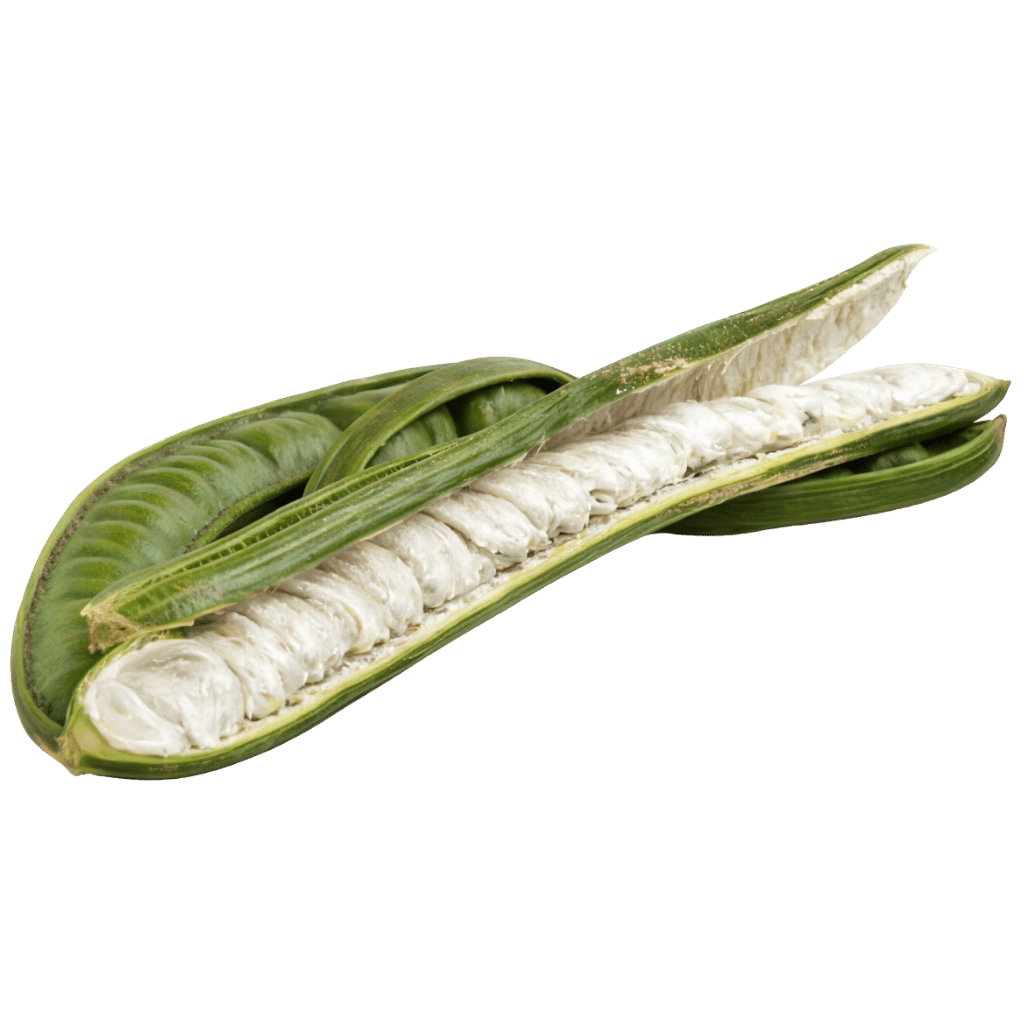
Ingá-feijão
Inga marginataVisión Botánica
- Leaves are alternate, paripinnately compound, glabrous, 10–30 cm long, with the rachis bare to narrowly winged (marginate) and bearing a gland between each pair of leaflets. Leaflets, usually in 1–3 pairs, are sessile, elliptic to lanceolate, pinnately veined, caudate at the apex, membranous and pointed, 3–12 cm long by 1–4 cm wide, with a dark-green, lustrous blade above and an irregular, curved, sparse lateral venation; the terminal (distal-most) pair of leaflets is always the largest and asymmetric, with glabrous or smooth blades, petiolules and rachis (Carvalho, EMBRAPA Florestas, "Espécies Arbóreas Brasileiras," vol. 2, 2010).
- The trunk is straight or generally somewhat twisted, with a short bole (fuste curto) and pronounced, cymose/dichotomous, irregular, near-horizontal branching. The crown is broad, rounded, densely foliated and intensely dark green, with glabrous branches. Bark is up to 6 mm thick; the outer bark surface is smooth to rough, dark brown, with numerous lenticels arranged in regular rows, exposing a brownish tone when scraped; the inner bark is fibrous and pinkish. Wood is light (density 0.40–0.50 g/cm³), with whitish, poorly differentiated sapwood and heartwood, medium texture and straight grain, moderately resistant and moderately durable when protected from weathering (Carvalho, EMBRAPA Florestas, "Espécies Arbóreas Brasileiras," vol. 2, 2010).
- The species forms a symbiotic association with Rhizobium bacteria, producing globose root nodules, reported to have low nitrogenase activity (Faria et al., 1984a, b, cited in Carvalho, EMBRAPA Florestas, 2010). The root system is sensitive to disturbance during nursery transplanting (pricking out), which must be done carefully to avoid damage. The species also regenerates vegetatively from roots (root sprouting) as well as from cut stumps (Wasjutin, 1958). No further detail on rooting depth or architecture is given in the consulted sources.
- Inflorescences are showy axillary racemes/spikes (cachos/espigas), one to two per leaf axil, rarely fascicled, densely flowered, 4–15 cm long. Flowers are numerous, white, showy and strongly and pleasantly fragrant, subsessile, glabrous to slightly pubescent, with long exserted stamen filaments; they tend to open suddenly, giving the inflorescence a cylindrical, brush-like appearance (Carvalho, EMBRAPA Florestas, "Espécies Arbóreas Brasileiras," vol. 2, 2010).
- The species is recorded as having flowers borne on the same individual (described as "monoecious" in the EMBRAPA source, i.e., bearing bisexual/perfect flowers rather than separate male and female trees), consistent with the perfect, hermaphroditic flowers typical of the genus Inga (Carvalho, EMBRAPA Florestas, "Espécies Arbóreas Brasileiras," vol. 2, 2010).
- Pollination vectors are essentially bees, moths and hummingbirds (Morellato, 1991, cited in Carvalho, EMBRAPA Florestas, 2010). The species is also noted as a major producer of nectar and pollen, making it strongly sought after by bees (Reitz et al., 1983, cited in the same source).
- Occurs naturally on a wide range of soil textures, from light to heavy, and tolerates acidic and poorly drained soils. It also tolerates waterlogging and periodic flooding, which supports its frequent occurrence along riverbanks and in riparian/swamp forest environments (Carvalho, EMBRAPA Florestas, "Espécies Arbóreas Brasileiras," vol. 2, 2010; Durigan & Nogueira, 1990).
- For nursery seedling production, application of about 5 mg of nitrogen (as ammonium sulfate) together with 20 mg of phosphorus per kilogram of substrate is recommended for better seedling development (Gonçalves et al., 1999, cited in Carvalho, EMBRAPA Florestas, 2010). At the nursery stage the species prefers partial shade, and direct sun should be avoided during the hottest hours of the day (shade screens or planting under tree cover), per Reitz et al., 1983 (cited in the same EMBRAPA source). No specific field irrigation regime is documented; the species naturally tolerates waterlogging and flooding.
- Propagation is by seed. Direct sowing is recommended into polyethylene bags or medium-sized polypropylene tubes; pricking out (transplanting) must be done carefully to avoid damage to the root system. Germination is hypogeal/cryptocotylar, with seedling emergence beginning 10–30 days after sowing and a high germination rate of around 80%; no pre-germination treatment is required. The species also regenerates vegetatively by stump and root sprouting (Wasjutin, 1958, cited in Carvalho, EMBRAPA Florestas, 2010).
- Seeds show recalcitrant storage behavior and should be sown soon after collection, as they do not tolerate long-term storage. The number of seeds per kilogram varies considerably between sources: 680 (Lorenzi, 1998) to 3,100 (Longhi, 1995). Seeds are bean-like, rhomboid in shape, brownish-green, 0.9–1.2 cm long by 0.6–0.8 cm wide, each fruit (pod) containing up to ten seeds enveloped in an edible white sarcotesta/pulp (Carvalho, EMBRAPA Florestas, "Espécies Arbóreas Brasileiras," vol. 2, 2010).
- No named or formally registered cultivars of Inga marginata are documented in the EMBRAPA monograph or other consulted sources; planting material is sourced from wild-collected seed rather than selected clones (Carvalho, EMBRAPA Florestas, "Espécies Arbóreas Brasileiras," vol. 2, 2010).
- No formal breeding or cultivar-improvement program for Inga marginata is documented in the consulted botanical/forestry literature. The species is used essentially in its wild/naturalized form — for reforestation, agroforestry shade (e.g., shading coffee plantations), apiculture, and restoration of degraded or riparian land — rather than through directed selection. It regenerates naturally by stump and root sprouting in addition to seed (Wasjutin, 1958, cited in Carvalho, EMBRAPA Florestas, 2010).