Back to Fruitpedia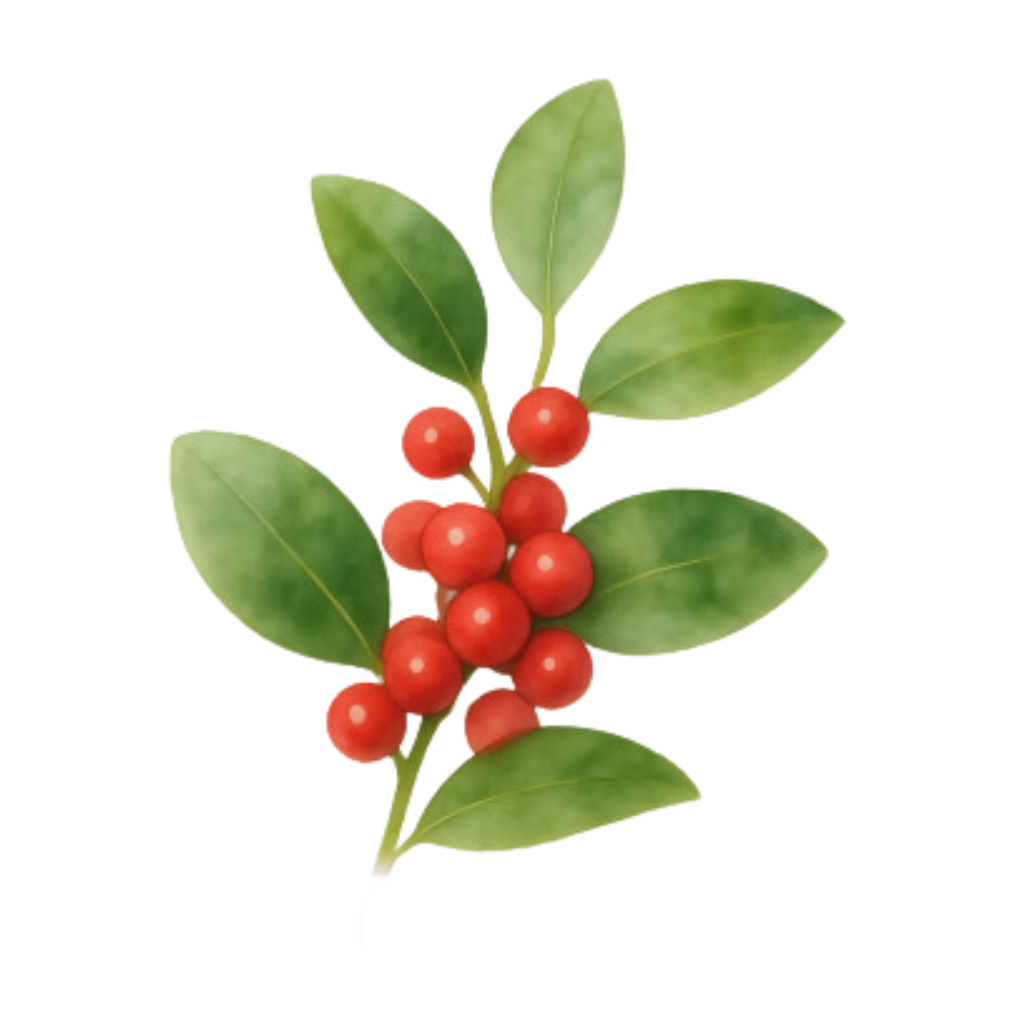
Wintergreen
Gaultheria procumbensVarieties
Very Berry
Winter Splash
Big Berry
Cherry Berries
Merry Berry
Botanical View
- Leaves are alternate but crowded toward the tips of the upright stems, evergreen, thick and leathery (coriaceous), glossy dark green above and paler beneath. Blades are elliptic to obovate, about 2-5 cm long and 1-2 cm wide, acute at both ends, with finely toothed, bristle-tipped and slightly revolute (down-rolled) margins. Foliage often turns reddish or purplish-bronze in winter and releases a strong oil-of-wintergreen scent when crushed.
- Stems are slender, several arising from the creeping rhizome and ascending about 3-8 cm (up to ~3 in) above the ground. Young stems are round and downy/hairy, becoming somewhat woody at the base; the upper portion carries the clustered leaves and the axillary flowers.
- The plant has a shallow, fibrous root system, typically within about 2.5 cm (1 in) of the surface, and spreads mainly by long, woody, horizontal rhizomes (roughly 6 mm thick) confined to the upper 2-3 cm organic/soil layer, producing extensive clonal colonies. As an ericaceous species it forms ericoid mycorrhizal associations for nutrient uptake from acidic organic soils (superficial hyphal sheaths have been reported on its roots). The shallow rhizomes make it vulnerable to fire that removes the organic layer.
- Flowers are borne singly (occasionally in small few-flowered racemes) in the leaf axils near the branch tips, nodding on short, round, downy pedicels. The corolla is urceolate (urn-shaped), white to pale pink, about 5-10 mm long, with five short lobes; there are ten stamens with awned anthers and a superior ovary. The showy red "berry" (6-9 mm) is not a true berry but the swollen, fleshy, accrescent calyx enclosing a many-seeded dry capsule.
- Flowers are hermaphroditic (perfect, bearing both stamens and pistil) and the species is self-fertile, set by insect pollination. It reproduces both sexually by seed and, predominantly, vegetatively by spreading rhizomes that form clonal patches.
- Insect-pollinated, chiefly by bees. Bumblebees (Bombus) are the primary visitors to the nectar-producing, urn-shaped flowers; other bees and butterflies also visit for nectar and pollen.
- Requires acidic, lime-free soil, optimally about pH 4.5-6.0 (tolerating up to ~7.0). It grows on humus-rich, moist but well-drained soils and also on peat, sand, sandy loam and poor, sterile substrates. It favours moist sites but tolerates a range from dry to poorly drained once established, and is intolerant of lime/alkaline soils.
- Adapted to nutrient-poor, acidic soils, it has low fertility requirements and needs little supplemental feeding; any fertiliser should be acidic/ericaceous rather than lime-based. It prefers steady, even moisture, especially while establishing, and lime-free (soft/acidic) water; avoid waterlogging and hard or alkaline water.
- Propagated by seed, by cuttings, by division, and naturally by rhizome spread. Seed is cold-stratified (pre-chilled ~4-10 weeks) then surface-sown on a lime-free/acidic medium, germinating in about 1-2 months at ~20°C. Semi-ripe ("half-ripe") wood cuttings 3-6 cm long root well in mid-to-late summer (July-August); rhizome clumps can be divided in spring. Birds and mammals disperse the seeds after eating the berries.
- Seed-raised plants are genetically variable, differing in vigour and in berry size and colour, so named fruiting and ornamental cultivars are propagated vegetatively (by cuttings or division) to keep them true to type rather than from seed.
- Numerous ornamental selections have been made, chosen mainly for berry size and colour, including 'Bell's Seedling' (large dark-red berries), 'Cherry Ripe' / Cherry Berries (large red fruit), 'Very Berry', 'Berry Cascade' (berries along the whole stem), 'Mother of Pearl' (pale pink) and white-fruited forms such as 'Snow White' and 'Winter Time'. Commercial series such as Winter Pearls (including 'Big Berry', from Syngenta Flowers) have been bred as compact, heavy-fruiting pot plants.
- Long cultivated as an ornamental evergreen groundcover, the species has more recently been the subject of dedicated breeding (for example programmes in Twello, the Netherlands, and by Syngenta Flowers for the Winter Pearls series) aimed at producing compact, uniform, free-flowering and heavy-fruiting plants with larger, brighter berries for the autumn/winter pot-plant and garden market; several selections are patented.