Back to Fruitpedia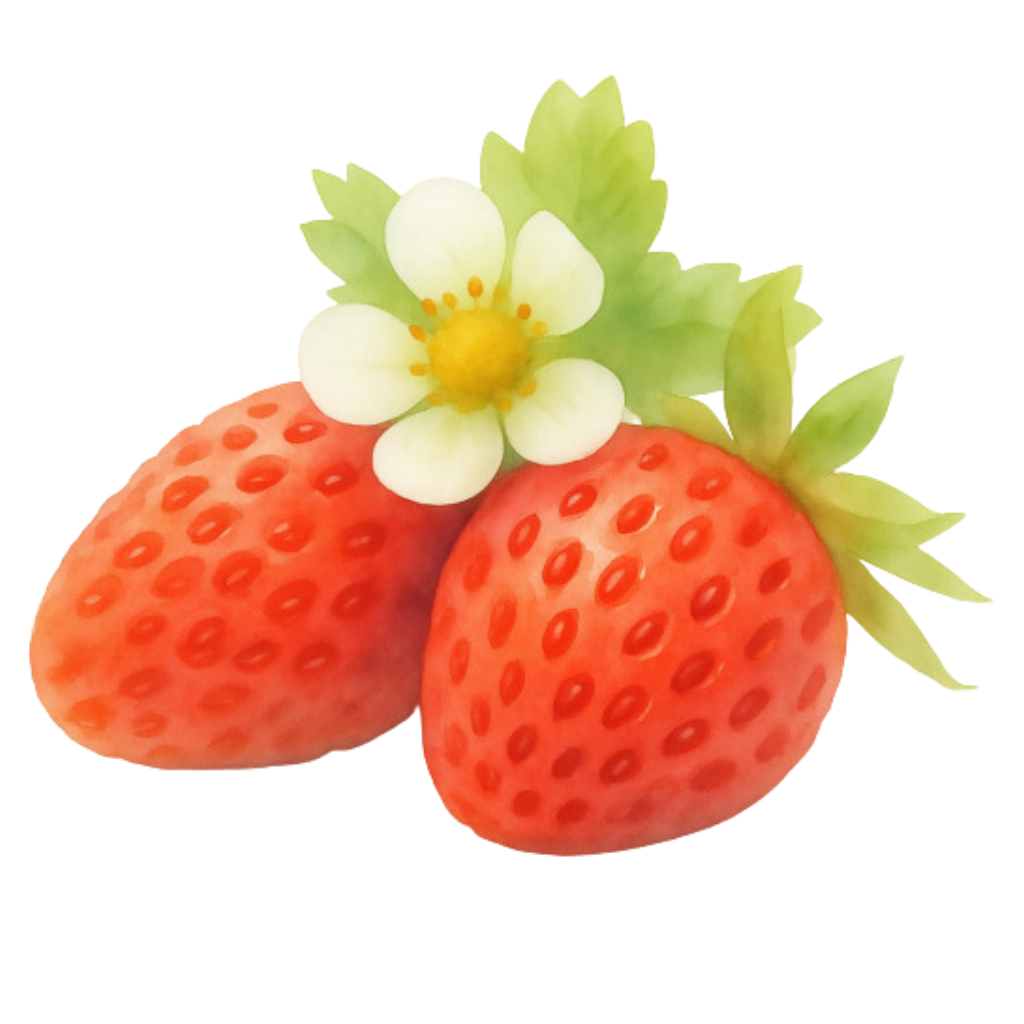
Wild Strawberry
Fragaria virginianaBotanical View
- Leaves are basal and ternately (palmately) compound with three leaflets. Leaflets are oval to obovate, roughly 2.5-10 cm long and up to about 4 cm wide, bluish-green and often glossy above, paler beneath, and coarsely toothed along the margins except near the wedge-shaped base. A diagnostic trait is that the terminal (end) tooth of each leaflet is smaller and narrower than the adjacent teeth, which distinguishes it from the woodland strawberry (F. vesca). Leaves are borne on long, hairy petioles.
- Herbaceous and essentially stemless (acaulescent): leaves and flower stalks arise directly from a short crown at ground level. The plant spreads horizontally by hairy, above-ground runners (stolons) up to about 0.6 m (2 ft) long, which root at their tips to form new plantlets. Flowering stalks (scapes/peduncles) are usually shorter than the leaves, so the flowers are often held at or below leaf level.
- Shallow, fibrous root system arising from a short woody crown (caudex) and slender rhizomes. Vegetative spread occurs both through these rhizomes and through the numerous above-ground stolons, whose rooted tips establish independent daughter plants.
- A loose, few-flowered cyme (cluster) of typically 4-6 flowers borne on a scape that is usually shorter than the surrounding leaves, with some flowers nodding. Individual flowers are about 1.3-2 cm (1/2-3/4 in) across, radially symmetrical, with 5 white rounded petals, roughly 20-35 yellow stamens surrounding a domed cluster of numerous pistils, 5 green sepals, and 5 alternating sepal-like bracts (an epicalyx).
- Gynodioecious: populations contain both hermaphroditic (perfect) plants and separate female (pistillate) plants; purely staminate (male) plants are also reported, giving subdioecious tendencies. The species is octoploid. It reproduces sexually by seed (achenes) and asexually (clonally) by stolons. Female plants depend on pollen from hermaphrodites, so seed set requires cross-pollination; outcrossing predominates, though experimental florivory (flower damage) has been shown to increase selfing.
- Insect-pollinated. Recorded floral visitors seeking nectar and pollen include little carpenter bees (Ceratina), cuckoo bees (Nomada), mason bees (Osmia) and other halictid/sweat bees, plus syrphid (hover) flies, thick-headed flies, tachinid flies, bottle flies, small butterflies, skippers, and ants. These visitors cross-pollinate the flowers, and pollinators tend to prefer the larger, pollen-bearing hermaphrodite flowers over female flowers.
- Adaptable to a wide range of soils but performs best in fertile, well-drained ground. It grows in soils from sandy loam to clay-loam and tolerates moist to dry-mesic conditions; loam and clay-loam with good drainage are ideal. It does not tolerate waterlogging.
- Low-maintenance once established. Best growth and fruiting occur in fertile, moist but well-drained soil with moderate, consistent moisture during flowering and fruiting; established plants tolerate short dry (dry-mesic) periods. Excessive irrigation or poorly drained soil promotes crown and fruit rots, so drainage is more important than heavy watering. Species-specific fertilizer rates are not well documented.
- Propagated both sexually and vegetatively. Seed (achenes) can be sown but germination is improved by cold, moist stratification to break dormancy. The most reliable and common method is vegetative: rooting the plantlets produced at the tips of stolons (runners), or dividing the crown/rhizome. Runner-tip and crown divisions establish quickly and reproduce the parent clone exactly.
- Because the species is gynodioecious and predominantly outcrossing, seed-grown (sexual) offspring are genetically variable and segregate for traits such as sex expression, vigor, fruit size, and flavor; seedling populations are not uniform. In contrast, plants propagated vegetatively from runners, crowns, or rhizomes are genetically identical to the parent and come true to type.
- Few named cultivars exist of the pure species, which is valued mainly as breeding germplasm rather than as a commercial fruit variety. Four subspecies are recognized: ssp. virginiana, ssp. glauca, ssp. grayana, and ssp. platypetala. Notably, the day-neutral (everbearing) trait of many modern garden-strawberry cultivars was introgressed from F. virginiana ssp. glauca of the Wasatch Mountains.
- Together with F. chiloensis, F. virginiana is one of the two wild octoploid parents of the modern cultivated garden strawberry, Fragaria x ananassa. F. virginiana was carried from eastern North America to Europe in the early 1600s, and F. chiloensis was brought from Chile in 1714; the two accidentally hybridized in 18th-century European gardens (notably in Brittany, France) to produce F. x ananassa. F. virginiana contributed flavor, aroma, cold hardiness, and remontancy; the day-neutral/everbearing trait of many modern cultivars traces to F. virginiana ssp. glauca from the Wasatch Mountains, introgressed in 20th-century breeding programs. It remains an important source of germplasm for flavor, hardiness, and disease resistance.