Back to Fruitpedia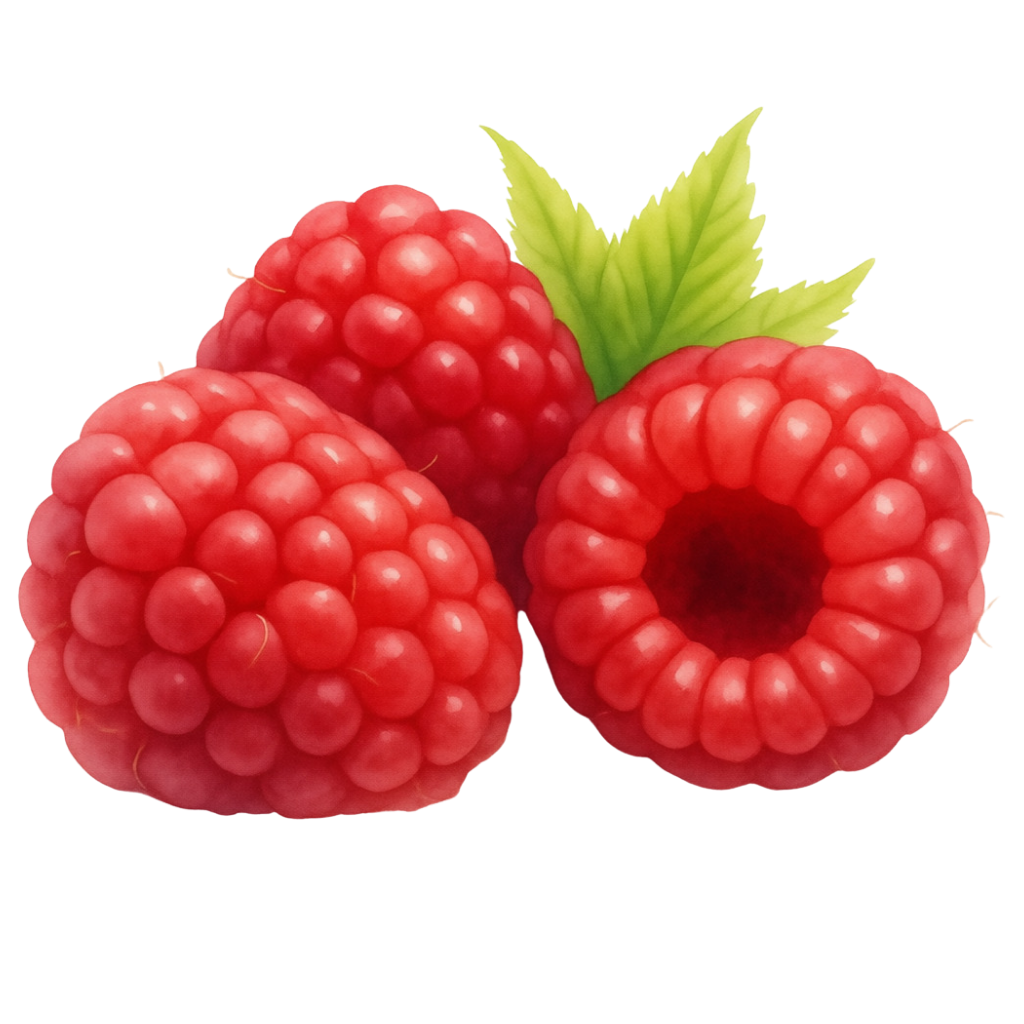
Wild Red Raspberry
Rubus idaeusVarieties
Heritage
Tulameen
11–13° BrixAutumn Bliss
Latham
Boyne
Willamette
8–10° BrixBotanical View
- Leaves are alternate and pinnately compound. Primocanes bear leaves with 5 (sometimes 7) leaflets; flowering floricanes bear leaves with 3 (sometimes 5) leaflets. Leaflets are ovate to lanceolate with pointed tips, rounded to cordate bases, and singly to doubly serrate margins, in the wild form roughly 3–9 cm long and 2.5–6 cm wide (up to ~15 cm on vigorous cultivated plants). The upper surface is green and the lower surface is distinctively white- to silvery-tomentose (densely felted with pale hairs). The petiole and rachis often bear small prickles.
- Canes are biennial, arising from a perennial crown and rhizome; they are erect to arching, round in cross-section, and glabrescent. Wild canes are armed with slender, weak, broad-based prickles or bristles about 1–4 mm long, frequently intermixed with gland-tipped hairs, and often bear a waxy (glaucous) bloom. Primocanes are typically unbranched in the first season; in the second year the floricane produces short flowering side shoots (laterals) from its nodes, fruits, and then senesces and dies back to the ground.
- The root system is perennial and shallow, consisting of a woody crown and spreading horizontal rhizomes (underground stems) from which new canes (suckers) emerge, allowing the plant to form spreading colonies and thickets. Fibrous feeder roots are concentrated in the upper soil layers, making the plant sensitive to both drought and waterlogging. Prostrate cane tips that contact moist soil can occasionally take root (tip layering).
- Flowers are borne in small terminal and axillary racemes or racemiform clusters on the short laterals of second-year canes, typically with 3–8 (occasionally 1 to ~20) flowers. Each flower is about 1 cm across, with five white, erect to spreading petals, five green sepals, and a central dome of many pistils (about 60–90 carpels) surrounded by a ring of numerous white stamens. Each successfully pollinated pistil develops into one drupelet of the aggregate fruit.
- Hermaphroditic and self-fertile (self-compatible); the flower has both stamens and many pistils. Although self-fertile, complete fruit set depends on pollen being moved among the many pistils, so animal pollination markedly improves the number of drupelets set and reduces crumbly, malformed fruit. Sexual reproduction is by seed, but the species reproduces prolifically by vegetative means (root suckers and rhizomes), so wild stands are largely clonal. Rubus idaeus is a diploid, 2n = 2x = 14, with a small genome (~290–300 Mbp).
- Primarily insect-pollinated. The chief pollinators are bees: honey bees (Apis mellifera) and bumblebees (Bombus spp.), together with solitary bees such as Osmia and Andrena; flies and other insects also visit. Bees are credited with the large majority of effective pollination in raspberry, transferring pollen among the ring of anthers and the central cluster of pistils to ensure most drupelets develop. Some wind movement of pollen can also occur.
- Prefers deep, fertile, organically rich, moist but well-drained loams, slightly acidic, ideally about pH 6.0–6.5. It is intolerant of waterlogged or heavy, poorly drained soils, which promote Phytophthora root rot; raised beds or ridged rows are commonly used on heavier ground. In the wild it grows on woodland edges, clearings, meadows, lakeshores, and disturbed roadside sites across a range of soils where moisture is adequate.
- Responds to moderate, balanced fertility with an emphasis on nitrogen, applied in spring; excessive nitrogen produces lush vegetative growth, longer internodes, and fewer fruiting laterals, so rates are kept moderate. Typical guidance is on the order of a few ounces of nitrogen per 3 m (10 ft) of row, adjusted upward as the planting matures. Consistent moisture is important, especially during flowering and fruit sizing: about 2.5–5 cm (1–2 inches) of water per week. Drip/trickle irrigation is preferred because it keeps foliage and fruit dry, reducing disease, and delivers water efficiently to the shallow roots.
- Most commonly propagated vegetatively, which preserves cultivar identity: by removing rooted root suckers, by root cuttings (segments of rhizome), by crown division, and, for wild trailing tips, by tip layering. Micropropagation (tissue culture) is widely used to bulk up clean, virus-tested plants. Seed propagation is reserved for breeding because seedlings do not come true to type.
- Seed-grown plants are highly variable and do not come true to type owing to the species' high heterozygosity and outcrossing. Seeds show strong double dormancy: a hard, impermeable seed coat plus embryo dormancy, so germination is naturally slow, erratic, and low without treatment. Germination is improved by scarification (e.g., acid scarification with sulfuric acid) followed by cold, moist stratification (commonly around three months); reported germination percentages vary widely by seed lot, parentage, and year (often from roughly 15% up to 45% or higher with optimized treatments, and higher still with in vitro embryo culture).
- Hundreds of red raspberry cultivars have been bred, divided into floricane-fruiting (summer-bearing) types that fruit on second-year canes and primocane-fruiting (autumn/"everbearing") types that fruit on first-year canes. Long-standing and representative examples include summer-bearing 'Malling Jewel', 'Boyne', 'Nova', 'Glen Ample', and 'Latham', and primocane-fruiting 'Autumn Bliss', 'Heritage', 'Polka', and 'Joan J'. Fruit color forms include red, yellow/gold, and (via hybridization) purple raspberries.
- The genus Rubus and the raspberries are thought to have an origin centered in Asia, with R. idaeus native across Europe and northern Asia. Red raspberry was gathered from the wild since antiquity and brought into cultivation in Europe by the medieval period, with named garden forms recorded from the 16th–18th centuries. Systematic breeding expanded in the 19th and 20th centuries, notably through the East Malling (UK) 'Malling' series and North American programs, drawing on both European R. idaeus and American R. strigosus and yielding today's summer-bearing and primocane-fruiting cultivars. It is a diploid (2n = 2x = 14) with a small, now fully sequenced genome, and modern breeding increasingly uses molecular and genomic tools for traits such as fruit quality, primocane fruiting, and disease resistance.