Back to Fruitpedia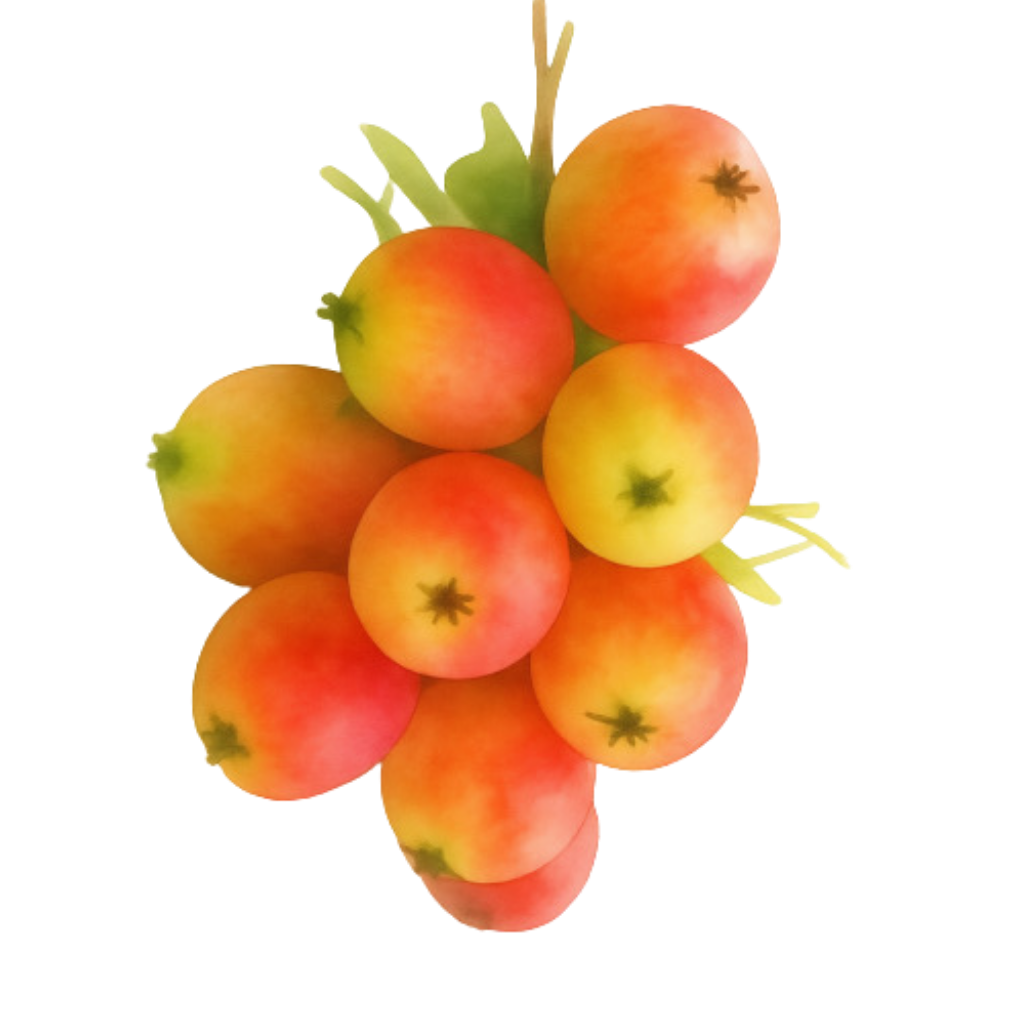
Wild Crabapple
Malus coronariaVarieties
Charlottae
Nieuwlandiana
Botanical View
- Leaves are alternate, simple and deciduous, ovate, about 7.5-10 cm (3-4 in) long and 4-5 cm (1.5-2 in) broad, with incisely (coarsely) serrate margins and often shallowly three-lobed on vigorous shoots. They emerge red-bronze and downy, maturing to dark green above and paler beneath, and turn yellow in autumn.
- Bark is reddish gray-brown, rough-textured, with longitudinal fissures and narrow scales. Young branchlets are densely woolly, becoming smooth reddish-brown; second-year growth develops short spur-like branches and thorn-like spurs (spines) reaching about 2.5 cm or longer. The wood has reddish-brown heartwood and yellow sapwood, and is heavy and close-grained (specific gravity ~0.70) but not strong; historically used for tool handles and mill gears.
- Roots are noted for hardiness — the species has been used as a rootstock for cultivated apple, conferring greater cold hardiness on the grafted scion. Detailed root-system morphology (depth, spread, mycorrhizal associations) is not well documented in the available literature.
- Flowers are borne in umbel-like clusters (corymbs/cymes) of about 5-6 (2-6) flowers on slender pedicels. Individual flowers are large, 4-5 cm (1-1.75 in) across, with 5 rose-pink petals that fade to white with age; they are strongly fragrant. Each flower has about 10-20 stamens and 5 carpels forming an inferior ovary with 5 styles. The fruit is a pome, depressed-globular, about 2.5-4 cm (1-1.5 in) in diameter, yellow-green and fragrant with a waxy surface, ripening September-October; the white flesh is sour, charged with malic acid.
- Flowers are hermaphroditic (perfect) and insect-pollinated. Like most Malus, the genus exhibits gametophytic self-incompatibility, so cross-pollination is required for reliable seed set. Malus coronaria is primarily tetraploid, though diploid and triploid individuals have been reported; this polyploidy is associated with facultative apomixis (production of some seeds from maternal tissue without fertilization, yielding clonal offspring). It hybridizes with domestic apple (M. domestica) where ranges overlap, producing both hybrid and apomictic seed.
- Pollinated by insects. The fragrant, nectar-rich flowers attract native bees and honey bees as well as butterflies, which are the principal pollinators.
- Adaptable to light (sandy), medium (loamy) and heavy (clay) soils, provided drainage is good. Prefers rich, moist to wet, well-drained soil, and tolerates a pH range from mildly acid through neutral to mildly alkaline.
- Prefers consistently moist, fertile soil; fruiting and vigor decline under drought or heavy shade. No species-specific fertilization or irrigation regimen is documented; culture generally follows that of ornamental crabapples (adequate soil moisture, avoiding waterlogging).
- Most commonly propagated by seed. Seed requires cold, moist stratification for about 3 months at ~1°C (roughly 40°F for 2-3 months) to break dormancy; fresh seed is best sown as soon as ripe in autumn in a cold frame and usually germinates in late winter, while stored seed may take 12 months or more. Can also be propagated by cuttings of mature wood taken in November in a frame, and named forms are propagated by grafting; the species itself is used as a hardy rootstock for cultivated apples.
- Seedlings are genetically variable owing to insect cross-pollination, self-incompatibility (outcrossing) and interspecific hybridization (notably with M. domestica, M. ioensis and M. angustifolia). Because the species is a facultative apomict, a proportion of seed may develop apomictically and produce offspring that are clones of the mother plant rather than variable recombinant seedlings.
- Selected forms include the double-flowered 'Charlottae' (forma charlottae; a wild double collected in Illinois in 1902, with fragrant semi-double to double pale-pink flowers of about 12-20 petals but sparse fruiting), 'Nieuwlandiana' (forma nieuwlandiana, another double-flowered form), and 'Elk River' (a Minnesota wild selection introduced ~1930 with large single pink flowers and persistent bright fruit). Two botanical varieties are recognized: var. coronaria and var. dasycalyx (the latter with hairy pedicels and sepals).
- Malus coronaria was the first North American apple described scientifically, by Linnaeus in Species Plantarum (1753); it was introduced to England in 1724 and was in cultivation in Pennsylvania by about 1750. Indigenous peoples (e.g. the Iroquois) dried the fruit for winter, and settlers used the hard wood and made the fruit into preserves, cider and vinegar. It has seen little formal breeding beyond selection of ornamental double-flowered forms (e.g. 'Charlottae', 1902) and hardy wild selections; it is valued chiefly as an ornamental and occasionally as a cold-hardy rootstock and parent in interspecific crosses.