Back to Fruitpedia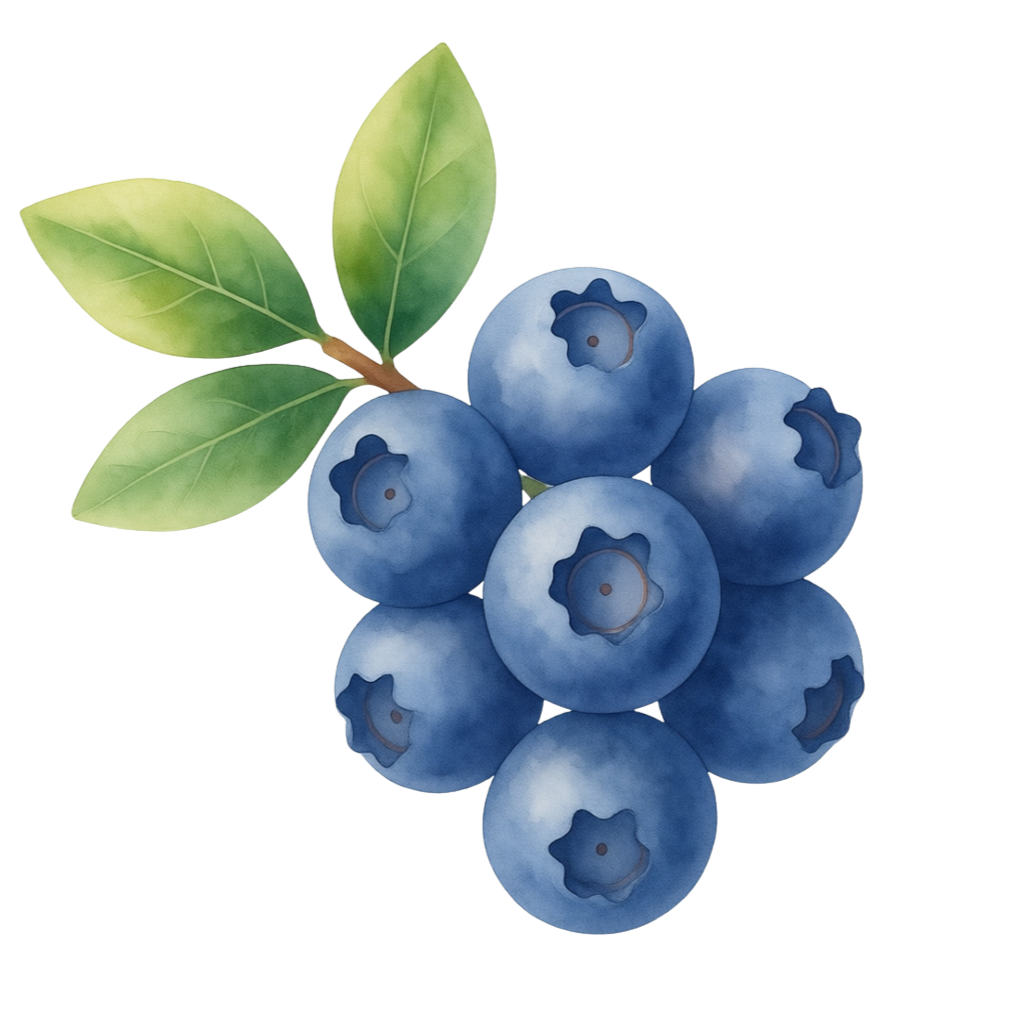
Wild Blueberry
Vaccinium angustifoliumVarieties
Blomidon
Brunswick
Chignecto
Cumberland
Fundy
Augusta
Botanical View
- Leaves are deciduous, simple and alternate, elliptic to lanceolate and comparatively narrow (the epithet angustifolium means "narrow-leaved"), roughly 1–3.5 cm long, with finely serrulate (small-toothed) margins whose teeth are often gland-tipped. They are glossy blue-green to bright green and smooth (or with fine hairs on the midrib) in summer, and turn brilliant crimson to scarlet in autumn, giving the barrens their characteristic fall color.
- Stems are slender, wiry and much-branched, forming a low canopy generally 5–60 cm high. Young twigs are green to reddish and finely warty or minutely ridged/angled, becoming reddish-brown to gray, scaly and woody with age. The above-ground stems are relatively short-lived and readily regenerate from the rhizome system after burning or mowing.
- The plant has a shallow, fine, fibrous root system together with an extensive network of woody underground rhizomes from which new aerial stems arise, allowing one clone to spread widely; roughly 70–85% of the plant's biomass is below ground. As in other Ericaceae, the fine roots form ericoid mycorrhizal associations that aid nutrient and water uptake in acidic, low-fertility soils. Rhizomes can persist and lie dormant for long periods before sprouting when light, moisture and oxygen are adequate.
- Flowers are borne in short, few-flowered axillary racemes or clusters (typically about 5–6 or more flowers) on the previous year's wood. Individual flowers are white to pale pink, urn-shaped (urceolate) to bell-shaped corollas about 4–6 mm long, nodding, with poricidal anthers that release pollen through terminal pores. The fruit is a many-seeded, sweet blue to blue-black berry covered with a whitish, waxy bloom.
- Flowers are hermaphroditic (perfect). The species is largely self-incompatible / partially self-sterile, so cross-pollination between genetically distinct clones is required for good fruit and seed set; self-pollination yields much lower berry set and fewer developed seeds. The poricidal anthers are adapted to buzz (sonication) pollination. Reproduction is both sexual (by seed) and vegetative/clonal (by rhizome spread), and commercial fields follow a two-year cycle of a vegetative "sprout" year followed by a cropping year.
- Pollinated primarily by bees. Native bumblebees (Bombus spp.) are especially effective because they buzz-pollinate and forage in cool, wet weather; other important wild pollinators include mining bees (Andrena spp., e.g. A. carlini and the specialist "blueberry bee"), Colletes inaequalis, and various Osmia, Halictus and Lasioglossum species. Managed honey bees (Apis mellifera) are commonly stocked (about 1–8 hives per acre) to supplement wild bees during bloom.
- Grows on acidic, well-drained, low-fertility soils — sandy, gravelly or rocky, often with high organic matter — with an optimum pH of about 4.0–5.0 (near 4.5–4.8). The low pH also helps suppress competing weeds. It tolerates infertile, drought-prone barrens, where ericoid mycorrhizae assist nutrient uptake.
- Nutrient requirements are low. Where fertilizer is used, modest nitrogen and phosphorus are applied — for example diammonium phosphate (DAP) or monoammonium phosphate (MAP), or a balanced fertilizer such as 10-10-10 — usually in the sprout year around bloom; over-fertilizing tends to favor weeds. About 25–50 mm (1–2 in) of water per week is beneficial, and supplemental irrigation (often drip) improves establishment and yield, especially during dry spells and in the fruiting year.
- Spreads naturally and vegetatively by rhizomes. It can be propagated by seed, by rhizome cuttings/pieces, by softwood or hardwood stem cuttings, by transplanting sod pieces or wild plugs, and by tissue culture (micropropagation). Managed stands are usually established by encouraging existing wild clones or by transplanting rather than by grafting.
- Because the species is highly outcrossing and heterozygous with large genetic diversity, seedlings are very variable and do not come true to type — progeny differ widely in vigor, yield, and berry size and color. This variability produces the mosaic of distinct clones seen in wild fields. Seed-propagated families (e.g. 'Novablue') have been developed, but uniform cultivars are normally maintained by clonal (vegetative) propagation.
- Commercial "wild" blueberry production relies mostly on managed native clones rather than named cultivars. Named lowbush cultivars released from the Agriculture and Agri-Food Canada (Kentville, Nova Scotia) breeding program include 'Augusta', 'Brunswick', 'Chignecto', 'Blomidon', 'Cumberland' and 'Fundy'; 'Burgundy' is also grown, and 'Novablue' is a seed-propagated family. V. angustifolium is a parent of cold-hardy "half-high" cultivars (V. angustifolium × V. corymbosum) such as 'Northblue', 'Northsky', 'Northcountry', 'Polaris' and 'Chippewa'.
- Long gathered as a wild crop by Indigenous peoples of northeastern North America, it remains a "managed wild" crop harvested largely from naturally occurring clones rather than a fully domesticated species. A formal genetic-improvement program began at Agriculture and Agri-Food Canada's Kentville Research Station (Nova Scotia) in the 1960s, producing six clonal cultivars culminating in 'Fundy'. The species has also been used as a source of cold-hardiness in breeding "half-high" blueberries (crosses with highbush V. corymbosum), notably in the University of Minnesota program.