Back to Fruitpedia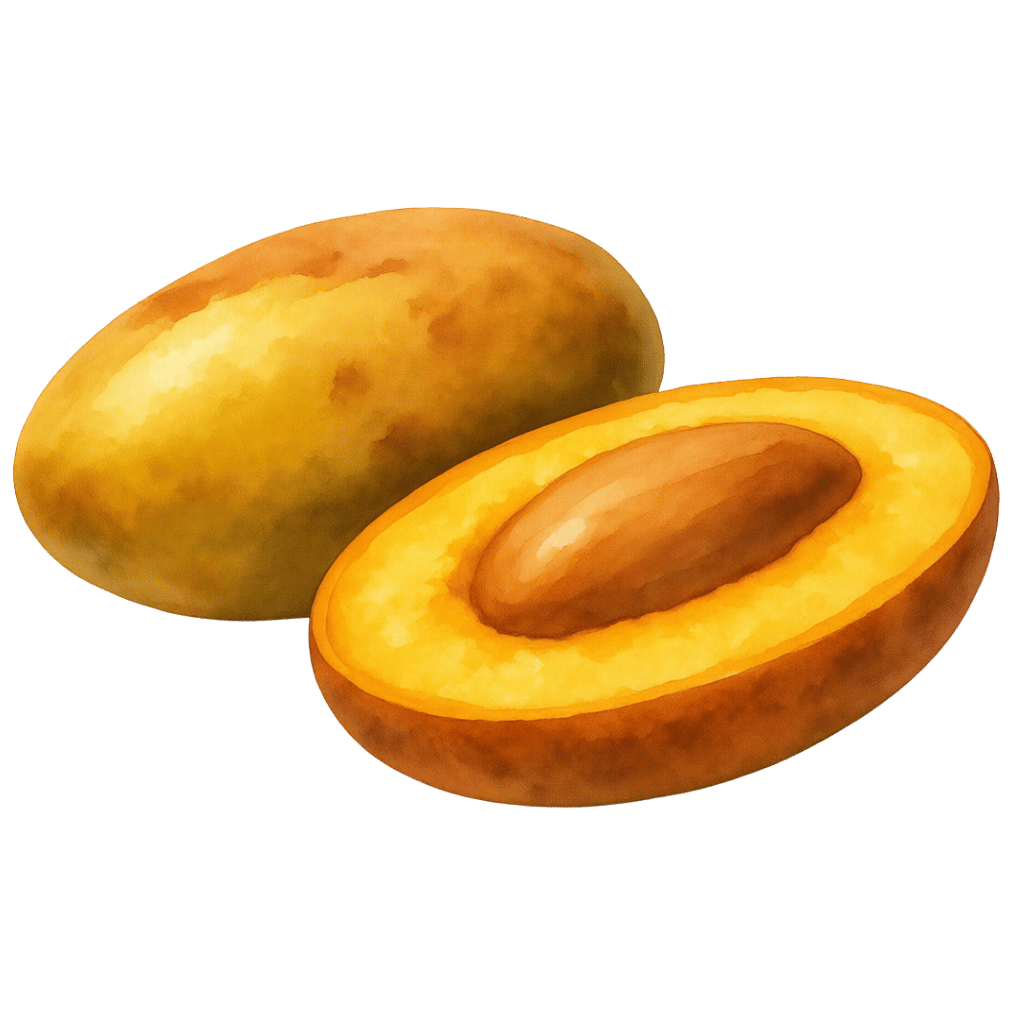
Uxi
Endopleura uchiBotanical View
- Leaves are simple, alternate, leathery (coriaceous), and elliptic-oblong in shape, reddish when immature and turning dark green at maturity, with a cuneate base, an acuminate apex, and serrate (toothed) margins. The midrib and the secondary and tertiary veins are prominent on the lower (abaxial) leaf surface, with the tertiary veins arranged in a reticulate pattern. A swollen, glabrous, green pulvinus is present at the base of the petiole. The petiole is flat and averages about 1.1 cm in length; the leaf blade averages about 27.4 cm long by 6.8 cm wide. Branches are glabrous and cylindrical along most of their length, becoming slender and pendent toward their tips.
- The trunk is straight and cylindrical, with thick, grey bark and reddish (dark red) heartwood/timber. Height reaches up to 30 m (most commonly 20-25 m), with trunk diameter at breast height up to 1 m in the largest individuals (commonly 45-60 cm); when grown without competition for light in open areas, the tree is markedly smaller, rarely exceeding 15 m in height. Under favorable, fertilized cultivation the annual growth increment is about 1 m in height and 2 cm in diameter; in selectively logged primary forest, periodic annual diameter increment is only about 0.5-0.6 cm. The wood is used in civil and naval construction and for plywood/laminates, and historically also as firewood or for charcoal (of only fair quality).
- Endopleura uchi does not form tabular/buttress roots, a trait noted by Embrapa researchers as making it attractive for ornamental planting in squares and parks, since it can be pruned without disfiguring its subglobose crown. The species does not tolerate waterlogging, particularly at the juvenile stage; in its natural habitat it is confined to well-drained "terra firme" (non-flooded upland) forest soils, and sites subject to inundation by rainwater or tides are considered unsuitable for orchards. No further data on root system architecture (depth, lateral spread, mycorrhizal associations) were found in the consulted sources.
- Inflorescences are axillary and cymose, arranged as panicles with dichotomous or trichotomous branching. Flowers are hermaphroditic, small, lightly to moderately fragrant, and greenish-white. The calyx has 5 suborbicular sepals fused at the base, about 0.7 mm long; the corolla has 5 free petals, 3.0-3.5 mm long by 1.0-1.4 mm wide. The androecium usually comprises 25 stamens (ranging 22-30), 1.5-2 mm long, fused at the base for up to one-third of their length; anthers are four-thecate (two thecae at the base of the connective, two slightly above). The ovary is glabrous, subglobose, 0.9-1.0 mm long, five-loculed, each locule holding a single anatropous ovule with a ventral raphe. The style is short but slightly longer than the ovary, and the stigma is lobed and capitate, positioned roughly level with the anthers.
- Flowers are hermaphroditic. There appears to be no genetic self-incompatibility mechanism, since isolated trees with no conspecifics nearby have been observed to set abundant fruit, indicating the species is self-compatible. However, the pronounced phenotypic variation seen among trees and fruits within the same natural population, and the fact that seedling-propagated trees never reproduce the fruit characteristics of the mother tree, indicate that E. uchi functions predominantly as an outcrossing (allogamous) species in natural stands.
- Anthesis (flower opening) occurs in the early morning hours. The flowers emit a relatively strong, pleasant fragrance and are visited by bees of the genera Trigona and Apis, a wasp of the genus Polybia, and a beetle of the family Meloidae, among other insect visitors; however, which of these floral visitors act as the species' effective pollinators has not been conclusively determined.
- The species occurs most frequently on dystrophic (nutrient-poor) soils, chiefly Yellow Latosols (Oxisols), Red-Yellow Latosols, Quartzarenic Neosols (sandy Entisols), Yellow Argisols and Red-Yellow Argisols (Ultisols). These soils are typically deep, friable and porous, with high acidity, low natural fertility (due to nutrient-poor parent material) and high exchangeable aluminum content.
- In experimental Embrapa Amazonia Oriental plantings, adequately fertilized trees show good growth, with an annual increment of about 1 m in height and 2 cm in trunk diameter. In common farmer practice, however, uxizeiro orchards are frequently established on former black-pepper (Piper nigrum) plots that were abandoned after disease decline, and growers typically apply no fertilizer at all. Wildling seedlings collected from the forest floor are potted, kept shaded, and irrigated in a nursery bed until well rooted before transplanting to the final site. No published fertilizer rate/formula or irrigation schedule specific to E. uchi was found in the consulted sources.
- Endopleura uchi is propagated both sexually (by seed) and asexually (by grafting; no vegetative cutting method is reported as effective). Seed-grown trees do not reproduce the mother tree's fruit characteristics, owing to cross-pollination, and require a long juvenile period (about 7 years to first fruiting); this method is used mainly for timber-oriented plantings, which produce a straight bole with natural pruning, especially at densities of 400 or more trees per hectare. For commercial orchards, grafting is recommended because it fixes desirable genotypes, produces more uniform and smaller trees, shortens time to first fruiting (3-4 years after planting), and eases pest and disease control. Cleft grafting ("garfagem em fenda cheia") and patch/chip budding ("borbulhia em placa") both give good results when performed in the correct season; the rootstock is seedling-grown E. uchi, graftable 8-10 months after seedling emergence. Scion sprouting after cleft grafting takes 35-45 days when grafted January-March, or 20-30 days when grafted July-September; budded grafts sprout 15-25 days after the plastic wrap is removed (removed 20-25 days after grafting). Grafting is best carried out in the rainy season, and grafted plants are ready for field planting 3-4 months after grafting. A low-input method used by smallholders is collecting self-sown wildling seedlings from beneath mother trees or house-yard/orchard sites, or burying seed pits near a cupuacu tree's root mass (to confuse termites) under woven plastic for up to 2 years until sprouting, then potting the seedlings.
- The propagule (diaspore) is a large, hard, woody pyrene ("caroco") that follows the ellipsoid shape of the fruit; it represents on average about 33-58% of fruit weight (estimates vary by source/genotype) and contains from zero to five seeds, most commonly one or two, though some genotype trials recorded up to five per fruit. Seeds are small (about 0.77 g, 2.95 cm long, 0.63 cm wide and 0.44 cm thick), bitegmic, with a light-brown testa, an almost transparent tegmen, abundant oily endosperm and leafy (foliaceous) cotyledons. Seeds are recalcitrant: they cannot be dried without losing viability once moisture content falls to about 14%, and they are also cold-sensitive, losing all viability after 30 days of storage at 3-5 degrees C; at natural fruit fall, seed moisture content is just above 35%. Germination is slow and markedly uneven, starting about 300 days after sowing and continuing for more than 1,000 days, reaching at most about 25% germination in nursery trials (limited partly by termite, Heterotermes tenuis, attack on seed tissue), or as little as about 10% one year after sowing when diaspores are placed under the canopy of mother or other trees. Germination is epigeal with a phanerocotylar seedling type; when a single pyrene holds more than one seed, they tend to germinate almost simultaneously. Considerable variability in fruit size, weight, shape, pulp percentage and pulp physicochemical composition exists both among wild populations and among characterized genotypes at the same site.
- No officially registered commercial cultivar (no "BRS" release) exists for this species. Embrapa Amazonia Oriental has characterized selected mother-tree genotypes/accessions used as grafting sources and breeding material, including EAO-1 and EAO-2 (maintained at Embrapa Amazonia Oriental headquarters, Belem, PA) and provenance selections named Tome-Acu, Santa Izabel 1, Santa Izabel 2 and Mosqueiro. These genotypes differ markedly in fruit weight (36.7-82.1 g), pulp yield (26.0-45.6%, with EAO-1 and EAO-2 giving the highest pulp percentages) and pulp chemistry (moisture 42.2-53.3%, pH 4.9-5.6, ether extract/oil content 12.2-18.0%). Across wild populations and cultivated genotypes generally, pulp yield is usually 26-30%, though selected genotypes with up to 45% pulp yield have been identified, indicating potential for future cultivar development.
- Endopleura uchi remains an undomesticated, "neglected" native fruit tree with no officially released cultivar to date. Early Amazonian botanists (Huber, 1904) and later Cavalcante judged the species commercially unviable to cultivate because they believed it needed 15-30 years to first fruit, so essentially all uxi fruit supply historically came from wild trees or from seedlings that had self-sown in secondary forest near towns and villages. Research at Embrapa Amazonia Oriental (Carvalho et al., 2007) overturned this assumption, showing seed-propagated trees can fruit by about 7 years and grafted trees by 3-4 years after planting. Combined with rising urban demand for uxi ice cream ("sorvete de uxi") in Belem, this finding has driven a recent (mostly last two decades), still small-scale shift toward deliberate planting, mother-tree selection and grafting by Embrapa researchers and family farmers (e.g., Sao Joao da Ponta and islands near Belem, PA), and adoption of the species as a shade tree for cacao and cupuacu in agroforestry systems pioneered by Japanese-Brazilian farmers in Tome-Acu, PA. No formal germplasm bank exists for the species, and its natural genetic variability is considered to have suffered substantial, largely unassessed losses through Amazon deforestation.