Back to Fruitpedia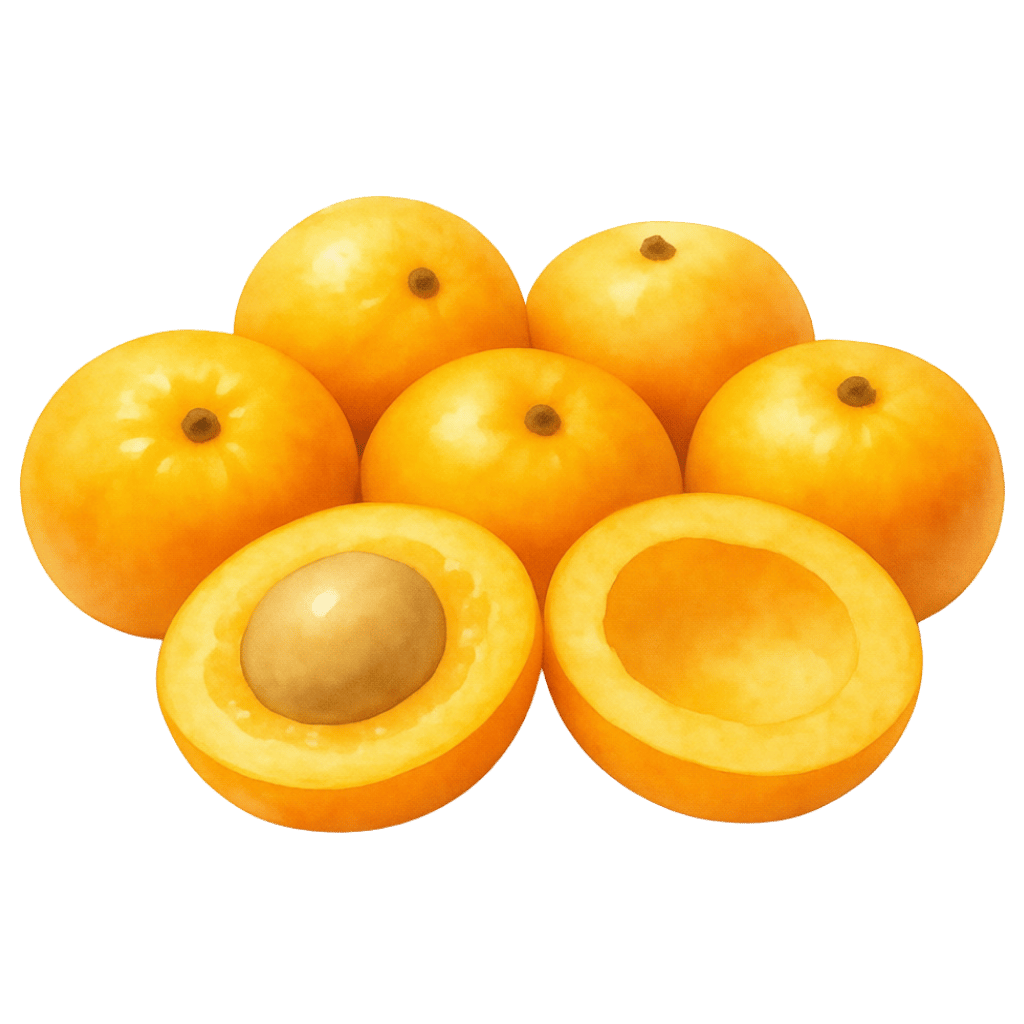
Uvaia
Eugenia pyriformisBotanical View
- Leaves are simple, opposite, exstipulate, and oblong-lanceolate, with a leathery (cartaceous) texture; blades measure 2.5-6 cm long by 0.8-2 cm wide, light green above and covered with fine hairs on the lower surface, on petioles 2.5-4.5 mm long. (Carvalho, P.E.R. "Uvaieira: Eugenia pyriformis." In: Espécies Arbóreas Brasileiras, v.4. Embrapa Informação Tecnológica/Embrapa Florestas, 2010, p.547-553.)
- The trunk is more or less straight to slightly twisted, with a short bole reaching a maximum of about 5 m; branching is sympodial, cymose, and irregular, with no apical dominance, giving an open, broadly rounded crown 6-7 m across. Twigs are slender, flattened or subquadrangular, and sericeous to velutinous (finely hairy). Bark is very thin (up to 4.5 mm), with a smooth, greyish-yellow outer surface that flakes densely in light-colored patches, leaving scars; trunk coloration has been likened to that of Luma apiculata (arrayán) of Andean-Patagonian forests. Natural self-pruning is poor, so cultivated trees benefit from periodic (annual, June-July) formative pruning. The wood is dense (0.90-0.98 g/cm3), whitish-brown, compact, elastic, and durable, though unsuitable for pulp/paper; it is used locally for fence posts, tool handles, and firewood. (Carvalho, P.E.R. "Uvaieira: Eugenia pyriformis." In: Espécies Arbóreas Brasileiras, v.4. Embrapa Informação Tecnológica/Embrapa Florestas, 2010, p.547-553.)
- Detailed root system morphology is not described in the available literature. The species shows a low incidence of arbuscular mycorrhizal colonization, and bare-root seedling transplanting is reported as not always successful, which is why direct sowing into individual nursery containers is recommended instead. (Carvalho, P.E.R. "Uvaieira: Eugenia pyriformis." In: Espécies Arbóreas Brasileiras, v.4. Embrapa Informação Tecnológica/Embrapa Florestas, 2010, p.547-553, citing Carneiro et al., 1998; Maixner & Ferreira, 1976.)
- Flowers arise in axillary dichasia (cymose clusters) or appear solitary or in small axillary clusters partly hidden by the foliage. Floral buds are minute (about 1 mm), globose, and green, arising singly or in groups of up to three on the same pedicel in the axils of young leaves; open flowers are showy, white, and hermaphroditic. (Carvalho, P.E.R. "Uvaieira: Eugenia pyriformis." In: Espécies Arbóreas Brasileiras, v.4. Embrapa Informação Tecnológica/Embrapa Florestas, 2010, p.547-553, citing Franzon et al., 2004.)
- Eugenia pyriformis is a hermaphroditic species, bearing bisexual (perfect) flowers. (Carvalho, P.E.R. "Uvaieira: Eugenia pyriformis." In: Espécies Arbóreas Brasileiras, v.4. Embrapa Informação Tecnológica/Embrapa Florestas, 2010, p.547-553, citing Díaz Cillo, 2008.)
- Pollination is carried out essentially by bees, including the European honeybee (Apis mellifera) and the bumblebee Bombus morio; stingless bees (Apidae: Meliponinae) have also been recorded as floral visitors, and the flowers are noted as a pollen source of apicultural value. (Carvalho, P.E.R. "Uvaieira: Eugenia pyriformis." In: Espécies Arbóreas Brasileiras, v.4. Embrapa Informação Tecnológica/Embrapa Florestas, 2010, p.547-553, citing Franzon et al., 2004; Gressler et al., 2006; Pegoraro & Ziller, 2003.)
- In the wild, uvaia grows on soils of regular-to-good fertility that are moist, well-drained, and sandy-clay (areno-argilosa) in texture; it develops well on soils derived from granitic, eruptive (basaltic), sedimentary, and alluvial parent materials. (Carvalho, P.E.R. "Uvaieira: Eugenia pyriformis." In: Espécies Arbóreas Brasileiras, v.4. Embrapa Informação Tecnológica/Embrapa Florestas, 2010, p.547-553, citing Mattos, 1985.)
- An unfertilized tree yields on average about 5 kg of fruit per year, rising to roughly 10 kg when well fertilized. For nursery seedlings grown in polyethylene bags, organic fertilization (25% of substrate volume) or chemical NPK 4-14-8 (4 kg per m3 of substrate) is recommended; for seedlings raised in polypropylene tubes, 100 g of slow-release commercial fertilizer is applied per 25 kg of substrate. (Carvalho, P.E.R. "Uvaieira: Eugenia pyriformis." In: Espécies Arbóreas Brasileiras, v.4. Embrapa Informação Tecnológica/Embrapa Florestas, 2010, p.547-553, citing Martins et al., 2004.)
- Propagation is by seed. Ripe fruit, harvested once the skin turns from green to yellow, yields 530-1,170 seeds per kilogram. No pre-germination treatment is required, though longitudinal splitting of seeds has been used to increase the number of seedlings obtainable from a single seed lot. Germination is hypogeal and cryptocotylar, with emergence generally beginning 20-45 days after sowing and germination performance typically high. Best nursery results come from sowing directly into individual containers, since bare-root transplanting is not always successful; seedbeds should be shaded and kept moist. Because of its close affinity to the pitanga (Eugenia uniflora), cleft grafting is expected to work well, which could allow cloning of superior genotypes for seed-orchard formation, though this has not been extensively validated in the literature. (Carvalho, P.E.R. "Uvaieira: Eugenia pyriformis." In: Espécies Arbóreas Brasileiras, v.4. Embrapa Informação Tecnológica/Embrapa Florestas, 2010, p.547-553, citing Maixner & Ferreira, 1976; Silva et al., 2003.)
- Seeds are large, globose, and white, up to 1 cm in diameter, exalbuminous (lacking endosperm), with a "eugenioid" embryo (fleshy cotyledons and an inconspicuous radicle) that is apparently undivided, as in other Brazilian Eugenia species. Seeds show recalcitrant physiological behavior: they have a thin (cartaceous) seed coat and lose viability rapidly on desiccation, becoming non-viable once moisture content drops below about 14%, with germinative capacity starting to decline 15-20 days after harvest. Cold storage can maintain seed moisture above 20% for 60 days while keeping the resulting drop in seedling emergence below 50% of the initial rate. (Carvalho, P.E.R. "Uvaieira: Eugenia pyriformis." In: Espécies Arbóreas Brasileiras, v.4. Embrapa Informação Tecnológica/Embrapa Florestas, 2010, p.547-553, citing Flores & Rivera, 1989; Andrade & Ferreira, 2000; Delgado, 2006; Justo et al., 2007.)
- No named commercial cultivars have been developed; the species remains undomesticated. Three botanical varieties are recognized: var. uvalha (Cambess.) Legrand, a small shrubby form reaching only about 1.5 m in height; var. riograndensis Mattos, known only from Veranópolis, Rio Grande do Sul; and var. argentea Mattos & Legrand, occurring in Paraná and Santa Catarina. Germplasm is maintained in Embrapa Clima Temperado's Active Germplasm Bank of native fruit species. (Carvalho, P.E.R. "Uvaieira: Eugenia pyriformis." In: Espécies Arbóreas Brasileiras, v.4. Embrapa Informação Tecnológica/Embrapa Florestas, 2010, p.547-553, citing Mattos 1978 and Donadio et al. 2002.)
- No formal domestication or genetic-improvement program has yet been carried out for uvaia. The species is conserved in the Active Germplasm Bank (Banco Ativo de Germoplasma) of native fruit species at Embrapa Clima Temperado (Pelotas, RS), where it is being characterized with the stated goals of better understanding the species and, in the future, developing a production system for commercial-scale cultivation and possibly a genetic breeding program. Researchers note that a targeted selection/breeding effort could address the fruit's main commercial limitation - a thin peel highly susceptible to bruising during harvest and transport - given the species' notably good flavor and abundant pulp. (Carvalho, P.E.R. "Uvaieira: Eugenia pyriformis." In: Espécies Arbóreas Brasileiras, v.4. Brasília: Embrapa Informação Tecnológica; Colombo: Embrapa Florestas, 2010, p.547-553, citing Franzon et al., 2004.)