Back to Fruitpedia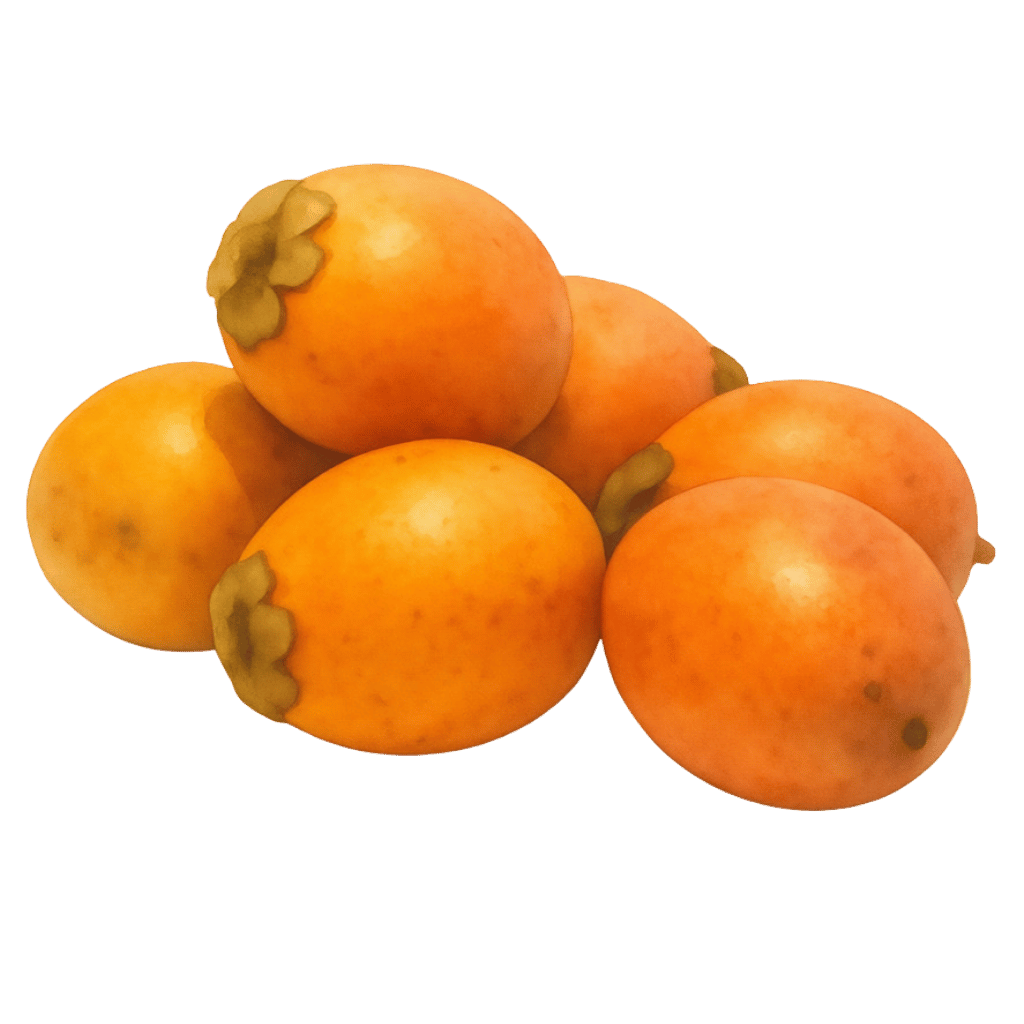
Tucuma
Astrocaryum aculeatumBotanical View
- Each palm bears 8-24 pinnate, reduplicate, ascending leaves 4-5 m long, armed with spines along their entire length (Kew POWO records 5-15 leaves with 100-120 leaflets per side). The sheath and petiole together measure 1.8-3.7 m and the rachis 1.4-6.4 m, carrying 73-130 pairs of linear leaflets grouped in clusters held in different planes - an irregular, plumose arrangement rather than a single flat plane - which gives the crown a shaggy appearance; leaflet undersides are pale/whitened, a trait typical of the genus.
- The stem (stipe) is solitary - never clustering, unlike its close relative A. vulgare - erect, 8-30 m tall (a few sources cap it at 25 m) and 12-40 cm in diameter, thickened and columnar. It bears rings of long, black spines over variable portions of its length; some individuals are heavily armed while others are nearly spineless (inerme), and together with the spiny leaves and inflorescence bract this makes the palm intimidating to handle.
- No species-specific description of the root system was found in the botanical/agronomic literature reviewed. As in all palms (Arecaceae), the root system is expected to be entirely adventitious, arising continuously from a root-initiation zone at the stem base, fibrous, without a taproot and without secondary thickening; the tolerance of A. aculeatum for poor, low-fertility, well-drained terra firme soils is consistent with the extensive, shallow fibrous root mat typical of the genus, but this has not been directly documented for the species itself.
- The inflorescence is a large, branched, erect, pedunculate, interfoliar panicle of spikelets (rachillae), borne on a 0.3-0.7 m peduncle and enclosed before anthesis by a single woody, spiny, peduncular bract 1.4-2.2 m long that splits open lengthwise. A mature inflorescence carries roughly 375-432 rachillae (averaging about 146 ± 20 cm in total length in one Central Amazon population) and bears 500-1,200 sessile, cup- or barrel-shaped, trimerous pistillate flowers - each with a superior, tricarpellate, one-ovuled ovary and a membranous ring of six vestigial staminodes at its base - together with an estimated 190,000-260,000 much smaller, tubiform staminate flowers bearing six exserted, rim-dehiscent stamens. Staminate-flower colour is polymorphic, ranging from wine-red to cream, a feature only recently documented and suggestive of undescribed infraspecific variation.
- The species is monoecious and protogynous, with a predominantly allogamous (outcrossing) mating system enforced by temporal separation of the sexes within each inflorescence: pistillate flowers open in the evening and remain receptive for about 24 hours, while staminate flowers begin anthesis only after the female phase and stay viable for just six hours. Population-genetic studies using microsatellite markers detected essentially zero self-fertilization and negative fixation indices (around -0.035 in adults, -0.060 in offspring), confirming strong outcrossing and an absence of inbreeding. Flowers are arranged in the "triad" pattern (one pistillate flower flanked by two staminate flowers) typical of the palm subfamily Arecoideae.
- Pollination is entomophilous. Studies of A. aculeatum populations near Manaus recorded floral visits by bees (Trigona sp. and the introduced Apis mellifera) and by beetles - chiefly Nitidulidae (Mystrops sp.) and Curculionidae (Terires minusculus) - drawn to the flowers' odour and pollen, with beetles reported as the most frequent visitors and floral nectar reward appearing limited. A parallel pollination-biology study of the closely related A. vulgare documented a similar beetle guild (Nitidulidae: Mystrops spp.; Curculionidae: Terires minusculus; plus Erirhininae and Baridinae weevils), consistent with cantharophily (beetle pollination) as the likely ancestral pollination syndrome in the genus.
- The species thrives on the well-drained, naturally low-fertility soils typical of Amazonian terra firme and is notably tolerant of poor and degraded ground, producing fruit without fertilizer for years even on impoverished sites. In closed forest on poor soils it occurs at low density (around 10 mature individuals per hectare); density rises sharply - to 10-100 adults per hectare, occasionally forming near-pure stands of over 100 adults per hectare - where farmers manage or seed it into cleared, anthropized land.
- No field fertilization or irrigation regime for mature, cultivated A. aculeatum has been documented; the crop is still essentially extractive/semi-wild, and Embrapa's own review notes that "agronomic studies remain scarce" for the species. For nursery seedling production, the recommended germination substrate is a 1:1 mixture of sand and cured sawdust in a covered nursery bed; after emergence, seedlings are transplanted into black polyethylene bags containing topsoil, commercial vegetable fertilizer and cured cattle manure in a 3:1:1 ratio, grown on with shading during establishment, and moved to the field once they reach the 4-5 leaf stage.
- Propagation is essentially by seed. The propagule is the "pyrenium" (caroço) - the stony endocarp plus its enclosed seed, usually one seed per pyrenium, with 10-50 seeds per kilogram of fruit. Seeds show pronounced physical dormancy linked to the thickness of the hard, stony endocarp and to fruit ripeness at harvest, producing slow, irregular, low-percentage germination: left inside the intact endocarp, germination can take 730-1,044 days. Depulping, drying the seed, removing the endocarp and then rehydrating it (soaking roughly 9-15 days in water, with daily water changes to prevent rot) shortens and synchronizes germination markedly, to about 104-187 days with rates up to 70%; simple farmer-level protocols (shade-drying pyrenes 1-2 weeks, cracking them open, soaking seeds 3-5 days, then sowing) can bring germination onset to as little as 30 days, though full stand establishment from unprocessed seed is often reported as taking up to two years. Seeds are sown with the germination pore facing sideways (about 90° to the soil surface) under roughly 1 cm of substrate. In-vitro germination of zygotic embryos is an active research line aimed at accelerating and standardizing propagation of elite genotypes. Heat from burning land to prepare swiddens also stimulates germination of buried seed, and seedlings tolerate shade well in early growth, typically being field-planted at the 4-5 leaf stage.
- A. aculeatum is a wild, non-domesticated palm with pronounced morphological and genetic variability. Fruit traits vary widely among individuals and populations - fruit weight 20-100 g (up to 150 g in some samples), length 3-8 cm, diameter 2.5-5.6 cm, pulp colour from yellow to red/orange - and staminate-flower colour ranges from wine-red to cream, a previously undocumented polymorphism. Microsatellite studies of natural populations report high genetic diversity (observed heterozygosity around 0.57-0.64; roughly 7-10 alleles per locus on average, up to 101 total alleles across 12 loci in a 15-population, 218-plant sample), with about 94% of genetic variation found within rather than between populations, and moderate genetic structuring associated with hydrographic basin/watershed; 17 private alleles detected across populations hint at incipient subpopulation divergence. Pollen dispersal averages around 81 m (range 3-194 m), with roughly 9% pollen immigration from outside populations, helping maintain diversity despite short-distance, largely gravity- and rodent-mediated seed dispersal.
- No named or officially registered cultivars of A. aculeatum currently exist. Improvement work is at the pre-breeding/germplasm stage: Embrapa Amazônia Oriental maintains the BAG-Tucumã active germplasm bank (registered with Brazil's Conselho de Gestão do Patrimônio Genético) with more than 200 accessions - including A. aculeatum material, some plants over 30 years old - and Embrapa Amazônia Ocidental has established a newer, 50-accession A. aculeatum germplasm bank still in its vegetative phase. Near Manaus, 290 elite "matrices" (individual wild palms selected for desirable traits such as high yield, large/heavy fruit, high pulp percentage, low fibre, sweet pulp and high oil content) have been catalogued across 16 populations in 15 municipalities of Amazonas state as a seed source for future plantings and as the starting point of a formal breeding programme launched in 2005.
- Astrocaryum aculeatum remains, in the words of recent genetic-diversity research, "incipiently domesticated": almost all fruit supply still comes from management of spontaneous wild and semi-wild populations rather than plantations. Local demand accelerated markedly from around 1990 in Manaus, when sliced fresh pulp began to be used in the now-iconic "sanduíche de tucumã" and in tucumã tapioca, sharply increasing agro-extractivist interest in managing natural stands. The first structured in-situ management/pre-breeding trial was run at the Pindorama site, Rio Preto da Eva (about 80 km from Manaus), where researchers monitored 272 palms over two years and developed practices still recommended today: clearing vegetation around productive palms, keeping at least 2 m spacing, culling low-quality or excessively tall individuals, retaining fruit on desirable palms for natural regeneration and wildlife, harvesting on a roughly biweekly rotation, and eliminating Astrocaryum acaule individuals suspected of hybridizing with the crop. A formal genetic-improvement programme was launched in 2005 through a partnership between the Universidade Federal do Amazonas and Embrapa Amazônia Ocidental, with the first field experiments installed in 2008; by 2015, 290 elite matrices had been catalogued across 16 populations in Amazonas state as founder material. No cultivars have yet been released; current work centers on germplasm conservation (in-situ, on-farm and ex-situ, via Embrapa's BAG-Tucumã and a newer Embrapa Amazônia Ocidental collection) and on shortening/standardizing seed germination, including in-vitro embryo culture, as a key bottleneck to future domestication.