Back to Fruitpedia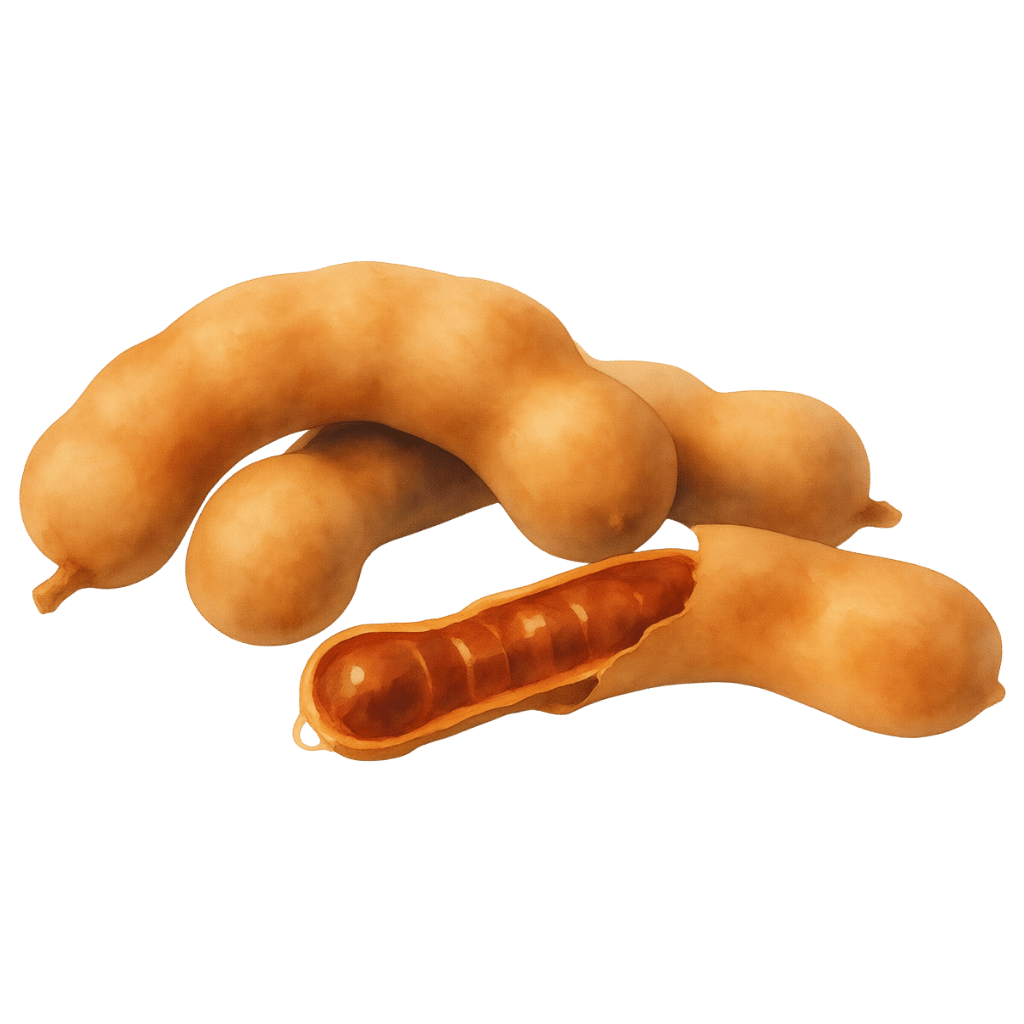
Tamarind
Tamarindus indicaVarieties
PKM 1
48° BrixUrigam
35.3° BrixManila Sweet
Prakai Thong
Sri Chomphu
Si Thong
Botanical View
- Leaves are alternate, paripinnate (even-pinnate) compound, roughly 3-15 cm long, with about 9-20 (occasionally up to ~24) pairs of small, opposite, oblong leaflets 1-3 cm long by 0.3-1.1 cm wide, glabrous (smooth) on both faces, with entire margins, a rounded-to-slightly-notched apex, and an asymmetric base sometimes fringed with fine hairs. The foliage has a soft, delicate green colour; leaflets fold together at nightfall and during intense midday heat (a nyctinastic "sleep" movement), and the crown can become briefly, partially deciduous in the hottest, driest part of the dry season before flushing again with the rains.
- The trunk is short but stout, often branching low into a cluster of ascending, later spreading and drooping limbs that build a dense, broad crown; old individuals can attain a very large girth. Bark is thick, rough, dark grey-brown to almost black, becoming deeply fissured (longitudinally and horizontally) and scaly with age. The wood is hard, heavy and dense, valued locally for tool handles, furniture and construction, and the tree also yields good firewood and charcoal.
- The tree develops a strong taproot together with wide-spreading lateral roots, an architecture that gives good wind anchorage and drought tolerance once established; Sahelian nursery guidance recommends pruning the taproot of seedlings when field-planting is delayed, to limit excessive deep-root investment before transplanting. As a legume, T. indica has been examined for rhizobial root-nodule symbiosis but is reported (e.g., in nodulation trials at the University of Ghana) as an unusual case among Fabaceae, with nodulation inconsistent or largely absent under the soil conditions tested.
- Flowers are borne in small, loose, lax racemes produced on new growth at branch tips and in leaf axils. Individual flowers are inconspicuous, only about 1-2.5 cm wide, with pale yellow to whitish petals streaked with orange-red veining; of the five petals, only the three upper ones are well developed, the two lower being reduced to minute bristles. The four sepals are pink to reddish, giving unopened buds a pink cast before the flowers open.
- Tamarindus indica is a predominantly out-crossing (allogamous), insect-pollinated, hermaphroditic species with an extremely low natural rate of self-pollination and no apomixis. Its flowers are nototribic (pollen is deposited on the visiting insect's back), which restricts effective pollen transfer to visitors with suitable body size and foraging behaviour. Bagging experiments that exclude insect visitors show wind pollination is negligible and unpollinated flowers set essentially no fruit, confirming strong dependence on animal pollination for fruit set.
- Flowers are visited and pollinated mainly by bees. Documented visitors (Burkina Faso study) include the honey bee (Apis mellifera), stingless bees (Trigona sp.), the solitary leafcutter bee (Megachile sp.), the carpenter bee (Xylocopa violacea), a paper wasp (Polistes fastidiosus), and hoverflies/bee flies (Syrphidae, Bombyliidae). Short-range foraging honey bees tend to promote near-self (geitonogamous) pollination within a tree, whereas the larger, longer-flying Xylocopa and Megachile bees carry pollen farther and are considered more important for true cross-pollination. Nectar is secreted only in the cooler hours of early morning and late afternoon, and pollen viability peaks shortly after anther dehiscence then declines quickly, concentrating effective pollinator activity into a narrow daily window.
- The species is markedly soil-tolerant, growing on substrates from deep alluvial loams to light and heavy clays, sandy or silty soils, rocky ground, and porous limestone, provided drainage is adequate; it also withstands coastal salinity. Sahelian nursery/young-plant trials report best early development on slightly acidic to near-neutral soils around pH 4.5-6.0, though field-grown mature trees tolerate a considerably wider pH range.
- In nursery beds, seedlings are grown in compost/manure mixed with sand, with a phosphate-fertilizer addition to speed root development; watering is typically applied once daily and then tapered before transplanting to harden seedlings, since waterlogging predisposes roots to asphyxiation and fungal disease. At field planting, holes are prepared about a month ahead and backfilled with roughly 1.5 kg compost/manure plus about 0.2 kg rock phosphate per hole; young trees need thorough watering at least twice weekly during the dry season for establishment. For mature trees, irrigation is applied according to site and production goals, but is often deliberately withheld for about a month around flowering, since excess water then favors vegetative growth over fruit set. Sahelian maintenance fertilization commonly uses about 100-200 g urea per tree after planting and again at the end of the rains, roughly 500 g of a nitrogen-potassium manure/fertilizer at the start of fruiting, and 2-3 kg of NPK compound fertilizer per fruiting tree, with phosphorus, potash/ashes and calcium the nutrients most often supplemented.
- Tamarind is propagated by seed and vegetatively. Seeds germinate readily (around 90% reported), usually within 1-2 weeks after a brief soak to soften the hard seed coat, and stay viable up to about 3 years in cool, dry storage (longer under refrigeration around 4-5°C); seedling-grown trees are genetically variable and slow to bear, typically fruiting only after 5-8 years (up to 10-14 in some regions). For true-to-type reproduction and much earlier bearing (often within 3-4 years), vegetative propagation is preferred: cuttings, air-layering (marcotting), shield/T-budding, side-veneer grafting, or approach grafting. In West African domestication programs, single-slot (whip) grafting, sapwood grafting and approach grafting onto 6-month-to-1-year-old seedling rootstocks achieve about 80-90% success, while sweet Thai-type cultivars are propagated almost exclusively by approach grafting (85-95% success versus roughly 5% for other methods) due to scion-rootstock compatibility issues; grafting is best done during active sap flow (about March-October in the Sahel).
- Seed and fruit traits vary widely within and between populations. Pods contain roughly 1-12 (commonly 3-10) hard, glossy, dark brown, squarish seeds set in fibrous pulp; about 2,000-2,500 dried seeds make up a kilogram. Pod length, curvature, pulp colour (pale brown to deep reddish-brown, with reddish pulp generally considered superior), sweetness/acidity, and pulp yield vary considerably with provenance and growing conditions — fruit from humid areas tends to carry proportionally more pulp than fruit from dry areas. Germplasm trials report significant phenotypic and genotypic variability (with high heritability) for pod yield, pod weight, pulp weight, and tree stature/habit (described as tall or small, spreading, semi-spreading, or upright), indicating good potential for selection-based improvement; molecular studies likewise find substantial genetic diversity across the species' range, with no immediate risk of genetic erosion given ongoing natural regeneration.
- Because most tamarind is still seed-propagated, few formally registered cultivars exist, though many named selections/accessions are held in breeding collections. Examples include Thai sweet-podded selections (marketed generically as "Makham waan"), "Manila Sweet" (distributed by USDA), and Indian selections such as "PKM 1", "Urigam", "DTS-1", "Thar Rashmi", "Goma Prateek", "Pratishthan", the "CHEST" series, and "Ajanta". ICRAF-led West African domestication work with national institutes in Mali, Burkina Faso, Niger and Senegal has selected and grafted numerous named accessions from local and introduced germplasm — e.g. "Niger 305", "Niger 309", "Nazino", "Kodiéna", "Manni" (Burkina Faso); "KTN 2", "Kibwezi", "Kitui" (Kenya); "TB 1"/"TB 2" (Brazil); "TV 2" (Vietnam); and sweet Thailand accessions — selected for pod size, sweetness/acidity, earliness, and yield. Two broad pulp-colour groups are recognized (reddish vs. brownish, reddish generally superior), and Asian accessions tend to bear longer pods with more seeds (6-12) than African/West Indian types, which tend to have shorter pods with fewer seeds (1-6).
- Tamarind has been cultivated for millennia, moving from its native tropical African dry woodlands into ancient cultivation in India (its common name derives via Arabic "tamar hindi", "Indian date") and subsequently the Middle East, Southeast Asia and, from the 16th century, the Americas. Formal breeding has advanced furthest in Asia, especially Thailand, where selection produced sweet-fleshed cultivars alongside traditional sour types, and in India, where regional selections have been released through agricultural research institutions. In Africa — the species' centre of origin and of greatest documented genetic diversity — domestication has been more recent and organized: since 1997 the World Agroforestry Centre (ICRAF), with national agricultural research institutes in Mali, Burkina Faso, Niger and Senegal, has run a Sahel-wide participatory domestication program that surveyed wild populations, selected roughly forty superior accessions for fruit size and flavor between 2005 and 2007, established a conservation/gene-bank orchard at Samanko (Mali), and introduced elite germplasm from Brazil, Kenya, Réunion, Thailand, China and Vietnam; grafted selections such as "Niger 309" have flowered within one year of planting, versus 5-8 years for ungrafted seedlings. Molecular diversity studies across ten populations spanning Africa, Asia and Indian Ocean islands found Cameroon to hold the greatest genetic diversity and confirmed clear differentiation between East and West African populations, with broad genetic diversity maintained across the species' range overall.