Back to Fruitpedia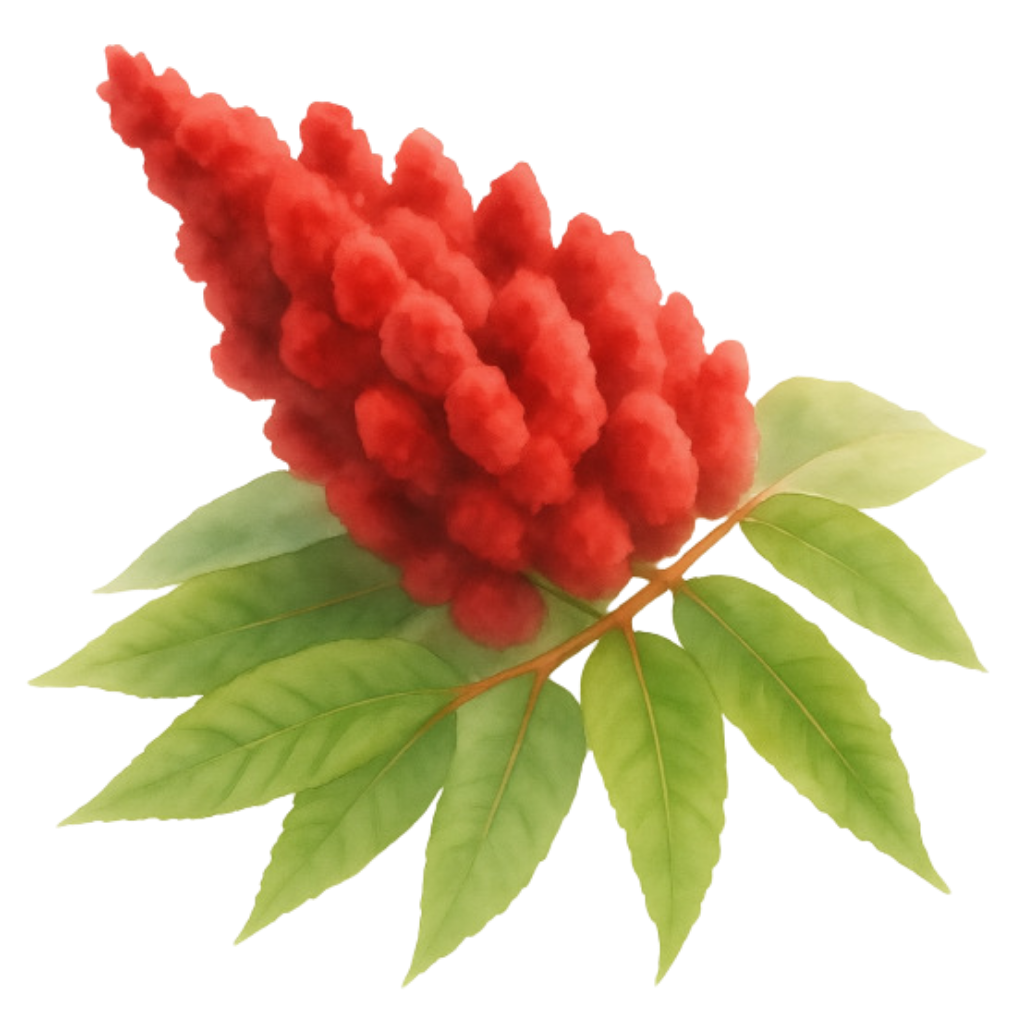
Staghorn Sumac
Rhus typhinaVarieties
Tiger Eyes
Dissecta
Laciniata
Radiance
Botanical View
- Leaves are alternate and pinnately compound, 25–55 cm (10–22 in) long, with 9–31 lance-shaped, sharply serrate (toothed) leaflets each 6–11 cm long. Leaflets are dark green and somewhat hairy above and paler, whitish and glaucous beneath. The rachis (leaf stalk) and petioles are densely covered in rust-colored velvety hairs. Foliage turns vivid shades of yellow, orange, red and purple in autumn. The cut-leaf cultivars ('Dissecta'/'Laciniata') have deeply dissected, fern-like leaflets.
- Young twigs and stems are stout, reddish-brown and densely covered with soft, velvety, rust-colored hairs (the "staghorn" texture); older twigs lose most of the hair but remain brown. Broken stems exude a white, sticky, milky sap. The pith is large and brown. Mature bark is thin, smooth to slightly scaly and grayish-brown with raised lenticels. The branching is coarse, open and forking, contributing to the antler-like appearance.
- The root system is shallow and wide-spreading, consisting of vigorous lateral roots and rhizomes that produce abundant root suckers. This clonal, rhizomatous spread allows a single plant to form extensive colonies and thickets over time, and makes the species effective for stabilizing banks and poor, disturbed soils. Suckering can be aggressive, so the roots are also considered a management concern in gardens.
- Flowers are borne in dense, erect, terminal, cone- or pyramid-shaped panicles up to about 20–30 cm (8–12 in) long. Individual flowers are small (about 5 mm across), greenish-yellow to greenish-white, and 5-merous. Because the plant is dioecious, male (staminate) and female (pistillate) panicles occur on separate plants; the female panicles are typically denser and develop into the showy fruiting clusters (infructescences).
- The species is dioecious: individual plants bear either male (staminate) or female (pistillate) flowers, so both sexes must be present for seed set. Only female plants produce the characteristic red fruit clusters. In addition to sexual reproduction by seed, it reproduces vegetatively and clonally through root suckers and rhizomes, and staghorn sumac often grows as single-sex clonal colonies.
- Pollination is chiefly by insects (entomophilous). The flowers are rich in pollen and nectar and are highly attractive to bees, including honey bees, making it a valued nectar/pollen (bee) plant; other flies and small insects also visit the flowers.
- Adaptable to a wide range of soils, including light (sandy), medium (loamy) and heavy (clay) types, and grows well in dry, poor, rocky or gravelly soils where many other plants fail. It tolerates mildly acid, neutral and mildly alkaline (basic) pH. Good drainage is important; it prefers dry to medium-moisture, well-drained soils and does not tolerate wet or poorly drained sites.
- Low-maintenance with minimal fertility and water requirements; it thrives in nutrient-poor soils and generally needs little or no supplemental fertilizer, as over-rich or over-watered conditions promote excessive, aggressive suckering. Once established it is markedly drought-tolerant and normally requires no irrigation; young plants benefit from occasional watering until established.
- Propagated by seed and, more commonly for named clones, vegetatively. Seeds have a hard coat and germination inhibitors, so they need scarification (e.g., a hot-water soak, around 80–90 °C, left to cool for about 24 hours, or acid scarification) often followed by cold stratification before sowing. Vegetative methods include half-ripe (semi-hardwood) cuttings with a heel taken in July–August, root cuttings about 4 cm long taken in winter (December) and set vertically, and division/transplanting of naturally produced root suckers in late autumn to winter. Cultivars are propagated vegetatively to stay true to type.
- Because the species is dioecious and outcrossing, seed-grown plants are genetically variable and do not come true to named cultivars, which must therefore be propagated vegetatively. The hard-coated seeds are long-lived and form a persistent soil seed bank, and germination is often improved after passage through birds or after fire/scarification. Fruit and seed set requires nearby male plants.
- Several ornamental cultivars are grown. 'Dissecta' (cutleaf staghorn sumac) and 'Laciniata' have finely dissected, fern-like foliage; 'Dissecta' holds the RHS Award of Garden Merit. Tiger Eyes ('Bailtiger', PP16185) is a popular dwarf, chartreuse-to-golden cutleaf selection with reduced suckering. 'Radiance' (sold as 'Sinrus') also holds an RHS Award of Garden Merit. The hybrid with Rhus glabra is grown as Rhus × pulvinata, including selections such as 'Red Autumn Lace'.
- Long cultivated in Europe (introduced by the 17th century) and North America as an ornamental, with selection focused on foliage form and color rather than fruit. Cut-leaf forms ('Laciniata'/'Dissecta') have been grown for well over a century. The notable modern selection Tiger Eyes ('Bailtiger') arose as a whole-plant mutation of 'Laciniata' discovered at Bailey Nurseries (Minnesota) in July 1985 and was patented (PP16185); the name combines "Bailey" and "Tiger." Breeding and selection have generally aimed at more compact, less aggressively suckering, and brighter-foliaged plants for landscape use.