Back to Fruitpedia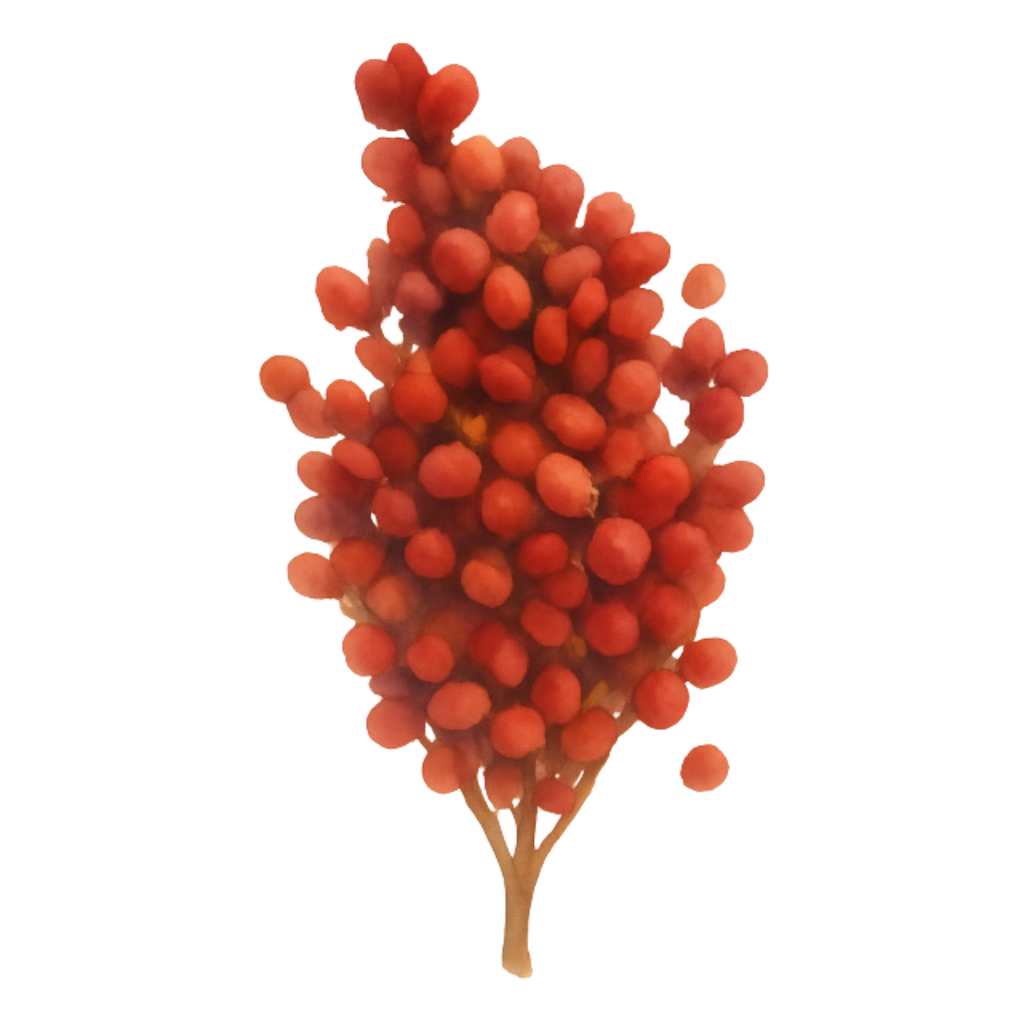
Smooth Sumac
Rhus glabraVarieties
Laciniata
Botanical View
- Leaves are alternate and odd-pinnately compound, 30–50 cm (12–20 in) long, with roughly 11–31 oppositely paired leaflets. Each leaflet is narrowly lanceolate to oblong-lanceolate, 5–13 cm long, with a serrated (toothed) margin. The upper surface is dark to yellowish-green and hairless; the underside is pale, whitened and glaucous with a waxy bloom. The rachis is smooth — neither winged nor hairy — and is often tinged red or purple. Foliage turns brilliant red in fall.
- Twigs are stout, hairless (glabrous) and typically covered with a whitish, glaucous bloom — the key trait separating smooth sumac from the velvety-twigged staghorn sumac. Bark on older trunks is brownish-gray, smooth to slightly warty and becoming shallowly fissured with age; major branches are smoother and reddish-brown. Buds are small and covered with brownish hairs. Branches are somewhat brittle and can break in strong wind.
- The root system is shallow and spreading, forming a surface plate, and is strongly rhizomatous, sending out horizontal runners that give rise to colonies of clonal shoots (root suckers). This vigorous suckering builds dense thickets, aids soil stabilization, and allows rapid regeneration after disturbances such as fire, cutting or mowing.
- Flowers are borne in dense, erect terminal panicles up to 10–25 cm (4–10 in) long on stout peduncles. Individual flowers are small (under about 6 mm across), with a yellowish-green to whitish-green corolla of 5 spreading lobes. Male flowers bear 5 stamens; female flowers have a single ovary with 3 styles. Pollinated female panicles develop into upright clusters of small red drupes densely covered with short, acidic (acrid) hairs, which persist through winter.
- The species is dioecious — individual plants bear either male or female flowers — so both a male and a female plant are required for fruit and seed set; it is not self-fertile. Alongside sexual reproduction it spreads extensively by clonal (vegetative) means through rhizomatous root suckers.
- Flowers are insect-pollinated and produce abundant, easily accessible pollen and nectar in dense clusters. Bees are the primary pollinators, including honeybees, bumblebees, carpenter bees and numerous solitary/sweat bee species; wasps and various flies also visit the flowers.
- Adaptable to a wide range of well-drained soils — light (sandy), medium (loamy) and heavy (clay) — and tolerant of poor, dry, rocky and infertile sites. It grows in mildly acidic, neutral and mildly alkaline (basic) soils, tolerating higher pH than most sumacs, and occupies habitats ranging from streambanks to dry and montane slopes.
- Thrives in low-fertility soils and generally needs no supplemental fertilization. It is highly drought-tolerant once established, prefers dry to moderately moist, well-drained conditions, and does not tolerate standing water or waterlogging. Occasional irrigation aids establishment, but mature plants require little to no watering.
- Propagated by seed and vegetatively. Seed has a hard, water-impermeable coat and requires scarification before sowing — for example a hot-water soak (steeping seed in water started at about 80–90 °C and left to cool, or 3–5 minutes in boiling water) or acid scarification — then sowing in a cold frame when ripe or in early spring. Vegetative methods include semi-ripe (half-ripe) cuttings with a heel taken in July–August, root cuttings about 4 cm long taken in early winter and set vertically, and lifting/transplanting suckers in late autumn or winter.
- Seeds exhibit physical (seedcoat) dormancy rather than physiological dormancy, and germination response is highly variable among seed sources, seedlots and even individual seeds. Optimal scarification duration differs by seedlot (e.g., roughly 4 hours of mechanical scarification or 6 hours in sulfuric acid in trials), and germination of individual clonal seedlots has ranged from about 25% to 75%, reflecting variable seedcoat permeability.
- Few cultivars exist. The most widely grown is 'Laciniata' (cutleaf/fernleaf smooth sumac), with finely dissected, ferny foliage, red petioles and orange-red fall color, vigorously suckering to about 3.5 m (12 ft). 'Cismontana' is a smaller, more drought-resistant selection reaching roughly 1.8 m (6 ft).
- Not a product of formal plant breeding; it is a wild North American native long used by Indigenous peoples, who ate the young shoots as a salad, made a tart lemonade-like beverage from the fruit, and smoked the leaves alone or blended with tobacco. It entered ornamental horticulture chiefly for its fall color and bold fruit clusters, with only a small number of selected cultivars ('Laciniata', 'Cismontana').