Back to Fruitpedia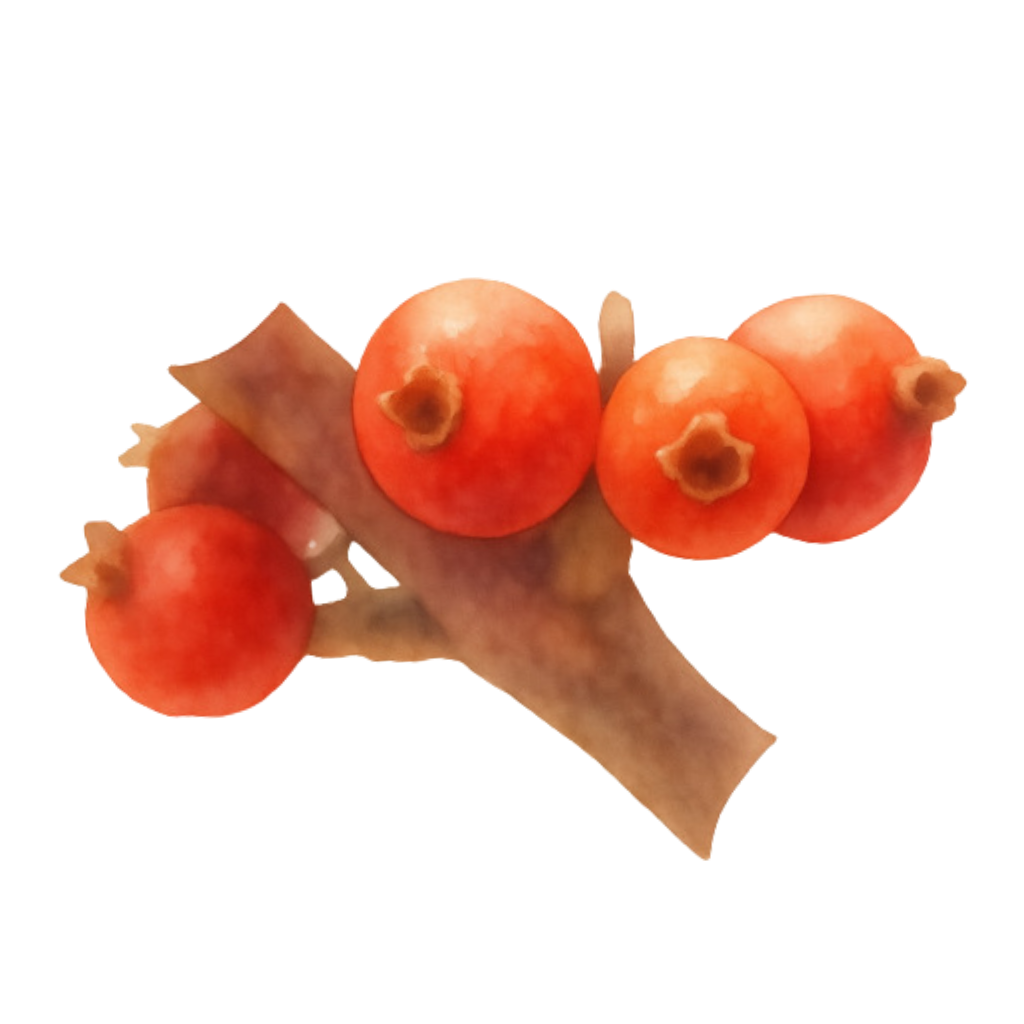
Silver Buffaloberry
Shepherdia argenteaVarieties
Sakakawea
Goldeneye
Xanthocarpa
Botanical View
- Leaves are simple and borne in opposite pairs (rarely subalternate), 2–6 cm long, oblong to narrowly oval with a rounded apex and entire margins. Both surfaces are covered with fine, silvery, silky hairs and scurfy scales, the underside more densely silvery than the upper surface, giving the foliage its characteristic silver-grey appearance. The plant is deciduous, shedding its leaves in autumn.
- Multi-stemmed, densely branched shrub with a thicket-forming habit. Branches are rigid and armed with sharp spines (short thorns up to about 5 cm / 2 in), the twigs coated in silvery scales that shed after the second season. The thin bark is greyish-brown, becoming rough, exfoliating and peeling on the lower trunk of older stems. The thorny, thicket-forming canopy provides cover and nesting sites for small birds and mammals.
- Deep, spreading, rhizomatous root system that produces root suckers, allowing the plant to form dense clonal thickets and to resprout after fire or top damage; this also makes it valuable for erosion control and soil stabilisation on slopes and in riparian zones. As an actinorhizal species it bears root nodules housing symbiotic nitrogen-fixing Frankia actinobacteria, which fix atmospheric nitrogen and enrich surrounding soil.
- Flowers are very small, tubular and apetalous, with a yellowish, 4-lobed calyx (four sepals, no petals). Because the plant is dioecious, male and female flowers occur on separate individuals: staminate (male) flowers are clustered in short axillary spikes/fascicles, while pistillate (female) flowers are borne singly or few in the leaf axils. Flowers open in early spring before or as the leaves emerge.
- Dioecious: staminate and pistillate flowers are produced on separate plants, so both male and female individuals are required for fruit set. Sexual reproduction is by seed; the species also reproduces vegetatively (clonally) through root suckers.
- Pollinated chiefly by insects, especially bees, which are drawn to the early-spring flowers as an early nectar and pollen source. Wind may also contribute to pollen transfer given the small, apetalous flowers.
- Adaptable to a wide range of soils including clay, loam, sand and shallow rocky ground. It grows best in well-drained soils and favours dry, moderately to strongly alkaline soils (tolerating pH above 8.0). It withstands poor, infertile soils, drought and salt (salt spray and saline/alkaline conditions), aided by its nitrogen-fixing symbiosis.
- Low input requirements. Because it fixes its own nitrogen through Frankia symbiosis, it needs little or no nitrogen fertiliser and can actually enrich surrounding soil. It is highly drought-tolerant once established and generally requires little supplemental irrigation, though occasional watering during establishment and prolonged drought benefits fruit production.
- Propagated by seed and vegetatively. Seed requires cold-moist stratification (about 90 days in damp sand at ~5 °C / 41 °F) for spring sowing, yielding roughly 42–54% germination; a warm pretreatment before cold stratification can aid dormancy break. Vegetative propagation is done by dividing/transplanting root suckers from established plants and by cuttings, which is often preferred to keep desired sex or cultivar traits and to guarantee female (fruiting) plants.
- Wild and open-pollinated populations are genetically variable, differing in vigour, fruit yield, suckering tendency and fruit colour. Fruit is usually bright red, but a proportion of seedlings produce orange or yellow fruit; within the open-pollinated 'Sakakawea' selection, for example, about 12–20% of plants bear yellow fruit. Sex is determined per seedling, so seed-grown plants segregate into males and females.
- Named selections are few. 'Sakakawea' (released 1983) was selected for improved horticultural traits including reduced suckering and higher, more uniform fruit yield. 'Goldeneye' and 'Xanthocarpa' are yellow-fruited selections. 'Silver Totem' is a narrow, columnar, male (non-fruiting) selection grown as a silvery ornamental. Most plantings, however, still use unselected seed-grown or wild stock.
- The species has undergone little formal domestication and is still largely used from wild or open-pollinated seed; historically its fruit was gathered by Indigenous peoples of the Great Plains and Great Basin for food, sauces and dye. The main documented breeding effort is the cultivar 'Sakakawea', released in 1983 by the USDA-NRCS with the Minnesota, North Dakota and South Dakota Agricultural Experiment Stations and developed at the Bismarck (North Dakota) Plant Materials Center from open-pollinated seed collected in Canada in 1954, selected for conservation and fruit-production traits. There is growing horticultural interest in it as a hardy, nitrogen-fixing, edible-fruited shrub for windbreaks, wildlife plantings and low-water landscapes.