Back to Fruitpedia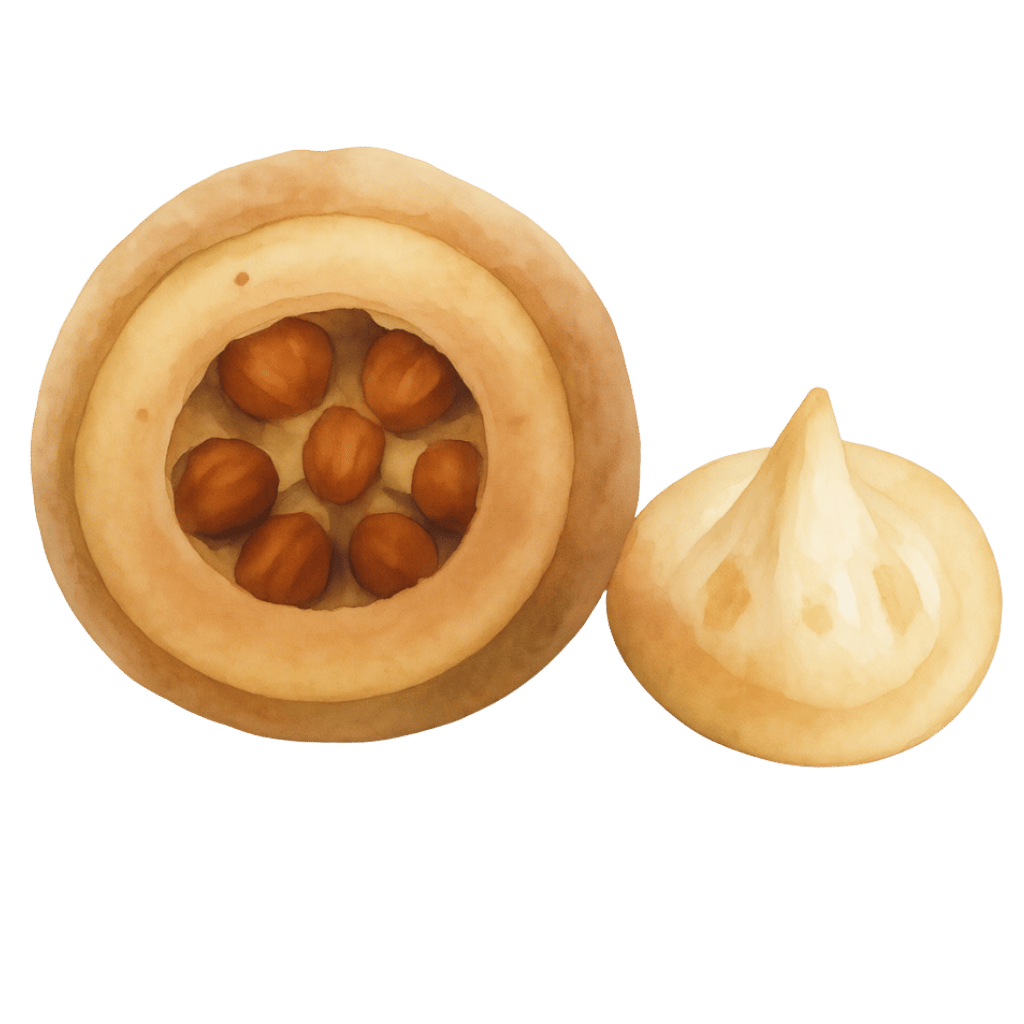
Sapucaia
Lecythis pisonisBotanical View
- Leaves are alternate, ovate to elliptic, with an obtuse-to-rounded base and an acuminate apex; margins are crenulate. They are chartaceous (thin, papery) when young, becoming coriaceous (leathery) and glabrous at maturity, with delicately impressed venation and 10-20 pairs of secondary veins. The blade measures 5-18 cm long by 3-8 cm wide, on a subwinged petiole 4-12 mm long. New leaves emerge red or soft green and darken to a glossy dark green with age; branching is dichotomous. Source: Carvalho, EMBRAPA, 2006, p. 494.
- The trunk is straight and very sturdy, with or without buttress roots, and the clear bole reaches up to 15 m long. The outer bark is dark brown and deeply fissured/grooved, forming flat, sinuous, interlaced ridges dotted with whitish lichen patches; beneath it, the inner bark is whitish. The wood is dense (specific gravity 0.85-1.00 g/cm3 at 15% moisture content); heartwood is light yellowish-brown to reddish-brown and uniform in color, with a clearly demarcated, white to pale-yellowish sapwood about 4 cm wide. Source: Carvalho, EMBRAPA, 2006, pp. 494, 498.
- Roots are described as superficial and thick. The trunk may develop buttress roots ("sapopemas") or may lack them. Source: Carvalho, EMBRAPA, 2006, p. 494.
- Flowers are borne in dense, showy terminal panicles ("panículas terminais densas, de aparência bonita"). Source: Carvalho, EMBRAPA, 2006, p. 494.
- The EMBRAPA monograph classifies the species' sexual system as monoecious ("sistema sexual: monóica"). Source: Carvalho, EMBRAPA, 2006, p. 494.
- Field studies in tree crowns of this species in southern Bahia identified the large carpenter bee Xylocopa frontalis as the presumed pollinating agent (Mori & Orchard, 1979, as cited in Carvalho, EMBRAPA, 2006, p. 494).
- Sapucaia occurs preferentially in lowland ("baixada") areas, on fertile soils that are humid and rich in organic matter. Source: Carvalho, EMBRAPA, 2006, p. 496.
- No specific fertilization or irrigation regimen for cultivation is documented in the consulted government/research sources. The species is reported to occur naturally in permanently humid, organic-matter-rich lowland soils (see Soil), which suggests it favors consistently moist, fertile conditions, but no formal fertigation protocol was found. Unknown / not documented — left blank pending a dedicated agronomic source.
- Recommended nursery practice is to sow a single seed per polyethylene bag (minimum 20 cm tall by 7 cm diameter) or in large polypropylene tubes; no pre-germination treatment is required. Germination is hypogeal (cryptocotylar); seedling emergence begins 30-90 days after sowing, with germination rates reported up to 68%, and seedlings reach plantable size about 8 months after sowing. For field/mixed-planting regeneration, direct sowing of two seeds per planting hole is used. The species also coppices vigorously, resprouting strongly from cut stumps. Seeds are orthodox in storage behavior: seed lots with 51% initial germination retained 55% germination after drying and storage at 5 degrees C, and 60% after storage at -18 degrees C. In laboratory tests, alternating temperatures of 20-30 degrees C with an 8-hour light/16-hour dark cycle on paper-roll substrate gave 54% germination. Source: Carvalho, EMBRAPA, 2006, pp. 497.
- Fruit shape is markedly variable across the species' range: a fully rounded fruit type predominates in the northern part of the distribution, while a more elongated type is more common in the south, and both types can be found within the same area — even beneath a single tree (Mori & Prance, 1983, 1990, as cited in Carvalho, EMBRAPA, 2006, p. 494). Seeds are angular and hard, though with a softer seed coat (testa) than the related Brazil nut (Bertholletia excelsa); they are smooth, reniform, dark, fusiform, with 6-12 grooves, glossy, 4-6 cm long by 2.5-3 cm wide, and enveloped in a fleshy whitish aril. Reported seed counts range from about 122 to 280 seeds per kilogram depending on the source population. Total flower production per individual tree in a southern Bahia study population ranged from 682 to 61,254 flowers (Mori & Orchard, 1979).
- No named or registered cultivars are documented in the consulted botanical/agricultural literature. Sapucaia nuts are gathered mainly from wild and semi-wild trees rather than from selected cultivated varieties (Carvalho, EMBRAPA, 2006).
- No formal breeding or cultivar-development program is documented for Lecythis pisonis. It remains essentially a wild/semi-wild resource: in Amazonia it is frequently planted near dwellings specifically to make seed harvesting easier for local and Indigenous communities, and in the cacao-growing region of southern Bahia it has traditionally been retained (not planted as a crop) as a shade tree in older cacao plantations, an agroforestry role rather than a bred orchard crop (Carvalho, EMBRAPA, 2006).