Back to Fruitpedia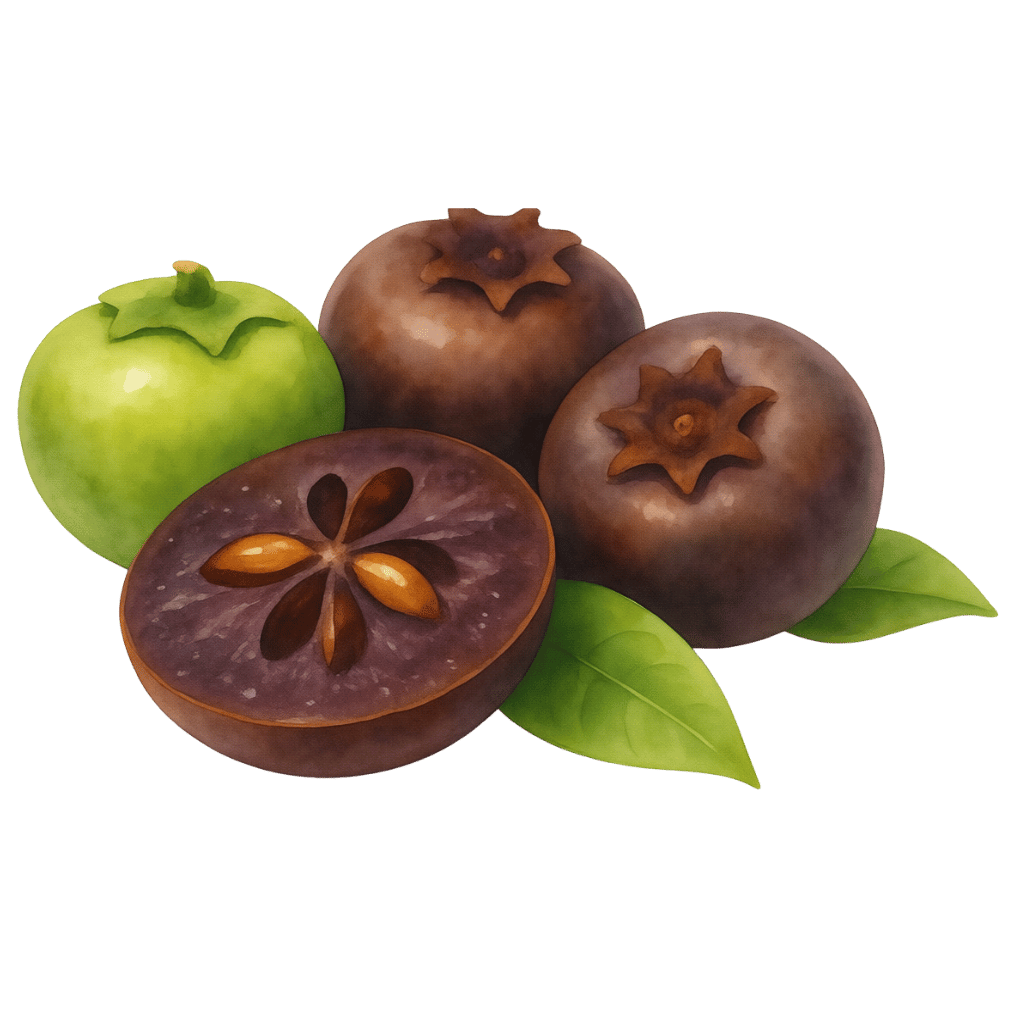
Black sapote
Diospyros digynaVarieties
Merida
Bernecker
Maher
Mossman
Superb
Cocktail
Botanical View
- Leaves are evergreen, alternate, and simple, elliptic-oblong to oblong-lanceolate, 10-30 cm (4-12 in) long, leathery (coriaceous) in texture and glossy dark green above; the leaf base is tapered or rounded and the apex bluntly acute. Young foliage may bear sparse, appressed hairs, becoming glabrous and shining above at maturity.
- The trunk is furrowed and covered in dark grey to black bark, reaching roughly 45-75 cm in diameter in mature trees. Dense branching produces the tree's characteristic broad, rounded to oblong crown. As in other Diospyros (the ebony genus), older heartwood develops a yellowish base color streaked or mottled with black, a wood quality resembling true ebony, though black sapote is grown for fruit rather than timber.
- Detailed root anatomy has not been well documented for this species. Seedlings are reported to establish a long taproot early in development, before significant elongation of the shoot. Trees tolerate periodic flooding and are moderately flood-tolerant, but prolonged waterlogging predisposes the root system to root rot, so well-drained soils are recommended.
- Flowers are borne singly or in axillary clusters, typically of 3 to 7, arising on new growth flushes. They are small, tubular, lobed, white, about 1-1.6 cm (3/8-5/8 in) wide, with a persistent green calyx. Clustered flowers are usually male (staminate), while female or perfect flowers tend to occur singly.
- Black sapote shows a mixed, polygamodioecious breeding system rather than strict dioecy: individual trees commonly bear either male flowers only, or a combination of perfect (bisexual) flowers together with purely male flowers. Perfect flowers have enlarged calyx lobes and only a faint fragrance, while male-only flowers have a more pronounced, gardenia-like scent. Because many trees are functionally male or bear few perfect flowers, fruit set can be inconsistent; unpollinated female/perfect flowers frequently develop into parthenocarpic (seedless or nearly seedless) fruit.
- Pollination is entomophilous (insect-mediated); extension sources describe the flowers as insect-pollinated without identifying a specific pollinator guild for this species. By analogy with the better-studied congener Diospyros kaki (Oriental persimmon), honeybees (Apis mellifera) and other bees are presumed to be significant visitors and pollen vectors, but dedicated pollinator studies for D. digyna are lacking.
- The species shows broad soil adaptability, growing well in sandy loam, well-drained sand, and oolitic limestone/high-pH calcareous soils, and tolerating periodic flooding. Preferred soil pH is roughly 6-7 (tolerated range about 5.5-7.5); despite tolerance of alkaline, limestone-derived soils, iron deficiency is uncommon. Good drainage is important, since waterlogged soils promote root rot.
- Young trees are commonly fertilized quarterly with a balanced formulation such as 6-6-6-2 (N-P2O5-K2O-Mg) plus minor elements, starting at about 0.1 kg (0.25 lb) per application; mature trees receive roughly 1.4-2.3 kg (3-5 lb) per application, 2-3 times per year. Newly planted trees need frequent irrigation (every other day for about the first week, then 1-2 times weekly for the first couple of months); established trees are moderately drought-tolerant and need supplemental water mainly during prolonged dry spells, but require abundant irrigation in regions with a pronounced dry season, since they are otherwise sensitive to drought stress.
- Trees are propagated from seed, which remains viable for several months in dry storage and germinates in about 2-4 weeks (roughly 30 days) at warm temperatures (around 25-30°C); seedlings are slow to bear, taking 5-6 years to flower. For named cultivars, air-layering (marcottage), shield-budding, and grafting onto seedling rootstock are used to preserve fruit quality, shorten the juvenile period to about 2-3 years, and control tree size.
- Seed number per fruit varies considerably: standard seedling fruit contains multiple seeds, while some individual trees and selected cultivars bear seedless or nearly seedless fruit through parthenocarpy, often coinciding with fruits that mature earlier (summer rather than the typical winter crop) and grow unusually large. Seeds that are produced remain viable for only a few months under dry storage and germinate within about 30 days when fresh.
- Named selections are propagated (grafted or budded) from superior seedlings rather than produced through formal breeding programs. Florida cultivars documented by UF/IFAS extension include 'Merida' (7-16 oz fruit, ripening early November to January), 'Bernicker' (few seeds, prolific bearer), 'Mossman' (large fruit with few seeds), and 'Superb' (nearly seedless); most commercial and dooryard trees elsewhere, including in Mexico, remain seedling-grown and unnamed.
- Black sapote is native to the lowland forests of Mexico (Jalisco to Chiapas, Veracruz, and Yucatán) and Central America, extending into Colombia in northern South America, where it has been consumed by indigenous peoples since pre-Columbian times (known to the Maya as "tauch"). Spanish colonizers carried the species from Mexico to the Philippines and to Amboina (Indonesia) before 1692, and it was later introduced to Florida and other tropical/subtropical regions in the 20th century. The crop has not undergone formal, systematic breeding programs; existing cultivars arose from clonal selection of superior wild or seedling trees (favoring reduced seed number, larger fruit, and productivity), and in parts of western Mexico the species is described as still undergoing an informal domestication process driven by traditional selective cultivation rather than controlled breeding.