Back to Fruitpedia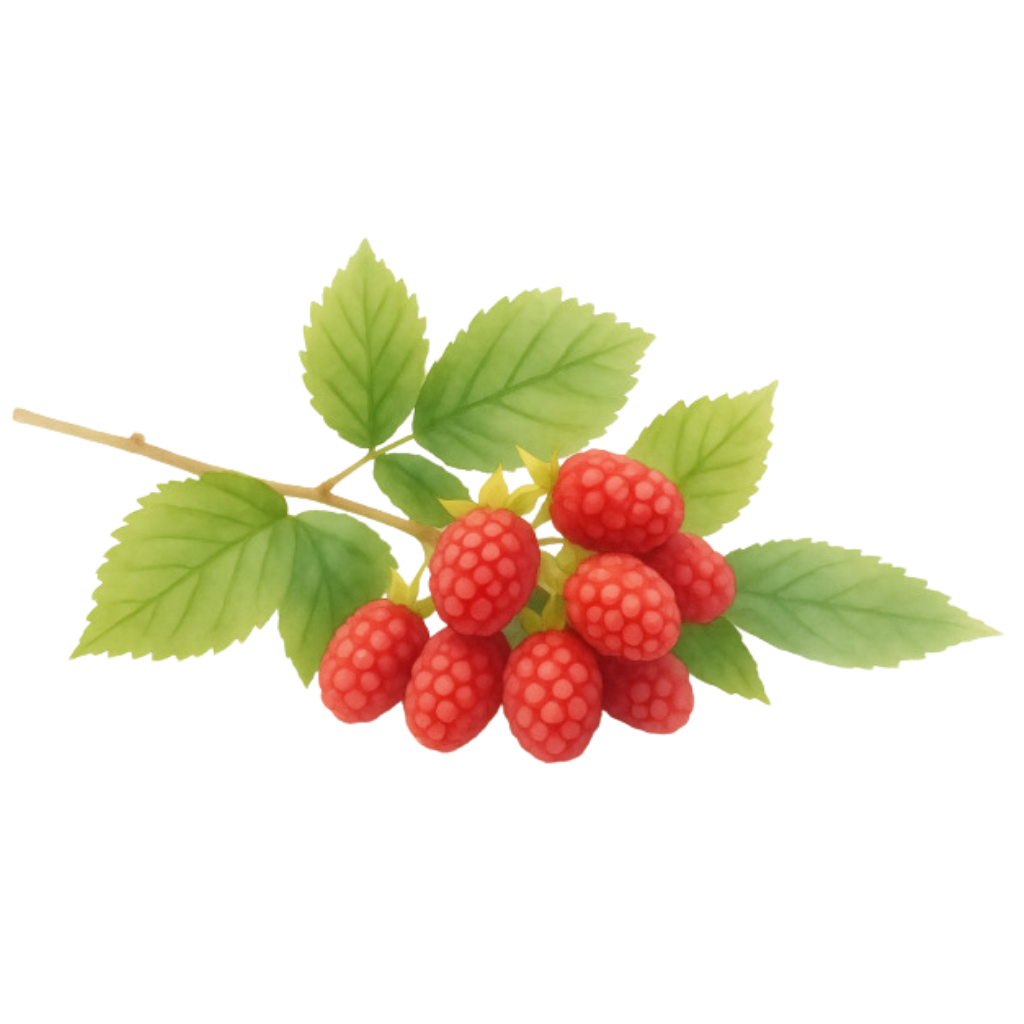
Salmonberry
Rubus spectabilisVarieties
Olympic Double
Botanical View
- Leaves are deciduous, alternate, and trifoliate (three leaflets), 7–22 cm (about 3–8.5 in) long. The terminal leaflet is larger than the two lateral leaflets, which are sometimes shallowly and unequally lobed. Leaflet margins are sharply toothed to doubly serrate. The upper surface is smooth to slightly hairy; the undersides are typically paler and more hairy.
- Stems (canes) are perennial and woody (not biennial as in many other brambles), erect to arching, and golden to yellowish-brown with shedding/exfoliating bark. New growth is typically covered with fine prickles, though armature varies from nearly unarmed to very bristly; smaller twigs zigzag slightly between nodes. Canes commonly form dense thickets.
- The root system is rhizomatous, spreading by branching underground rhizomes. Sprouting buds occur on the rhizomes, stumps, and root crowns, allowing vigorous vegetative regeneration; roots usually survive disturbance such as fire even when the top growth is killed, and about 30–40% of the plant's biomass is underground.
- Flowers are borne singly or in small clusters of 2–3. Each flower is 2–3 cm in diameter, with five hairy sepals and five pinkish-purple (magenta) petals surrounding roughly 75–100 stamens and numerous pistils with superior ovaries. Flowers are perfect (bisexual). The resulting fruit is an aggregate of many drupelets on a receptacle.
- Flowers are perfect (hermaphroditic) but are reported to be largely self-incompatible, requiring cross-pollination to set full fruit. Reproduction is sexual (the species is a diploid, 2n=14, in subgenus Idaeobatus), supplemented by extensive clonal spread via rhizomes and root-crown sprouting.
- Pollinated primarily by insects (including bees and beetles) and by hummingbirds. Its early spring bloom coincides with the northward spring migration of Rufous and other hummingbirds, which are important pollinators of the nectar-rich flowers.
- Prefers consistently moist to wet, humus-rich and nitrogen-rich soils; it is a facultative wetland species (FAC+) equally likely in wetlands or uplands. It tolerates light (sandy), medium (loamy), and heavy (clay) soils and prefers well-drained but moist conditions. Optimal pH is about 5.0–6.5 (acidic to near-neutral), with tolerance reported across roughly pH 4.5–8.5.
- Requires consistently moist soil and does not tolerate prolonged drought; it thrives on nitrogen-rich sites and is often associated with the nitrogen-fixing red alder (Alnus rubra), so it is well supplied with nitrogen in its natural habitat. As a predominantly wild-harvested species it is rarely irrigated or fertilized commercially; where cultivated, it benefits from organic-rich soil and reliable moisture.
- Propagated both by seed and vegetatively. Seeds are dispersed by birds and mammals in their feces; germination is improved by warm stratification for about 90 days followed by cold stratification at about 40°F (4°C) for 90 days, and scarification (e.g., sulfuric acid or sodium hypochlorite) can further aid germination. It is easily propagated vegetatively by cuttings, layering, or division, and sprouts readily from rhizome and root-crown buds.
- Each aggregate fruit contains roughly 17–65 seeds. The species shows notable fruit-color polymorphism, with red and yellow-orange morphs that otherwise have similar physical qualities; seed-grown plants are genetically variable, as expected for a sexually reproducing outcrossing species.
- Selections are ornamental rather than fruiting cultivars. The best known is 'Olympic Double' (formerly sold as 'Flore Pleno'), a double, magenta-rose flowered form found on the Olympic Peninsula, Washington in 1971; a double-flowered clone is also known from Washington and British Columbia. 'Golden Ruby' has golden foliage with simple pink flowers and red fruit, and 'Gun Hildi' and 'Olympic Flame' are similar double/ornamental forms.
- Salmonberry has not been domesticated as a commercial fruit crop; it remains largely wild-harvested and was a traditional food of Pacific Northwest Indigenous peoples. Human selection has produced only ornamental forms (notably the double-flowered 'Olympic Double'). It is nonetheless a valued genetic resource in the genus: a diploid wild species in subgenus Idaeobatus of interest to Rubus breeding programs, which have focused primarily on raspberries and blackberries.