Back to Fruitpedia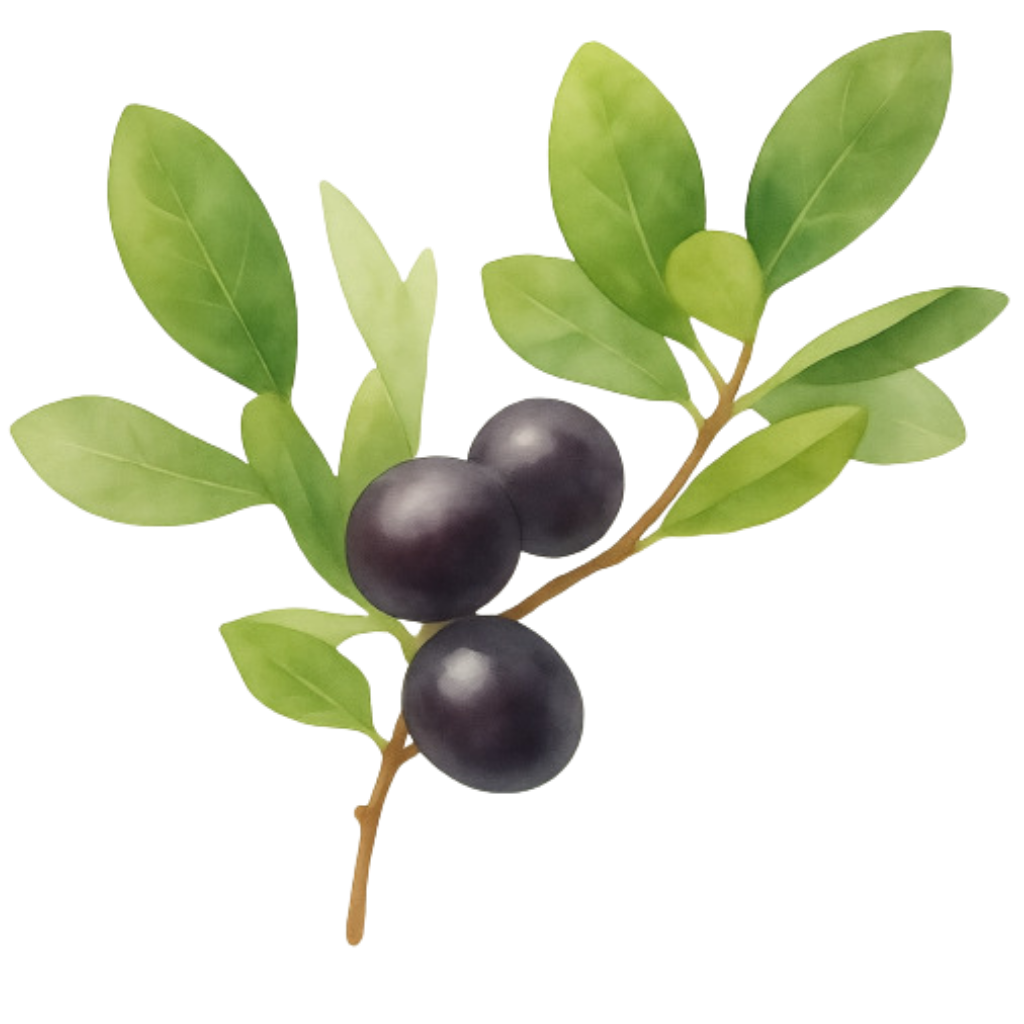
Salal
Gaultheria shallonBotanical View
- Leaves are alternate, evergreen, thick and leathery, ovate to ovate-elliptic, and 5-10 cm (2-4 in) long, with finely and sharply serrulate (serrate) margins. They are glossy dark green above and paler, rougher, and lighter green beneath. Individual leaves generally persist about 2-4 years before being shed.
- Stems are erect to spreading and pilose to hirsute, with branchlets that are glandular to pubescent. Twigs are reddish-brown with shredding bark and can survive 16 years or longer, but bear leaves only during their first few years.
- Most of the plant's biomass is underground as an extensive but variable network of roots and rhizomes concentrated in the upper soil layers. Creeping rhizomes give rise to new aerial shoots, allowing clones to spread and persist; rhizomatous portions of individual plants can live for hundreds of years. As a member of the Ericaceae, salal forms ericoid mycorrhizal associations.
- Small, urn-shaped (urceolate), five-lobed flowers are borne in showy, one-sided (secund) bracteate racemes of roughly 5-15 flowers on terminal and subterminal shoots in the upper leaf axils. The rachis is reddish to salmon-colored and the flowers are sticky and glandular, colored white to pink or deep rose. The fruit is a fleshy, dark purple to blue-black berry-like structure (a pseudoberry formed by the swollen, fleshy calyx enclosing the capsule), each averaging about 126 small (~1 mm), brown, reticulate seeds.
- Flowers are hermaphroditic (perfect/bisexual). The species reproduces both sexually by seed and vegetatively (clonally) by rhizomes, layering, suckers, and stolons, with clonal spread generally predominating in established stands. Details of its compatibility/breeding system beyond the hermaphroditic flowers are not well documented.
- Flowers are insect-pollinated, chiefly by bees and flies, and are also visited and pollinated by hummingbirds.
- Grows on a wide range of mineral and organic substrates, including shallow rocky soils, sand dunes, coarse alluvium, glacial till, and peat, over diverse parent materials such as granite, serpentine, and metamorphic rock. Growth is generally best on moist sandy or peaty soils; it tolerates nutrient-poor to moderately rich and acidic soils and commonly establishes on decaying wood and stumps.
- Drought-tolerant once established and generally requiring no supplemental irrigation in its moist maritime native range, though it grows best on consistently moist soils. In commercial floral-greenery production, nitrogen fertilization (about 100 lb N per acre) has been reported to increase salable shoot yield by roughly 50-150 bunches per acre.
- Propagated both by seed and vegetatively. Seed germinates well under light (requiring at least about 8 hours of light per day), typically beginning within about 27-45 days. Vegetative propagation is by division of established clumps and by root, stem, or rhizome cuttings (best results from cuttings taken in late summer), as well as by layering, suckers, and stolons; initial growth is slow.
- Seed production is prolific, averaging about 126 seeds per fruit, with cleaned seed averaging roughly 3,209,000 per pound; seeds are small (~1 mm), brown, and reticulate. Laboratory germination is generally good (up to about 73%), but viability declines in storage (for example, from about 31% to 21% after one year at 40 degrees F). Populations vary geographically in flowering phenology and morphology.
- Grown largely as the wild species rather than from numerous named garden cultivars, and most horticultural and floral-greenery material is wild-type. A few modern tissue-culture selections have been patented (for example the 'Gaulsidh' series and 'Gaulbri 1'). The species is also a parent of the garden hybrid Gaultheria x wisleyensis (formerly x Gaulnettya wisleyensis; e.g., 'Wisley Pearl'), a cross with Gaultheria mucronata.
- Introduced to Britain from western North America by David Douglas in 1828 as an ornamental. Commercial harvest for the floral-greenery industry began in the late 1940s, and over roughly 15 years salal became the leading Pacific Northwest florist green (marketed as "lemon leaf" in the eastern U.S.), displacing red huckleberry. Directed cultivar breeding is limited and recent, involving a few patented tissue-culture selections; historically the plant has been used essentially as the wild species.