Back to Fruitpedia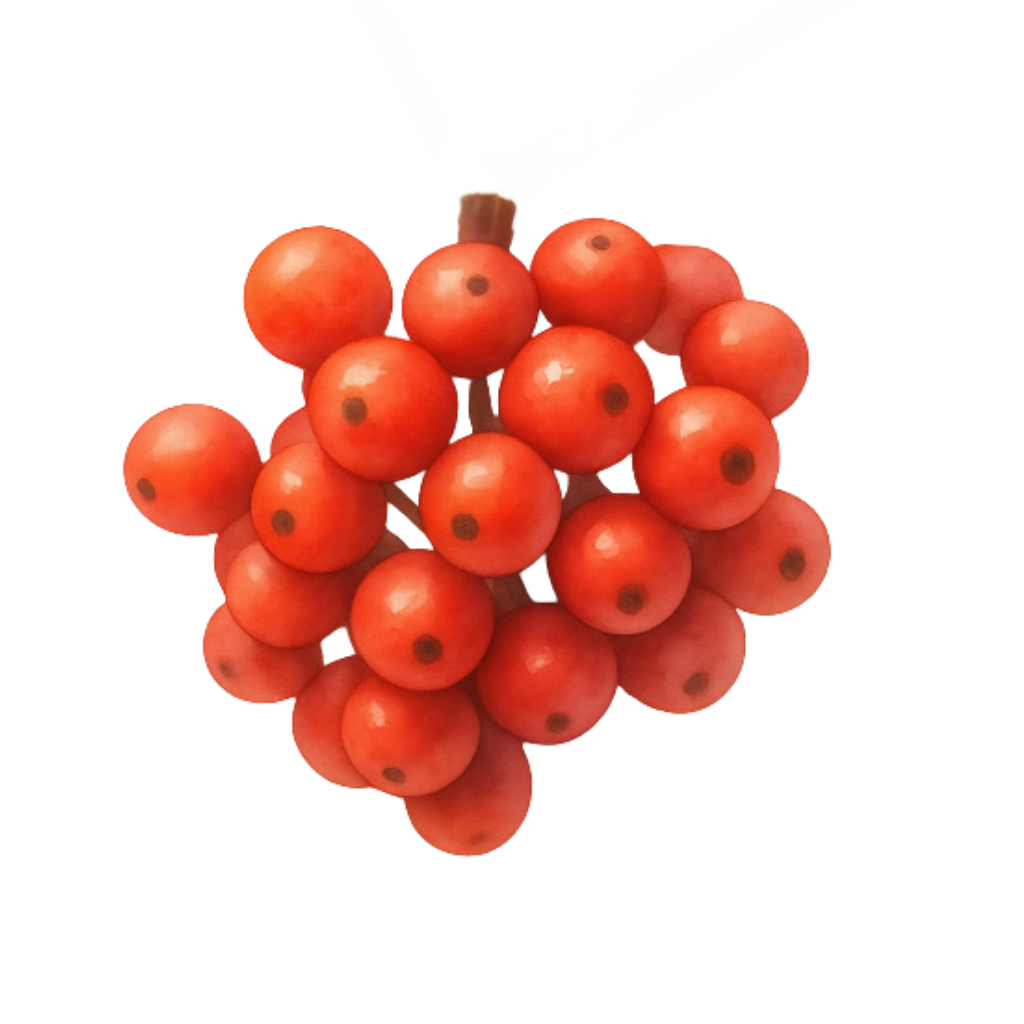
Russet Buffaloberry
Shepherdia canadensisBotanical View
- Leaves are opposite, deciduous, oval to narrowly ovate or egg-shaped, short-stalked, and about 2-6 cm (roughly 0.5-2.5 in) long (USDA NRCS Plant Guide; The Morton Arboretum). The upper surface is dark green, while the lower surface is densely covered with whitish, silvery scale-like hairs interspersed with scattered rusty-brown scales, a scaly indumentum typical of the Elaeagnaceae (USDA NRCS Plant Guide; The Morton Arboretum).
- Russet buffaloberry is a many-branched, deciduous shrub typically 0.9-3.9 m (3-13 ft) tall, with an open, rounded growth habit and a slow growth rate; mature stems are brown and slightly scaly (USDA NRCS Plant Guide; The Morton Arboretum). Unlike the related silver buffaloberry (Shepherdia argentea), which bears a thorn at the tip of short branches, S. canadensis stems are unarmed and lack spines, prickles, or thorns (Native Plant Trust, Go Botany; Oregon State University Landscape Plants).
- Shepherdia canadensis is an actinorhizal, nitrogen-fixing shrub whose roots form a symbiosis with the filamentous soil actinobacterium Frankia, producing coralloid nodule clusters on fine lateral roots (USDA Forest Service Proceedings RMRS-P-21, Walls & Zamora 2001). In field-collected plants sampled in the Northern Intermountain region, 100% of shrubs examined were nodulated, with nodule clusters (mean diameter about 19 mm) forming almost entirely (80%) on lateral roots immediately below the root crown; the nodules characteristically branch in a single plane, producing distinctive fan-shaped clusters (Walls & Zamora 2001). The species lacks a single, distinct taproot; main lateral roots branch immediately below the crown, and root architecture has otherwise been described as fibrous and shallow to rhizomatous with deeper underground parts, reflecting variation across its wide geographic range (USDA Forest Service FEIS; Walls & Zamora 2001). Nodulation is most abundant in nutrient-poor, sandy soils, and the nitrogen-fixing symbiosis allows the shrub to colonize disturbed, nitrogen-deficient sites, creating a localized "island of fertility" that benefits neighboring vegetation (USDA Forest Service FEIS).
- Flowers are small, inconspicuous, and produced in short axillary clusters on the previous year's wood, appearing before or as the leaves emerge in early spring (USDA NRCS Plant Guide; PMC — "Demographic effects on fruit set in the dioecious shrub Canada buffaloberry"). Staminate (male) flowers are brownish-yellow and disk-shaped, offering both pollen and nectar; pistillate (female) flowers are yellowish-green and funnel-shaped, offering only nectar (The Morton Arboretum; PMC study). Flowers are apetalous, with a small four-lobed calyx typical of the Elaeagnaceae (USDA NRCS Plant Guide).
- The species is dioecious, with staminate and pistillate flowers borne on separate individual shrubs, though occasionally monoecious individuals occur (USDA Forest Service FEIS; USDA NRCS Plant Guide). Anthesis in pistillate plants typically begins three to seven days earlier than in staminate plants (USDA Forest Service FEIS). Because both sexes are required for fruit set, and pollinators appear largely unable to discriminate between male and female flowers, fruit production in natural populations is frequently pollen-limited and correlates positively with the density of nearby male shrubs within a few meters (PMC — "Demographic effects on fruit set in the dioecious shrub Canada buffaloberry"). Studied populations have shown a slight, though not statistically significant, female-biased sex ratio (same source).
- Pollination is carried out almost entirely by dipteran (fly) insects — about 97% of floral visits — predominantly hoverflies (Syrphidae) and dance flies (Empididae), with lesser contributions from Hymenoptera (bees/wasps) and Hemiptera (true bugs) (PMC — "Demographic effects on fruit set in the dioecious shrub Canada buffaloberry"). Individual pollinators visit an average of about six flowers per plant, spend roughly nine seconds per flower, and show a re-visitation rate of about 25%, indicating largely localized foraging behavior (same source).
- The species tolerates a wide range of generally poor, well-drained soils, characteristically growing on sandy, gravelly, or rocky substrates, including riverbanks, shores, dry to moist rocky slopes, open rocky woods, and occasionally calcareous marshes (USDA NRCS Plant Guide; USDA Forest Service FEIS). Its nitrogen-fixing symbiosis with Frankia allows it to thrive on nutrient-poor, disturbed soils where mineral nitrogen is limiting, and nodulation is most abundant in nutrient-poor sandy soils (USDA Forest Service FEIS; USFS Proceedings RMRS-P-21). It prefers moist to wet soil conditions but also occurs on dry sites, growing in partial shade to full sun (USDA NRCS Plant Guide).
- No cultivated fertilization or irrigation regime is documented for this species in agricultural or extension literature; owing to its actinorhizal nitrogen-fixing capacity, it is generally not dependent on soil nitrogen fertility and is instead used to improve nutrient-poor soils in reclamation and revegetation of disturbed forest and rangeland sites (USDA Forest Service FEIS; USFS Proceedings RMRS-P-21, Walls & Zamora 2001). In related actinorhizal shrubs, nodule formation and nitrogen-fixing activity are known to decline under both soil-moisture deficit and waterlogging, and nitrogen fertilizer additions can inhibit nodulation, indicating the species is best suited to well-drained, unamended soils rather than fertilized or heavily irrigated conditions (USFS Proceedings RMRS-P-21).
- Propagation is primarily by seed. Seeds should be collected in autumn and not allowed to dry out; they have a hard seed coat that benefits from scarification (e.g., sulfuric acid treatment for 20-30 minutes) followed by two to three months of cold, moist stratification to promote embryo development and germination (USDA NRCS Plant Guide, citing Dirr & Heuser 1987). Acid-scarified seed has achieved germination rates of 72-80% (USDA Forest Service FEIS), whereas untreated seed shows poor, highly erratic, or delayed germination (same source). Seedlings are typically grown in individual pots in a cold frame before outplanting the following spring or summer (USDA NRCS Plant Guide). Vegetative propagation is possible from root cuttings, whereas stem cuttings have generally been unsuccessful; containerized transplants have also been used successfully in restoration plantings in Ontario and Alaska (USDA Forest Service FEIS). In the wild, the shrub also regenerates vegetatively via sprouts from surviving root crowns and dormant buds on the root system, notably after fire, though it is not considered an aggressive re-sprouter (USDA Forest Service FEIS).
- Plants begin producing seed at about 4-6 years of age, with good seed crops generally produced annually thereafter (USDA Forest Service FEIS). Germination is naturally poor, highly erratic, and often delayed due to a hard, impermeable seed coat, requiring a minimum of about 60 days of cold stratification (and typically scarification) to break dormancy (USDA Forest Service FEIS). Seeds are also noted to be highly susceptible to greenhouse/nursery pathogens during propagation (same source). One naturally occurring color variant, forma xanthocarpa Rehder, produces yellow rather than red fruit (USDA Forest Service FEIS).
- No widely recognized, formally released horticultural cultivars of Shepherdia canadensis are documented in USDA plant materials literature; the species remains largely undomesticated and is propagated from wild-collected seed, available only occasionally through native plant nurseries within its range (USDA NRCS Plant Guide). The only named botanical variant is the naturally occurring yellow-fruited form, Shepherdia canadensis forma xanthocarpa Rehder (USDA Forest Service FEIS).
- Shepherdia canadensis has not undergone formal plant breeding or selective improvement programs; it remains an essentially wild, undomesticated shrub, propagated from wild-collected seed and offered only occasionally by native plant nurseries within its natural range (USDA NRCS Plant Guide). Historically, the species held ethnobotanical importance to numerous Indigenous peoples of North America: the Wet'suwet'en used twigs, leaves, berries, and juice medicinally, and berries were whipped with water into a frothy dessert known as "Indian ice cream," traditionally sweetened with salal berries, camas bulbs, or hemlock cambium; the Salish and Kootenai peoples used a decoction of debarked branches as an eyewash (USDA NRCS Plant Guide, citing Moerman 1998 and Pojar & MacKinnon 1994). More recent research interest has centered on its actinorhizal nitrogen-fixing capacity for use in reclamation and revegetation of disturbed forest and rangeland sites in western North America, rather than on horticultural breeding (USFS Proceedings RMRS-P-21, Walls & Zamora 2001).