Back to Fruitpedia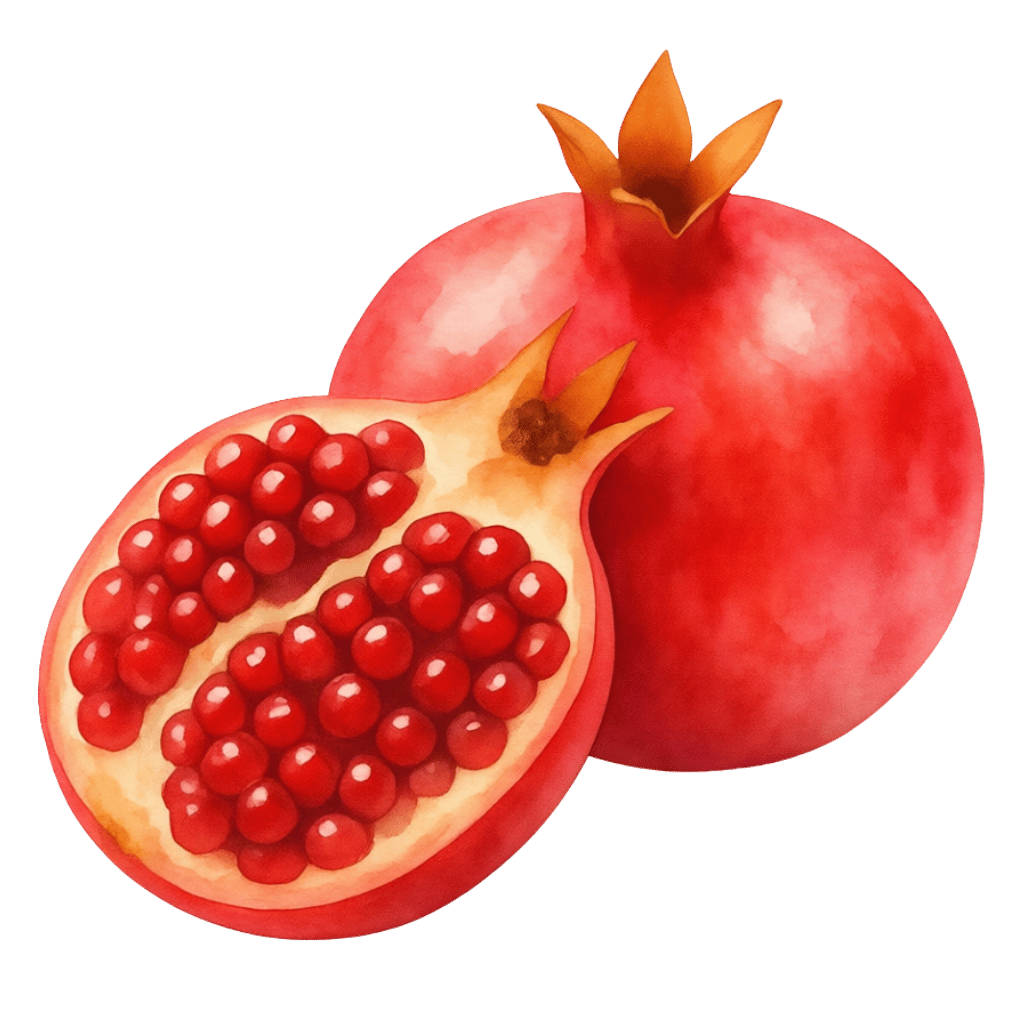
Pomegranate
Punica granatumVarieties
Wonderful
15–17.6° BrixParfianka
Angel Red
Bhagwa
15.9–16° BrixGanesh
16–16.2° BrixMollar de Elche
13.5–17.6° BrixBotanical View
- Leaves are simple, opposite to subopposite (occasionally in whorls), glossy, leathery, oblong-lanceolate, about 1-10 cm long, with entire margins and short petioles; foliage is deciduous or semi-evergreen depending on climate.
- A much-branched, multi-stemmed shrub or small tree, often spiny/thorny particularly in wild or seedling forms, with grayish-brown bark; strong basal suckering produces a dense, rounded, thicket-forming canopy.
- The root system is shallow and laterally spreading, with maximum root activity generally concentrated within the top 30-60 cm of soil and within about 30-60 cm radial distance from the trunk; deeper soil layers (below ~60 cm) show little root activity. Plants sucker readily from the root crown, contributing to a multi-stemmed growth habit.
- Showy, actinomorphic flowers about 3 cm wide are borne singly or in clusters of up to five at branch tips. Each flower has a thick, tubular, red-orange calyx with 5-8 fleshy, pointed sepals, 3-7 crumpled petals (red, white, or variegated), and numerous stamens.
- Andromonoecious: a single plant bears both hermaphrodite (bisexual) flowers and functionally male flowers (with atrophied ovaries), with male flowers sometimes making up 60-70% of total flowers depending on cultivar, climate, and season. The species is capable of both self- and cross-pollination; self-pollination has been reported to give around 45% fruit set versus about 68% with cross-pollination. Pollen viability is generally lower in male flowers than in hermaphrodite flowers.
- Pollination is carried out mainly by bees, with butterflies and other insects also visiting the showy, nectar-rich flowers; wind pollination is negligible.
- Highly adaptable to a wide range of soil types, thriving on calcareous, alkaline soils as well as deep, acidic loams. Well-drained soil is important, as poor drainage promotes root and fruit rot; the species also tolerates moderate soil salinity.
- Irrigation is essential for good fruit set, size, and yield, particularly during establishment and dry periods; drip irrigation is commonly used and helps limit nitrate leaching. Nitrogen requirements for mature orchards are approximately 62-112 kg N/ha depending on planting density, applied mainly from late winter through late spring during flowering and fruit set. The species tolerates brackish irrigation water and moderate soil salinity, but overwatering or poor drainage promotes fungal disease and fruit cracking.
- Commercial propagation is predominantly vegetative, using hardwood cuttings (about 25-50 cm long), often treated with indole-3-butyric acid (around 50 ppm) to improve rooting; air-layering and transplanted root suckers are also used. Seed propagation is used mainly for breeding and rootstock purposes, since seedlings are highly variable and not true-to-type.
- Because pomegranate is highly heterozygous, seed-grown (sexually propagated) plants show substantial genetic and phenotypic variability and do not come true-to-type from seed. Genomic studies show clear divergence between soft-seeded and hard-seeded cultivar groups, reflecting the influence of geography, domestication, and selection history; commercial cultivars are therefore maintained through clonal (vegetative) propagation rather than seed.
- More than 500 named cultivars exist worldwide, differentiated mainly by seed hardness, fruit color, and climate adaptation. Widely grown cultivars include 'Wonderful' (the industry standard in the USA and Israel), 'Bhagwa'/'Phule Bhagwa' and 'Ganesh' (leading soft-seeded Indian cultivars), 'Mridula', 'Angel Red', 'Kandhari', and 'Spanish Ruby'. Ornamental/dwarf forms include Punica granatum var. nana and double-flowered forms such as 'Multiplex' and 'Pleniflora'.
- Domesticated roughly 5,000 years ago in a region spanning the Iranian plateau, Caucasus, and Central Asia (modern Iran, Turkmenistan, Afghanistan), one of the earliest fruit trees domesticated in the Near East; archaeobotanical evidence includes dried fruit from Bronze Age tombs at Jericho and in Cyprus. It spread along ancient trade routes through the Mediterranean, Middle East, and South Asia. Modern breeding programs are maintained by ICAR-National Research Centre on Pomegranate (Solapur, India), the Agricultural Research Organization at Newe Ya'ar (Israel), a germplasm collection at the Agricultural Experiment Station of Elche (Spain), and University of California research stations. Reference genomes (e.g., cv. 'Bhagawa', cv. 'Wonderful') and molecular markers are now used alongside conventional selection to improve productivity, seed softness, and disease resistance; over 500 cultivars have been named worldwide.