Back to Fruitpedia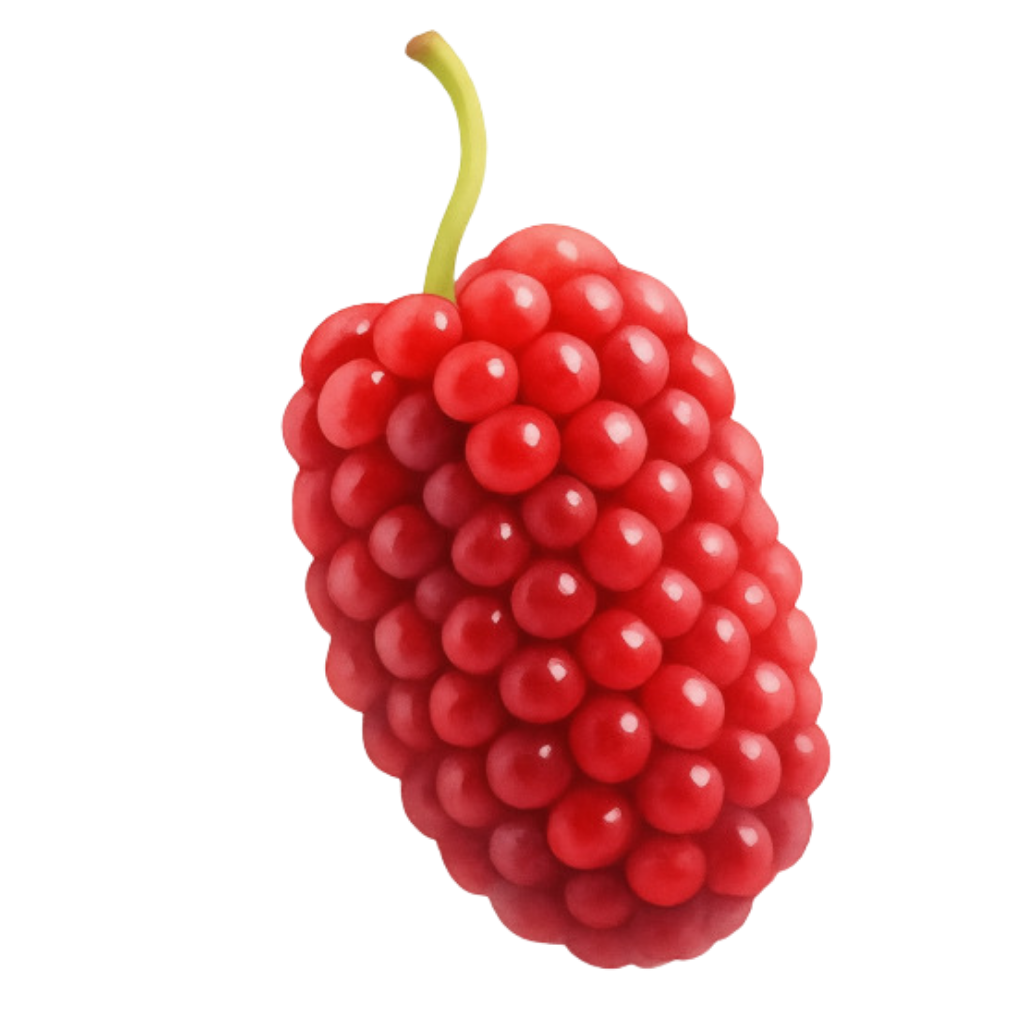
Red Mulberry
Morus rubraVarieties
Illinois Everbearing
Silk Hope
Collier
Travis
Hicks Everbearing
Gerardi Dwarf
Botanical View
- Leaves are alternate, simple, and deciduous, generally 7-18 cm long (rarely to 36 cm) and 8-12 cm broad, roughly twice the size of white mulberry leaves. The blade is ovate to broadly heart-shaped with a toothed (serrate) margin and a pointed tip, and is highly variable, ranging from unlobed to two- or three-lobed (mitten- or glove-shaped); lobed leaves occur more often on vigorous new shoots and unlobed leaves in the crown. The upper surface is noticeably rough, like fine sandpaper, while the underside is densely soft-hairy. Cut petioles exude milky sap, and the foliage turns yellow in autumn.
- Trunk relatively short with a spreading crown of stout, somewhat crooked branches; the bark is grayish-brown, becoming ridged and furrowed with age and often shedding in narrow, scaly plates. Young twigs are slender, greenish-brown, and contain milky sap; wood is soft to moderately hard and durable.
- The root system is extensive and shallow, dominated by lateral, horizontal roots concentrated in roughly the upper 60 cm (24 in) of soil, combined with smaller vertical roots. This structure provides anchorage and efficient uptake of surface-soil moisture and nutrients, contributing to establishment across diverse soils.
- Flowers are borne in pendulous, catkin-like spikes. Male (staminate) flowers are grouped in slender, elongated, drooping catkins, while female (pistillate) flowers form shorter, tighter, cylindrical clusters. Individual flowers are small, inconspicuous, and yellowish- to reddish-green. The fruit that develops from a female cluster is a compound (multiple) aggregate 2-3 cm long, made of many small achenes each surrounded by a fleshy calyx, blackberry-like, ripening from pale green through red to dark purple.
- Predominantly dioecious, with male and female flowers on separate trees, though it is occasionally monoecious (both sexes on the same plant). The species is generally not self-fertile, so fruit set typically requires nearby trees, and it is capable of hybridizing with the introduced white mulberry (M. alba).
- Wind-pollinated (anemophilous). The small, greenish flowers offer little nectar and are not adapted to attract insect pollinators; pollen is dispersed by air currents from male catkins to female flowers.
- Grows on a wide range of soils including clays, sands, and loams, and tolerates a broad range of soil pH. It performs best in rich, moist, well-drained soils typical of mesic hardwood forests, floodplains, and bottomlands, but adapts to drier and poorer sites.
- Requer umidade adequada do solo, especialmente durante o estabelecimento e a frutificação, embora árvores estabelecidas tolerem períodos secos moderados. Responde a solos férteis e ricos em matéria orgânica. Informação específica sobre regimes de adubação e irrigação comercial de Morus rubra é limitada.
- Propagated readily by seed and by cuttings. Seeds are collected from ripe fruit in summer and benefit from cold stratification at about 4 C (40 F) for 2-3 months, after which germination occurs within roughly 1-2 weeks. Secondary hardwood cuttings taken in summer can be rooted under intermittent mist with rooting hormone (e.g., IBA) and warm soil temperatures around 21-27 C (70-80 F). Grafting is also used, and grafted trees fruit years earlier than seedlings.
- Seedlings are genetically variable, reflecting the outcrossing, wind-pollinated breeding system; leaf shape and other traits vary considerably. Because the species hybridizes with M. alba, seed collected near white mulberry may yield hybrid, non-true-to-type offspring.
- Few cultivars are true M. rubra; several popular fruiting selections are hybrids with M. alba. Named selections associated with red mulberry or its hybrids include 'Illinois Everbearing' and 'Silk Hope', which are favored as native-leaning alternatives to invasive white mulberry.
- Espécie nativa norte-americana historicamente utilizada de forma silvestre pelos povos indígenas e primeiros colonos. Foi objeto de tentativas de cultivo para a sericicultura no período colonial, embora a amoreira-branca tenha prevalecido nesse uso. O melhoramento moderno de amoreiras frutíferas concentrou-se em grande parte em híbridos de Morus alba × Morus rubra, como 'Illinois Everbearing', mais do que em seleções puras de Morus rubra.