Back to Fruitpedia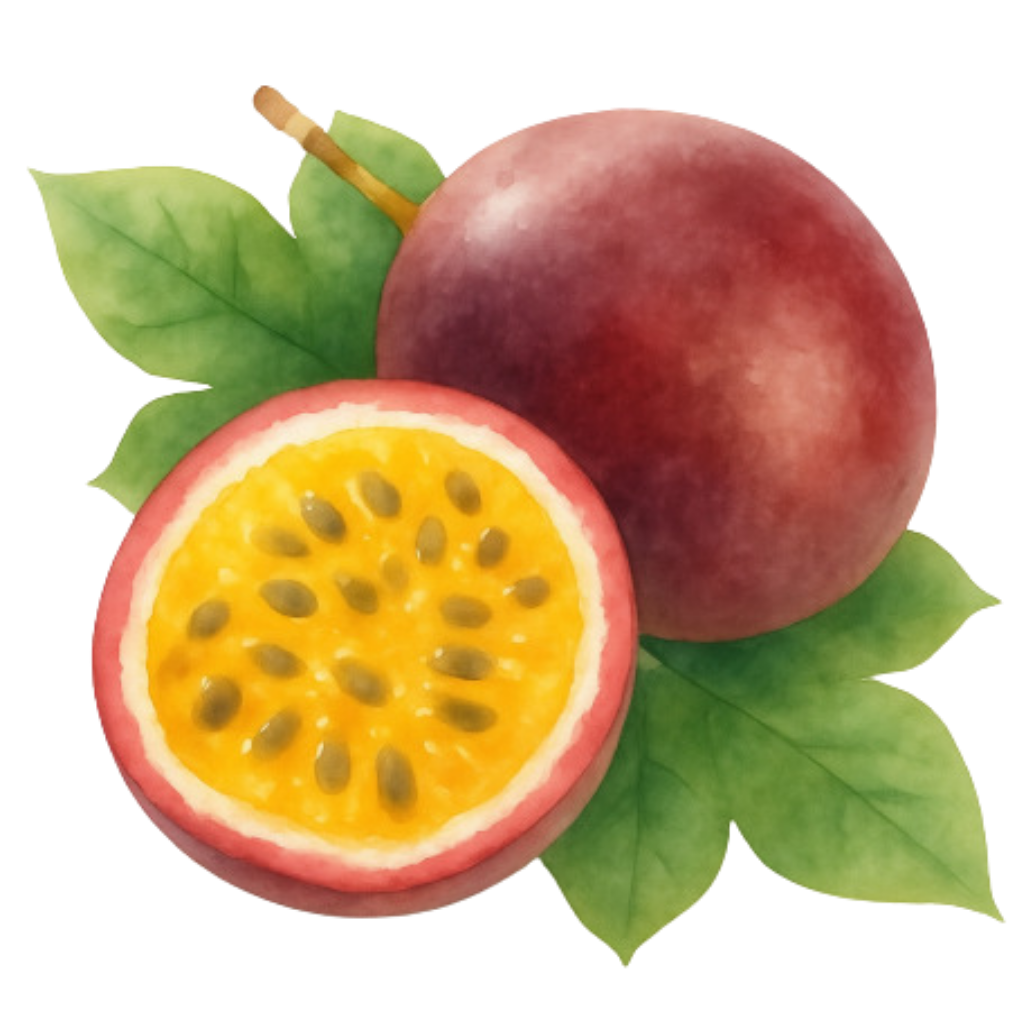
Purple Passionfruit
Passiflora incarnataVarieties
Nellie Kelly
Black Knight
Panama Red
Misty Gem
Sweetheart
Frederick
Botanical View
- Leaves are alternate and palmately lobed, typically 3-lobed (occasionally 5-lobed), about 6-15 cm (2.4-5.9 in) long, dark green above and paler/whitish beneath, with finely toothed (serrate) margins. They are deciduous, often turning gold or yellow in autumn. The petiole bears a pair of prominent extrafloral nectary glands near the base of the blade that secrete drops of sweet nectar (attracting ants and other insects).
- Stems are long, trailing or climbing, herbaceous to slightly woody, and may be smooth (glabrous) or somewhat pubescent, with green, smooth, coarsely grained bark. The vine climbs and attaches by unbranched axillary tendrils. In cold climates the top growth is killed to the ground each winter and regrows from the rootstock in spring; in warm climates the base becomes woody and persistent.
- The plant grows from a perennial rootstock with running, horizontal roots of fairly uniform diameter and subterranean rhizomes. It spreads vigorously and colonially by root suckers, often forming patches and behaving weedily. The rhizomatous root system enables it to survive cold to roughly -15 C (5 F), resprouting after the top is frost-killed.
- Flowers are solitary and axillary, borne on a peduncle, showy and fragrant, about 6-9 cm (roughly 2-3 in) across and short-lived (each flower lasts about one day). Each flower has 5 sepals and 5 petals (pale lavender to bluish/pinkish-white), a conspicuous corona of purple- and white-banded, wavy filaments, and a central androgynophore bearing 5 stamens with large anthers above, topped by an ovary with 3 recurved styles ending in knob-like stigmas.
- Flowers are hermaphroditic (perfect) but strongly self-incompatible (gametophytic self-incompatibility) and functionally self-sterile: self-pollination generally yields no fruit, so cross-pollination between genetically distinct individuals is required for fruit set. Controlled crosses between plants of different genotypes/populations set fruit at high rates, whereas selfed flowers set none. The fruit is a many-seeded berry (maypop).
- Pollination is chiefly by large bees, especially carpenter bees (Xylocopa) and bumblebees, with hummingbirds also visiting the flowers. The large, pendent anthers dust pollen onto the back of a foraging bee (or the face of a hummingbird), which is then transferred to the downward-curving stigmas.
- Grows best in well-drained soils but tolerates a wide range of textures (sand, loam, clay, or high-organic soils) and tolerates occasionally wet and acidic soils. It is drought-tolerant once established; poorly drained, wet winter soils can cause root rot.
- Established plants are drought-tolerant and need little supplemental water, though moderate, even moisture during active growth and fruiting supports better yields; waterlogging should be avoided. It is not a heavy feeder and grows on moderate fertility; a loose mulch is often used to keep the roots cool and moist.
- Propagated by seed, by stem and root cuttings, and by division/transplanting of the root suckers and rhizomes. Root cuttings (about 4-8 in) and suckers root reliably and are the easiest methods. Seeds germinate best when sown in darkness in very warm soil (about 35-40 C / negative photoblasty), where they can reach roughly 90% germination in 5-10 days, but seed dormancy often makes germination slow and erratic.
- Seed shows a combination of physical and physiological dormancy, causing erratic and often low germination; chemical scarification and gibberellic acid (GA3), plus warm temperatures and darkness, improve germination. Because the species is self-incompatible and obligately outcrossing, seed-propagated populations are genetically variable rather than uniform.
- Few named selections exist. A white-flowered form is grown as 'Alba'. The best-known related clone is the hybrid Passiflora 'Incense' (P. incarnata x P. cincinnata), a fragrant, deep-violet-flowered, cold-hardy ornamental. Most plants in cultivation and in the wild are seed-grown, genetically variable material rather than fixed cultivars.
- Historically wild-collected as an ornamental, edible-fruited, and medicinal plant, with relatively little formal breeding. The most notable breeding effort produced the hybrid 'Incense': in 1971 a Tennessee clone of P. incarnata was crossed with P. cincinnata (P.I. 98883, of Argentine origin), and the resulting cold-hardy, showy F1 hybrid was released in 1973, combining ornamental flowers with P. incarnata's temperate-winter hardiness. Cross-compatibility studies among wild genotypes (from FL, MO, OK, IL, MS, etc.) have characterized its self-incompatibility and outcrossing behavior.