Back to Fruitpedia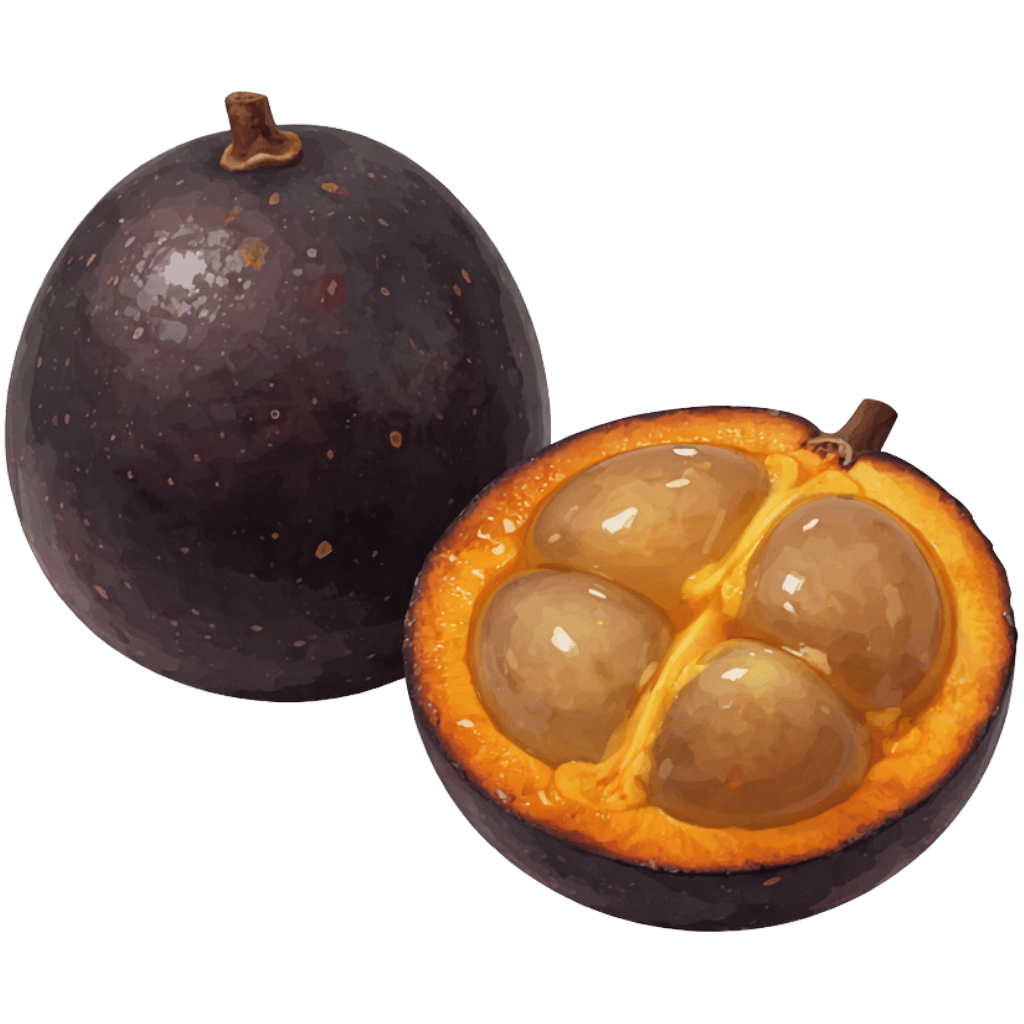
Puca
Mouriri pusaBotanical View
- Leaves simple, opposite, sub-sessile. Blade oblong-elliptic to oval, 3-6 cm long, subcoriaceous, glabrous on both surfaces; apex sub-rounded and mucronulate; base acute-obtuse; lateral veins entirely inconspicuous (obscure), giving the leaf a peninerved appearance typical of the genus Mouriri.
- Trunk short and tortuous, 20-30 cm in diameter, covered by thick, strongly suberous (corky) bark that is grayish-brown, marked by irregular longitudinal fissures, and that peels off in thin plates/scales. The crown is small and sparse.
- Não foram localizados estudos publicados que descrevam especificamente a morfologia do sistema radicular de Mouriri pusa (arquitetura, profundidade ou biomassa subterrânea). De modo geral, espécies lenhosas do Cerrado desenvolvem sistemas radiculares profundos e extensos, associados à tolerância à seca sazonal e ao fogo, mas não há dado quantitativo específico publicado para esta espécie.
- Flowers solitary or in fascicles of 2-5, borne directly on leafless, woody branches (a ramiflorous habit recalling that of jaboticaba). Petals white; stamens long and numerous, poricidal and dithecal, each bearing an abaxial elaiophore (oil-secreting gland) near the apical pore on the connective — the diagnostic anther feature of the Melastomataceae subfamily Memecyloideae, illustrated specifically for M. pusa by Buchmann & Buchmann (1981) in their comparative survey of Mouriri anther morphology.
- As in other Melastomataceae with poricidal anthers, pollination in the genus Mouriri is achieved through "buzz pollination" (sonication) by bees, with pollen as the main floral reward and the elaiophore secretion as a secondary, non-nectar resource. Controlled hand-pollination trials establishing the self-compatibility index have not been published specifically for M. pusa, but the two congeners for which this has been tested (M. acutiflora, M. guianensis) were found to be self-compatible yet still dependent on biotic (bee) pollination for full fruit set, and neither is apomictic; whether this reproductive pattern also holds for M. pusa has not been directly confirmed.
- Not directly documented for M. pusa itself. In the genus Mouriri more broadly, floral visitors and pollinators recorded on congeneric species (M. acutiflora, M. guianensis, M. myrtilloides, M. nervosa) are bees capable of sonication ("buzz pollination"), including Meliponini (Melipona spp., Trigona spp.), Centridini (Centris spp.), Xylocopini (Xylocopa spp.), and Euglossini (Eulaema spp.); pollen from the poricidal anthers is the primary reward sought, with the elaiophore oil as a secondary resource of still-debated ecological function.
- Grows on stony and sandy terrain ("terrenos pedregosos e arenosos") typical of Cerrado substrates (Lorenzi, 2009); occurs terrestrially in dry forests, dry-to-moist savannas, and dry shrublands (CNCFlora/Flora e Funga do Brasil, 2020).
- Não há protocolo agronômico publicado de adubação ou irrigação para a espécie: trata-se de planta nativa de coleta extrativista, sem cultivo comercial estabelecido em escala que documente exigências de fertirrigação.
- No standardized vegetative or seed-propagation protocol has been published specifically for M. pusa. Embrapa's "Plantas para o Futuro" initiative explicitly lists propagation and seedling/nursery production among the principal unresolved agronomic knowledge gaps for this and other underexploited Cerrado fruit species, which remain exploited almost exclusively through wild extractivism rather than cultivation.
- Fruit a globose, smooth berry containing 1-4 seeds enveloped in sweet, fleshy pulp. Wild populations show natural variation in ripe-fruit peel and pulp color, recognized in recent physicochemical/phytochemical characterization studies as three morphotypes/varieties — "yellow puçá," "brown puçá," and "black puçá" — which also differ measurably in color parameters (hue, chroma, lightness) and bioactive-compound content.
- No formal cultivars have been developed, registered, or commercially released; M. pusa remains an undomesticated, wild-harvested (extractivist) species with no known commercial orchards. The only documented intraspecific variation is a fruit-peel-color morphotype grouping — "yellow puçá," "brown puçá," and "black puçá" — recognized in recent physicochemical/phytochemical characterization studies of wild populations, but these are not formal cultivars.
- No breeding or domestication history is documented for this species. Mouriri pusa has never been the subject of a formal genetic-improvement or cultivar-development program; it continues to be harvested exclusively from wild/native stands. Embrapa's "Plantas para o Futuro" initiative explicitly lists matrix selection and genetic improvement among the unaddressed agronomic research priorities for this and other underexploited Cerrado fruit species.