Back to Fruitpedia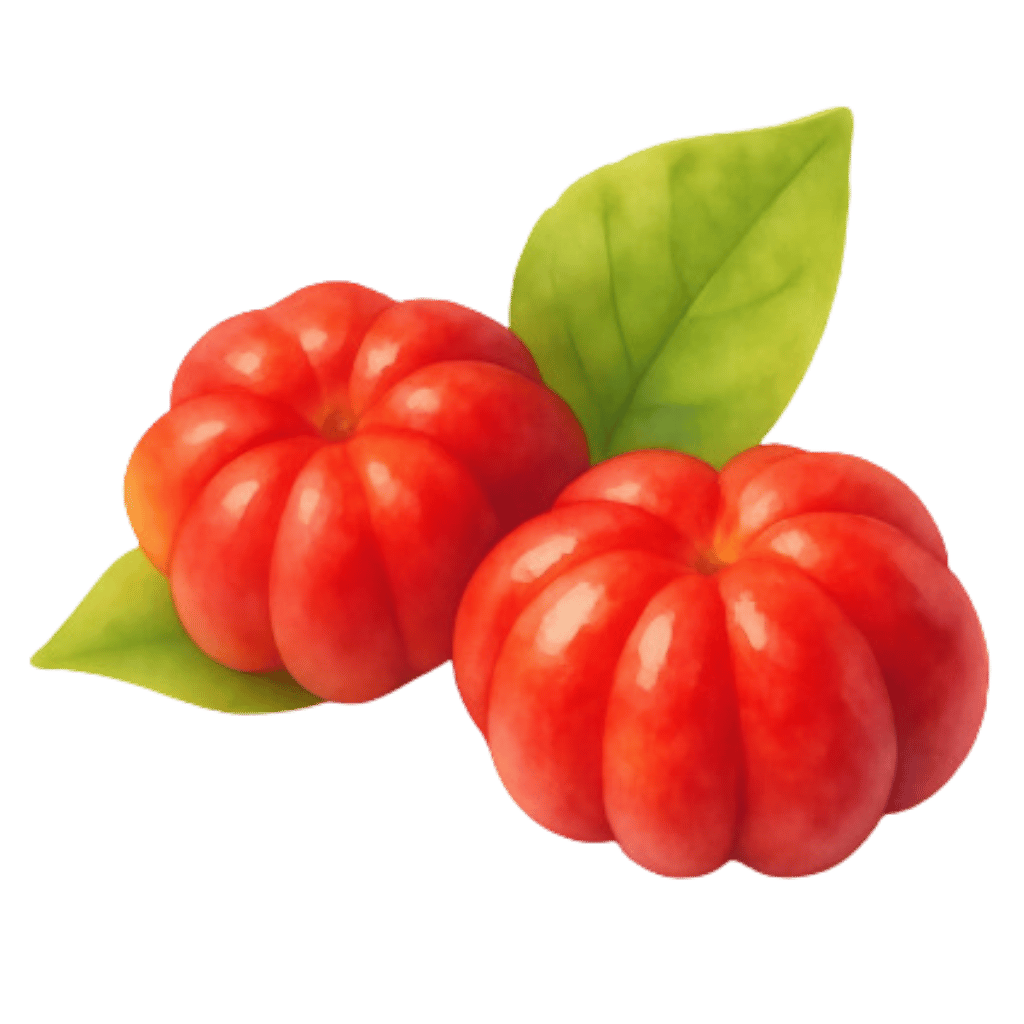
Surinam cherry
Eugenia unifloraVarieties
Tropicana
9° BrixLover
11.5–16.9° BrixVermilion
11–17.3° BrixGitit
Zill Dark
Black Star
Botanical View
- Leaves are opposite, simple, short-petiolate (petiole about 2–3 mm), semi-coriaceous, ovate to ovate-lanceolate in shape, 2.5–7 cm long by 1.2–3.5 cm wide, with an acute base and an acuminate to blunt apex. They are glabrous and glossy, dark green when mature, with numerous small translucent gland dots scattered across the blade; young leaves are bronze to reddish and membranous in texture, becoming darker with age. When crushed, the leaves release a strong, characteristic aromatic odor.
- In shrub form the plant has a low, branched, dense canopy; taller tree forms have a straight, slender trunk that may be somewhat twisted or irregularly fluted, with a bole up to about 7 m long and stem diameters up to about 50 cm DBH in old individuals. Branching is dichotomous to sympodial, without strong apical dominance, producing many thin, slender branches; natural self-pruning is poor, so periodic training and pruning are needed in cultivation. The bark is thin (up to about 4.5 mm), mottled pale gray on the outer surface, flaking off in thin scaly plates as the tree matures (becoming smoother once fully shed); inner bark is sand- to cream-colored with a short-fibrous, layered texture. The bark is notably tannin-rich. The wood is moderately dense (about 0.74 g/cm3), whitish, hard, compact and durable, traditionally used for tool handles and other implement parts and as firewood, but it is unsuitable for pulp/paper production.
- The root system is deep, with a taproot and numerous secondary and tertiary roots. Roots have some capacity to sucker/resprout at the base of the plant, forming dense multi-stemmed thickets ("touceiras") under favorable conditions.
- Flowers are borne solitary or clustered (typically 4–8, sometimes up to 6 or more) in the leaf axils at the base of the current season's young shoots, each on a slender, thread-like (filiform) pedicel 1–3 cm long. The calyx has 4 oblong-elliptic sepals (2.5–4 mm), two larger than the other two; the corolla has 4 free, white to creamy-white, obovate, deciduous petals (6–8 mm); stamens are numerous (roughly 50–60); the ovary is bilocular (2-loculed) with several ovules, topped by a filiform style (~6 mm) and a capitate stigma.
- Flowers are hermaphroditic (perfect), described in Brazilian forestry literature as having a "monoecious" sexual system in the sense that each flower bears both functional stamens and pistil. They function as "pollen flowers" (flores-pólen), offering pollen as essentially their only floral reward (little nectar is produced), with a small, dry, papillate stigma. The species is primarily insect (bee)-pollinated; while capable of self-pollination, seeds and seedlings derived from manual cross-pollination have been shown to be more vigorous than those from self-pollination.
- Flowers open during the day and last only one day; they are visited by a wide range of insects — one study recorded 29 visiting species across Hymenoptera, Diptera, Coleoptera and Neuroptera. Bees are the dominant visitors, and the introduced European honeybee (Apis mellifera) is the most frequent and abundant visitor, considered the species' effective pollinator.
- The species is not demanding regarding soil type and grows adequately in sandy soils (including coastal/restinga sands), sandy-clay, clay-sandy, clayey and even stony soils, and can tolerate periodic waterlogging; it occurs naturally in humid and alluvial soils. For orchard establishment, fertile, deep, well-drained (permeable) soils with topography suited to mechanization are preferred. It is not tolerant of saline soils.
- Fertilization is based on soil analysis results and regional recommendation tables (e.g., Cavalcanti et al., 1998, for Pernambuco). Base fertilization is applied 30–60 days before planting by mixing the phosphorus dose and aged cattle or poultry manure into the topsoil of each 35×35×35 cm planting pit. Under irrigated cultivation, nitrogen and potassium are split into three to four annual applications. In Brazil's semi-arid Northeast, irrigation is used to extend the harvest season, raise yields and improve fruit quality; drip, micro-sprinkler and "xique-xique" (perforated hose) systems are preferred because they concentrate water at the root zone and raise humidity around the canopy, with irrigation intervals of about two to three days giving higher yields than rainfed orchards.
- Propagation is most commonly done by seed, though vegetative propagation is also used and is preferred for producing uniform, selected-cultivar orchards. Seeds are extracted from ripe fruit, depulped, washed, shade-dried and sown in black plastic bags (or similar containers) using a soil/aged-manure substrate; germination is hypogeal, typically occurring 18–34 days after sowing, with germination rates of up to about 87%. For vegetative propagation, cleft grafting (full cleft, or simple whip/tongue) onto E. uniflora rootstock gives the best results, with graft-take rates around 55–59% depending on technique and markedly higher success (up to 77.5%) when using 9- to 12-month-old rootstocks versus only 16.9% on 6-month-old rootstock; patch budding on 12-month rootstock achieves about 56.7% success. Propagation by semi-hardwood stem or root cuttings is also possible but requires phytohormone treatment and an intermittent mist system.
- Seeds are recalcitrant and short-lived, losing viability within roughly 15–20 days (up to about a month) after extraction from the fruit, so they must be sown fresh. Polyembryony has been documented in E. uniflora seed (Gurgel & Soubihe Sobrinho, 1951), which can produce more than one seedling per seed and germination rates that exceed 100% relative to intact seed counts when seeds are experimentally fragmented. Fruit normally contain one large seed or two to three smaller ones, though counts of one to six seeds have been observed, and seedless individuals have been found in Rio Grande do Sul. Considerable genetic variability exists among wild populations and germplasm accessions, most visibly in mature fruit color (light red through orange and dark red to nearly black/purple), as well as in fruit size (1.5–5 cm diameter), presence/absence of surface ridges, acidity, soluble-solids content, and drought/frost tolerance.
- Brazil has historically had only one officially released cultivar, 'Tropicana' (IPA), a shrub 2.0–2.5 m tall with a rounded canopy about 3.9 m in diameter, yielding an average of 20.8 kg/plant/year under rainfed conditions on 11-year-old plants; its fruit is shiny dark red, 3.0–4.5 g, with 2–3 seeds, ~9 °Brix soluble solids and 2.2% acidity. A distinct botanical variety, "pitanga-preta" (Eugenia uniflora var. rubra Mattos), with near-black fruit, has also been described. Embrapa Clima Temperado germplasm evaluations (since the 1980s) were expected to yield at least two further cultivars. Ex situ collections show fruit color ranging from light red through orange and dark red to nearly black/purple, with variation in fruit size (1.5–5 cm), seed number (1–6, occasionally seedless), acidity and soluble solids across genotypes. Outside Brazil, the cultivar 'Gitit' was released in Israel (Lahav & Slor, 1997).
- Eugenia uniflora remains largely semi-domesticated; most orchards are propagated from wild or landrace seed rather than bred varieties. Brazil holds the world's largest ex situ germplasm base, though many accessions are still unevaluated. The Instituto Agronômico de Pernambuco (IPA, Itambé, PE) maintains the largest collection (120 accessions) and, after genotype evaluation and grafting trials (Bezerra et al., 1999; 2002; 2004), released Brazil's only official commercial cultivar, 'Tropicana', selected from a population collected in Bonito, PE. Smaller Brazilian collections are held by Embrapa Clima Temperado (Pelotas, RS; 42 accessions, evaluated since the 1980s, with new cultivars in development as of 2013), Unesp-FCAV (Jaboticabal, SP; 23), Universidade Federal de Viçosa (6), UFBA (12), EBDA (4) and INPA (2). Minor collections of mostly Brazilian-origin material exist abroad (CIRAD/Guadeloupe, CATIE/Costa Rica, USDA-ARS/Hawaii, INIA/Peru, and others). Outside Brazil, the cultivar 'Gitit' was released in Israel (Lahav & Slor, 1997). The species' chromosome number is 2n = 22 (Pedrosa et al., 1999, cited in Carvalho, Embrapa Florestas).