Back to Fruitpedia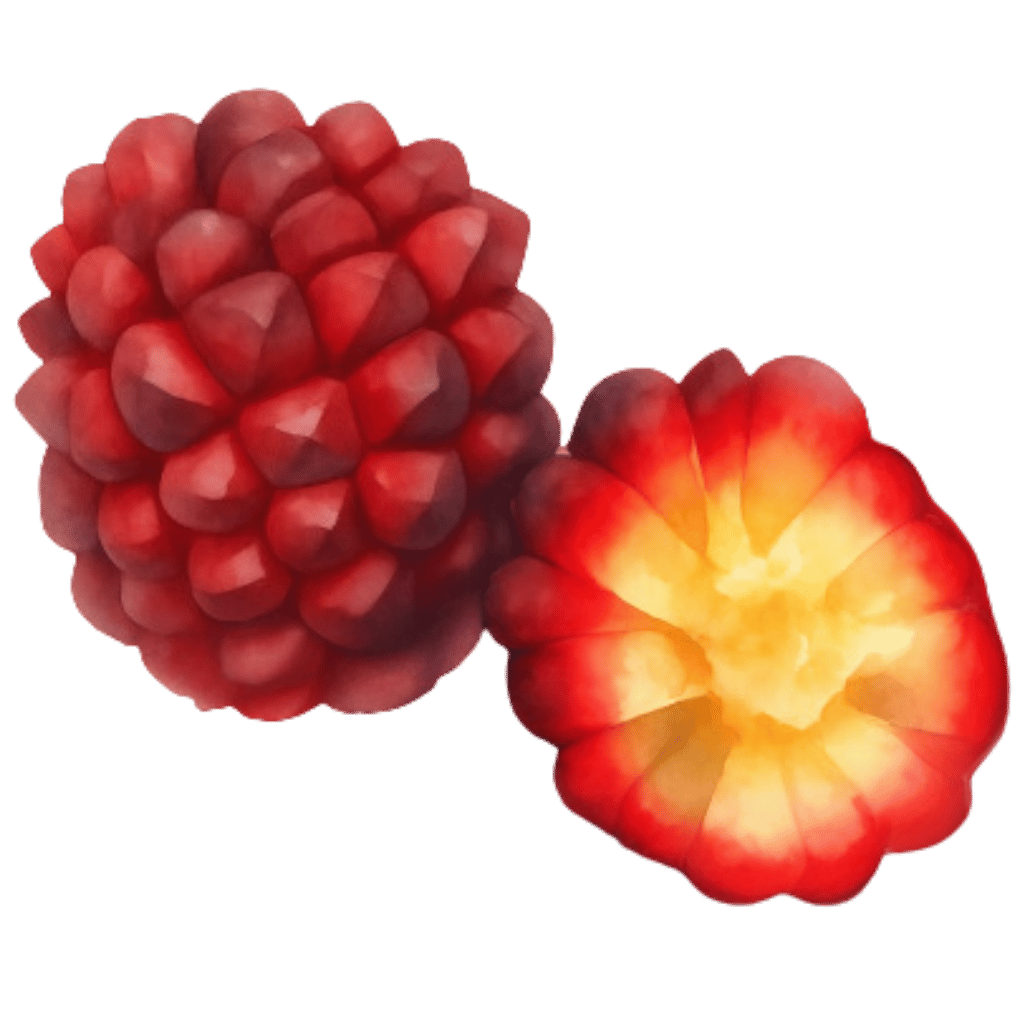
Pindaiba
Xylopia aromaticaBotanical View
- Leaves are simple, alternate, aromatic, glabrous on the upper (adaxial) surface and tomentose on the lower (abaxial) surface, 6–14 cm long. Anatomically the leaf is dorsiventral, with a mesophyll of three palisade parenchyma layers and two spongy (lacunose) parenchyma layers, and secretory cavities located between palisade cells (associated with essential-oil production). The epidermis is unistratified on both faces with markedly thickened, straight cell walls and a thick cuticle; silica bodies occur in the adaxial epidermis. The leaf is hypostomatic, with paracytic stomata level with the surrounding epidermal cells. Non-glandular, pluricellular, acute-tipped trichomes occur on both surfaces, helping maintain a humid boundary layer and reduce transpiration. Xeromorphic traits — a well-developed hypodermis, extended sclerenchymatic sheaths around the vascular bundles, and reinforced palisade tissue — reflect adaptation to seasonally dry, high-irradiance Cerrado/savanna habitats.
- The trunk is erect, 15–25 cm in diameter on a tree of 4–6(–10) m, with horizontal to somewhat drooping branches. The wood yields an excellent white fiber and has traditionally been used for fence/gate posts, beams, general and internal construction, tool handles, box linings, and cordage/rope-making. Bark tissue accumulates non-volatile secondary metabolites, notably alkaloids, alongside the terpenoid-rich essential oils (dominated by bicyclogermacrene and spathulenol in the leaves) that are characteristic of the species. Comparative wood-anatomy studies of Cerrado trees show that, unlike most co-occurring species, X. aromatica lacks a pronounced hydraulic transition between stem and branch xylem, while a distinct hydraulic bottleneck is present at the root-to-stem transition.
- Species-specific descriptions of root system architecture (depth, spread, presence of a taproot) are not documented in the available literature. Comparative wood-anatomy studies of Cerrado tree species show that root wood of X. aromatica has a higher proportion of multiple (grouped) vessels than the stem base, a trait associated with greater hydraulic safety against embolism in roots relative to the stem; a marked hydraulic bottleneck occurs specifically at the root-to-stem transition. In degraded, compacted subsoils used for revegetation trials, seedlings of the species have been shown to establish and grow despite high soil resistance to root penetration and low water infiltration, and the species accumulates leaf iron to concentrations exceeding typical toxicity thresholds without visible toxicity symptoms, suggesting tolerance useful for restoring iron-rich or otherwise compromised soils.
- Flowers are large, white-petalled and borne solitarily (not in compound inflorescences), typically in leaf axils. As in other Annonaceae, the flower has two whorls of three petals; the inner petals close over a small pollination chamber. A floral nectary occupies the roof of the chamber, contiguous with an elaiophore that lines the pollination channel and secretes lipids; nectar secretion begins in the pistillate (female) phase while elaiophore secretion starts just before anthesis, both ending in the staminate (male) phase. Flowers emit a strong, fruity/mildly sweet scent during the female phase, dominated by benzenoid compounds (methyl benzoate, 2-phenylethyl alcohol); unlike many beetle-pollinated Xylopia species, X. aromatica flowers do not exhibit thermogenesis.
- Flowers are hermaphroditic and protogynous (dichogamous), with a two-day anthesis typical of Annonaceae. The pistillate (female) phase occupies most of the first day, with stigmas receptive for roughly 12 hours from morning to late afternoon; the staminate (male) phase begins around 05:00–06:00 on the second day and lasts about 3 hours, after which all pollen is released and the stamens are shed. This temporal separation of female and male function promotes cross-pollination between flowers via trapped floral visitors.
- Pollination is carried out primarily by thrips (Thysanoptera) and secondarily by small beetles, chiefly sap beetles (Nitidulidae, e.g. Conotelus sp.) and rove beetles (Staphylinidae). Beetles enter the flower during the female phase, when the chamber is open, are trapped inside as the chamber closes overnight, and exit during the male phase carrying pollen adhered to their setose bodies via lipids secreted by the elaiophore, effecting cross-pollination. Flowers attract these visitors through a mildly sweet, benzenoid-dominated scent rather than through heat production (thermogenesis), which distinguishes X. aromatica from many other cantharophilous (beetle-pollinated) Xylopia species.
- In native Cerrado stands the species grows on sandy or silty soils and on the typically acidic, dystrophic (nutrient-poor) Oxisols of the biome, with observed soil pH around 4.3–4.9 and low phosphorus and organic-matter content; foliar nutrient data indicate the species is not demanding of phosphorus. For nursery seedling production, general guidance for Annonaceae (the family to which X. aromatica belongs) recommends deep, well-aerated soils with pH between 6.0 and 6.5. The species has also established successfully in compacted, nutrient-poor exposed subsoils on degraded land and tolerates elevated leaf iron concentrations without toxicity symptoms, indicating suitability for revegetating degraded or metal-affected soils.
- Wild Cerrado populations are adapted to naturally acidic, low-fertility soils and show low demand for phosphorus. In a field trial reintroducing seedlings onto degraded exposed subsoil, growth (height and stem-diameter increment over 12 months) responded positively to soil conditioning with organic and industrial residues, with the best results from a combined application of about 32 t/ha of dried aquatic macrophytes and 30 t/ha of sugarcane bagasse ash; nitrogen and phosphorus were identified as the two nutrients most limiting to early seedling growth on such degraded soils. No specific documented irrigation regime for field cultivation was found in the reviewed literature.
- Propagation is exclusively by seed; the germination percentage is naturally low. Seeds are small (about 7 mm long) with embryos showing morphophysiological dormancy, which makes nursery seedling production difficult. Seed quality can be assessed via X-ray imaging and seedling-emergence tests; seedling morphology and emergence are influenced by seed weight, and removing malformed or insect-infested seeds improves the physiological potential of a seed lot. For propagation, fruits should be collected once a good proportion have already dehisced (split open); scarifying the seeds increases germination rate. Nursery-grown seedlings typically take 9–11 months to reach a size suitable for field planting.
- Each dehiscent, cylindrical fruit (2–3 cm long, green outside and red inside when ripe) contains 3–9 shiny black seeds. Seeds are small (around 7 mm long) and show variability in weight, which in turn influences seedling morphology and field emergence rates — heavier, well-formed seeds are associated with better seedling establishment, while malformed or insect-damaged seeds reduce a lot's physiological quality. Fruiting is irregular, with large seed crops produced only every 2–3 years.
- No named cultivars or formal genetic-improvement/breeding programs are documented for X. aromatica; it remains an undomesticated species harvested from wild Cerrado and Amazonian populations. EMBRAPA researchers have noted that its condiment (pepper-substitute) qualities could be better exploited economically with further study, but no selected varieties currently exist.
- There is no history of formal domestication or genetic improvement for X. aromatica; all use derives from wild-harvested material. EMBRAPA has flagged the species as a candidate for further agronomic study given its regional economic potential as a native condiment, and researchers have called for population-genetic-structure studies (as have been conducted for the related X. brasiliensis, where isoenzyme-based work suggested roughly 10 ha as sufficient for in situ genetic conservation of a dense population) to inform future conservation and, potentially, selection work.