Back to Fruitpedia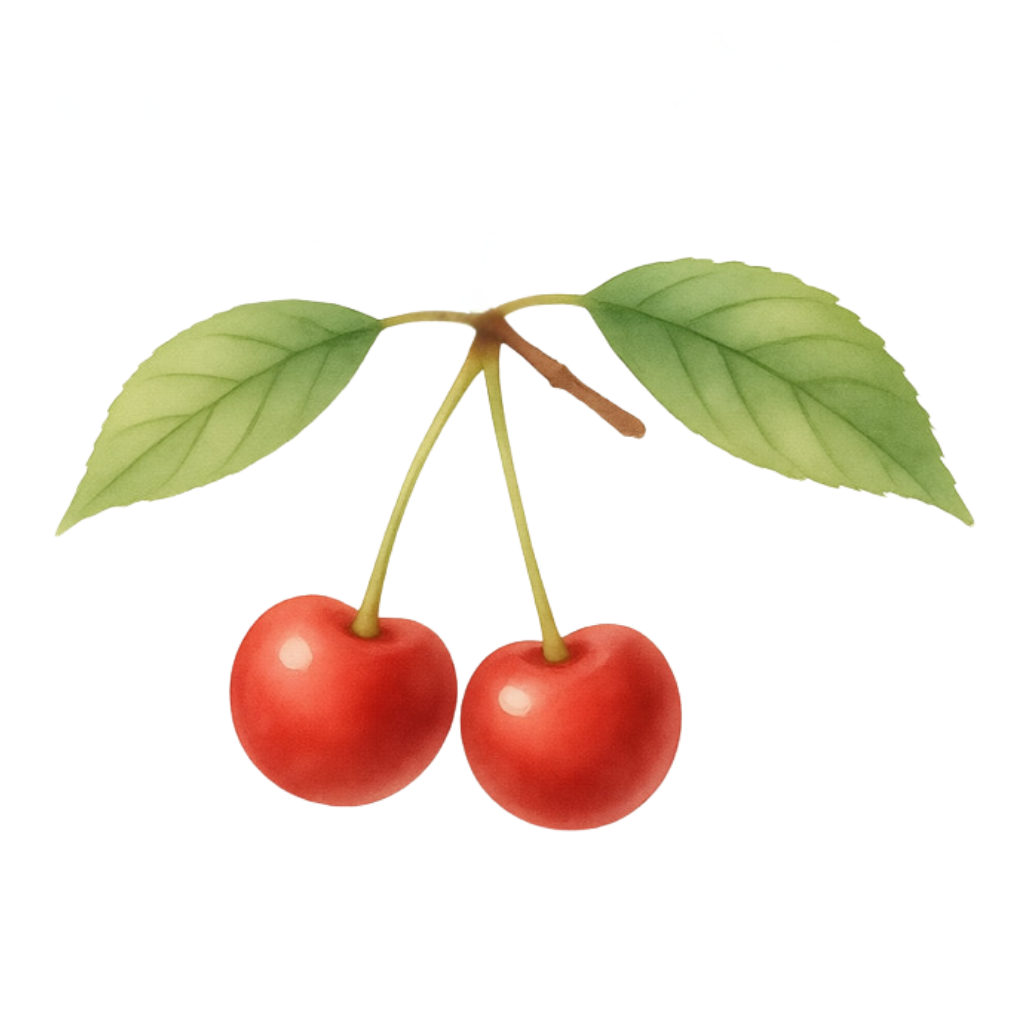
Pin Cherry
Prunus pensylvanicaVarieties
Stockton
Jumping Pound
Botanical View
- Leaves are deciduous, simple and alternate, thin, oval to lance-shaped, about 4-11 cm long and 1-4.5 cm wide, with a long-pointed (acuminate) tip and a tapered to rounded base. Margins are finely and sharply serrate. The upper surface is dark, shiny yellow-green; the lower surface is paler and smooth or slightly hairy along the veins. The petiole often bears small glands near the blade. Autumn color is showy, turning bright red to orange.
- Bark is thin, smooth and lustrous reddish-brown to gray, marked by conspicuous horizontal, orange lenticels; on older trunks it exfoliates in thin, papery horizontal strips. Twigs are slender, red to reddish-brown, shiny and smooth (occasionally sparsely hairy), with a flaky waxy cuticle and a bitter almond taste; buds are small and clustered near the twig tips. The wood is soft, light and of little commercial value.
- Pin cherry has a shallow, wide-spreading root system with numerous lateral branches. Root systems of 4- to 14-year-old stands were found to be less than about 36 cm (14 in) deep, and wind-thrown 25-year-old trees had roots confined to the upper roughly 61 cm (24 in) of soil. The shallow lateral roots readily produce root suckers, allowing clonal spread after disturbance or cutting.
- Flowers are borne in small, umbel-like clusters (corymbs) of about 3-7 (occasionally up to 5-7) flowers arising from lateral buds, on slender pedicels. Individual flowers are about 1 cm (roughly 1/2 in) across, with 5 rounded white petals, a green hypanthium (floral cup), and numerous stamens with yellow anthers surrounding a single pistil. The flowers are perfect (bisexual) and fragrant.
- Flowers are hermaphroditic (perfect/bisexual) and insect-pollinated; the species reproduces both sexually by abundant seed and vegetatively by prolific root suckering (and stump sprouting after cutting). Like many cherries it is essentially outcrossing and largely dependent on insect visitation for fruit set; a strict self-incompatibility status specific to this species is not well documented.
- Insect-pollinated. The nectar- and pollen-rich spring flowers are an important early-season resource for a range of native bees and other insects, including bumblebees (Bombus), mining bees (Andrenidae), cellophane/plasterer bees (Colletidae), sweat bees (Halictidae), honey bees, and various flies and butterflies.
- Grows on a wide range of soils and drainage classes, from rocky ledges and sandy plains to moist loamy soils, but does best on moderately coarse to coarse-textured, well-drained soils. It performs well on somewhat dry sites and on shallow organic layers relatively low in nutrients. It prefers moderately acidic soils, with an optimum pH of about 5.0-6.0, and tolerates more acidic conditions.
- Not a cultivated crop, so no standard fertilization or irrigation regime is established; as a pioneer it tolerates low-nutrient, shallow soils and moderately dry sites without amendment. It prefers moist but well-drained conditions and has only moderate drought tolerance owing to its shallow roots. No specific fertilizer program is documented.
- Propagated mainly by seed, which requires cold, moist stratification to overcome dormancy: about 60-90 days of prechilling at 3-5 C (37-41 F), or a 24-hour soak followed by ~30 days of alternating 5-day cycles at 5 C and 30 C, can give at least 75% germination; germination is otherwise slow and erratic, sometimes taking up to 18 months. It suckers readily and can be increased by division of root suckers, but propagation from stem cuttings has proved difficult with little reported success.
- Seed is small and very numerous, roughly 30,000-50,000 seeds per kg (13,600-22,700 per lb), with mature stands producing over a million fruits per acre. Seeds are notably long-lived, remaining viable in the soil seed bank for 50-100 years until fire or disturbance triggers germination; air-dried seed stored cold stays viable for 3-10 years. Because plants are wild and outcrossing, seedlings show natural genetic variability; no formal seed-quality or provenance grading exists.
- No widely recognized commercial or ornamental cultivars. Two botanical varieties are accepted: var. pensylvanica across most of the range, and var. saximontana Rehder, a smaller shrubby form of the western mountains (British Columbia and Alberta south to Montana, Wyoming and Colorado).
- Not a domesticated fruit crop and has no formal breeding history or named horticultural selections. It is valued and used chiefly as a native pioneer for wildlife habitat, erosion control, and rapid revegetation/reclamation of burned, cut-over and disturbed sites, and occasionally as a rootstock or ornamental for its spring bloom, red fruit and fall color rather than as a bred cultivar.