Back to Fruitpedia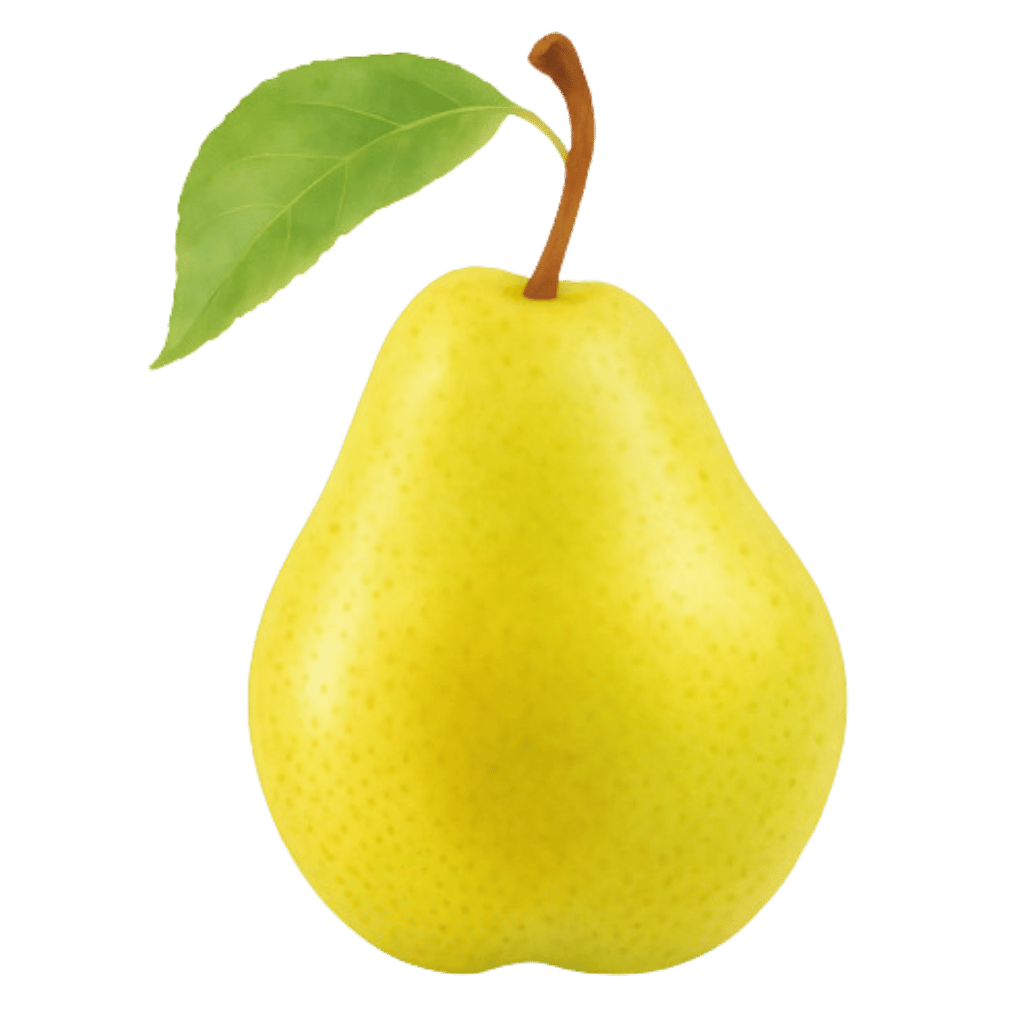
Pear
Pyrus communisVarieties
Bartlett (Williams)
Packham's Triumph
11–12° BrixRocha
10–12° BrixAbate Fetel
Triunfo
12–13° BrixPrincesinha
12–13° BrixBotanical View
- Leaves are simple, alternate, ovate to elliptic or nearly round, 2.5-10 cm (1-4 in) long and 3-5 cm wide, with a finely serrated (crenate-serrate) margin and obtuse base and apex; blades are glabrous and glossy dark green above, paler and duller below (young growth may be briefly downy), with a slender petiole 2-5 cm long and no persistent stipules. Foliage turns yellow to gold, sometimes reddish, in autumn. Source: Trees and Shrubs Online (International Dendrology Society, Bean's Trees and Shrubs); North Carolina State University Extension Gardener Plant Toolbox; Epagri Agropecuaria Catarinense v.30 n.2 (Faoro et al., 2017).
- Trunk is erect and conical to rounded, capable of exceeding 1 m in diameter in old, unpruned trees; bark is grey-brown, developing shallow furrows and flat, scaly ridges with age. Branches often form short, stiff fruiting spurs; wild forms (P. communis var. pyraster) commonly bear thorny/spiny branchlets, whereas cultivated (domesticated) trees are typically unarmed. One-year-old shoots are green to straw-green with few lenticels and little or no pubescence, and trees show strong apical dominance, so branches are often trained by bending (arching) during orchard establishment. Source: Trees and Shrubs Online (International Dendrology Society, Bean's Trees and Shrubs); Epagri Agropecuaria Catarinense v.30 n.2 (Faoro et al., 2017).
- Seedling-grown Pyrus communis develops a moderately deep, wide-spreading ("heart") root system rather than a persistent single taproot, with structural framework roots and a dense mat of fine feeder roots concentrated in the upper soil profile; roots readily produce adventitious sucker shoots after injury or severe pruning. In commercial orchards trees are grafted onto seedling or clonal pear (Pyrus communis) rootstocks, which are vigorous (trees regularly exceeding 6 m), or onto quince (Cydonia oblonga) rootstocks, which induce dwarfing but only about one-third size reduction and often require an interstock owing to graft incompatibility. Source: World Agroforestry Centre species database; Oregon State University pear rootstock research (Research Directions Based on the Current State of Pear Rootstocks); Epagri Agropecuaria Catarinense v.30 n.2 (Faoro et al., 2017).
- Flowers are borne in corymbose clusters (racemose corymbs) of about 5-9 (commonly 5-7) flowers arising from terminal mixed buds on short spurs, opening before or with the leaves in early spring. Individual flowers are showy, white, 2.5-3.5 cm across, with five petals, numerous stamens, and an epigynous (inferior), 5-carpellate ovary embedded in receptacle tissue containing up to 10 ovules (2 per carpel); the corymb spans roughly 5-7.5 cm, on a slender peduncle/pedicel 2.5-5 cm long, sometimes finely pubescent ("woolly"). Source: Trees and Shrubs Online (International Dendrology Society, Bean's Trees and Shrubs); North Carolina State University Extension; Epagri Agropecuaria Catarinense v.30 n.2 (Faoro et al., 2017).
- Pyrus communis bears hermaphroditic (perfect) flowers but is self-incompatible through an RNase-based gametophytic self-incompatibility (GSI) system controlled by a single, highly polymorphic S-locus (roughly 30 documented S-RNase alleles across cultivated European pear). Pollen tubes that share an S-haplotype with the pistil are arrested about one-third of the way down the style, blocking self-fertilization; commercial orchards therefore require at least two S-genotypically cross-compatible cultivars (or a compatible wild-pear pollen donor) for adequate fruit set, and developing seeds release auxins that drive ovary/fruit expansion, making full fertilization important for fruit quality. Source: Frontiers in Plant Science, "Finding a Compatible Partner: Self-Incompatibility in European Pear (Pyrus communis)" (Sanzol, 2019, PMC6477101); Epagri Agropecuaria Catarinense v.30 n.2 (Faoro et al., 2017, giving the S1/S2 example for cv. Williams).
- Pyrus communis is primarily insect-pollinated, chiefly by honeybees (Apis mellifera), although its flowers are only moderately attractive to bees because of low nectar volume (roughly 0.6-3 microliters per flower) and low sugar concentration (about 16-21 degrees Brix). Attractiveness is further reduced where more rewarding native flowering species (e.g. Mimosa scabrella, Piptocarpha angustifolia in southern Brazil) bloom simultaneously nearby, drawing bees away from pear orchards. Commercial growers therefore interplant two or more cross-compatible cultivars as pollinizers and often supplement with rented honeybee colonies. Source: Epagri Documentos No.378 (Faoro, 2026, citing Sezerino, 2014 and Sezerino & Orth, 2015, Biotemas; Free, 1993); Frontiers in Plant Science, "Finding a Compatible Partner..." (Sanzol, 2019, PMC6477101).
- Prefers deep, well-drained, fertile loam soils with neutral to slightly alkaline pH (about 6.0-8.0); tolerates a range of textures (clay, loam, sand) and occasional dry soil once established, but is sensitive to poorly drained or waterlogged sites, which favor root diseases such as Rosellinia (Dematophora) white root rot. Source: North Carolina State University Extension Gardener Plant Toolbox; Epagri Documentos No.378 (Faoro, 2026, Table 12, root disease listing).
- Standard orchard practice combines pre-plant soil correction with annual balanced N-P-K fertilization plus micronutrients such as boron, whose deficiency is linked to fruit physiological disorders; irrigation is important around fruit set and development. In Brazil's semi-arid Vale do Sao Francisco region (Pernambuco), controlled drip irrigation combined with gibberellin-inhibiting plant growth regulators and summer ("green") pruning allows trees to enter production by the second year and produce two harvests annually, circumventing the normal winter-chill requirement, with yields of roughly 26-60 t/ha per crop reported for cultivars such as 'Centenaria', 'Housui' and 'Princesinha'. Foliar/leaf tissue analysis is recommended to guide fertilization programs. Source: Epagri Documentos No.378 (Faoro, 2026); Epagri Agropecuaria Catarinense v.30 n.2 (Faoro et al., 2017).
- Commercially propagated almost exclusively by grafting (whip-and-tongue or chip-budding) selected scion cultivars onto rootstocks - seedling or clonal Pyrus communis, quince (Cydonia oblonga, e.g. clones 'BA29', 'EM.A', 'EM.C') for size control, or vigorous Pyrus calleryana/P. betulaefolia. Because many European scion cultivars are graft-incompatible with quince, an interstock (e.g. 'Beurre Hardy', about 10-20 cm long) is often inserted as a compatibility "filter." True seed propagation is used only to produce rootstocks or in breeding programs, not to multiply named cultivars, since seedlings do not come true to type. Source: Epagri Agropecuaria Catarinense v.30 n.2 (Faoro et al., 2017); North Carolina State University Extension Gardener Plant Toolbox.
- Because Pyrus communis is an obligate cross-pollinator under a gametophytic self-incompatibility system, its seeds are highly heterozygous and seedlings segregate widely for vigor, fruit quality, disease resistance and chilling requirement; this variability is exploited in breeding programs (e.g. the biparental mapping cross 'Old Home' x 'Louise Bonne de Jersey' used for rootstock QTL studies) to select new scion cultivars and rootstocks, but it also means that seed-grown trees cannot reliably reproduce a named cultivar and must instead be propagated by grafting. Source: Frontiers in Plant Science (Sanzol, 2019, PMC6477101); Oregon State University pear rootstock QTL research (ir.library.oregonstate.edu).
- Major commercial European pear cultivars include 'Williams' (='Bartlett', ='Williams' Bon Chretien'), 'Packham's Triumph', 'Rocha' (Portugal), 'Beurre d'Anjou' (='Anjou'), 'Abate Fetel', 'Doyenne du Comice', 'Forelle' and the Williams mutation 'Max Red Bartlett'. In Brazil, cultivated European types include 'Williams', 'Packham's Triumph', 'Rocha' and 'Santa Maria'; lower-quality hybrid types include 'D'Agua', 'Kieffer', 'Tenra', 'Centenaria' and 'Triunfo'; and Asian-type cultivars grown alongside P. communis include 'SCS421 Carolina' (first Brazilian-bred Asian pear, released 2015), 'Housui', 'Kousui' and 'Nijisseiki'. Source: Epagri Documentos No.378, "Potencial do cultivo de pereira no Brasil" (Faoro, 2026); Epagri Agropecuaria Catarinense v.30 n.2, p.47-50 (Faoro et al., 2017).
- Formal pear breeding is comparatively recent and limited worldwide. In Brazil, organized breeding/cultivar-evaluation work began in 1947 with agronomist Orlando Rigitano at the Instituto Agronomico de Campinas (IAC-SP), continued from 1974 by Fernando A. Campo Dall'Orto and from 1988 by Wilson Barbosa; in Santa Catarina, pear breeding/evaluation began with Empasc (later Epagri) in 1975, and Ivan D. Faoro's program (from 1989), aided by a 1996-2001 JICA-Epagri-Embrapa cooperation with Japan, produced 'SCS421 Carolina' (released 2015), the first Brazilian-bred Asian-type pear cultivar. Most widely grown European cultivars originated as chance or open-pollinated seedlings rather than directed crosses: 'Williams' (='Bartlett') arose from open pollination found near Aldermaston, England, circa 1765, and was renamed 'Bartlett' in the USA in 1817, later giving rise by mutation or cross-breeding to cultivars such as 'Max Red Bartlett' and 'Packham's Triumph' ('Uvedale St. Germain' x 'Williams'). Source: Epagri Documentos No.378 (Faoro, 2026); Epagri Agropecuaria Catarinense v.30 n.2 (Faoro et al., 2017, citing Hedrick 1921).