Back to Fruitpedia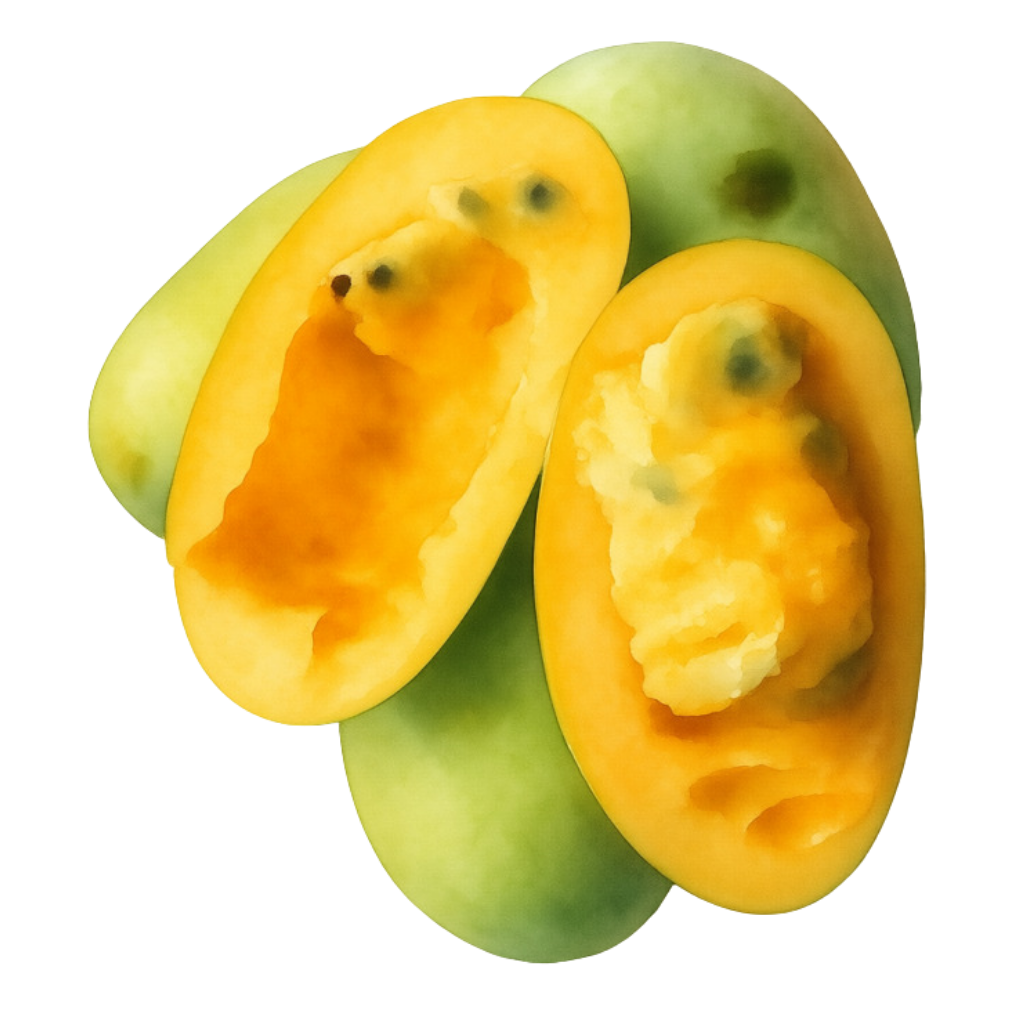
Pawpaw
Asimina trilobaVarieties
Shenandoah
Susquehanna
22–25° BrixSunflower
Overleese
Mango
KSU-Atwood
Botanical View
- Leaves are simple, alternate, obovate to oblong-obovate, large (15-30 cm long), with entire margins and an acuminate tip, tapering to a short petiole. They are dark green and drooping, turning yellow in autumn, and emit a faintly unpleasant odor when crushed. The foliage gives the tree a distinctive tropical appearance.
- A small tree or large shrub with a slender, often leaning trunk and thin, smooth to slightly warty grayish-brown bark. Young twigs are marked by rusty or reddish-brown hairs; the wood is weak and brittle. It commonly forms clonal colonies via root suckers, producing thickets of genetically identical stems.
- The root system is dominated by a long, fleshy, brittle taproot that is easily damaged during transplanting, making bare-root transplanting difficult. The plant also spreads by shallow lateral roots that produce suckers, forming clonal patches.
- Flowers are solitary, borne on the previous year's wood, appearing before or with the leaves in spring. Each flower is nodding, cup-shaped, about 2-5 cm across, with three sepals and six petals in two whorls (outer larger, inner smaller). Petals mature from green to a deep reddish-purple or maroon-brown. Flowers are perfect (bisexual), with numerous spirally arranged stamens and several separate carpels.
- Flowers are hermaphroditic but functionally self-incompatible and protogynous: the stigma becomes receptive before the same flower sheds its pollen, discouraging self-pollination. Trees are generally self-sterile, and fruit set requires cross-pollination between genetically distinct (non-clonal) individuals.
- Pollination is by carrion- and dung-feeding insects, chiefly flies and beetles, attracted by the flowers' deep flesh-red color and faint fetid or fermented odor mimicking decaying matter. These natural pollinators are inefficient and unreliable, so fruit set is often low and hand pollination is commonly used to improve yields in cultivation.
- Prefers deep, rich, moist but well-drained soils that are slightly acidic to neutral (pH roughly 5.5-7.0). It tolerates periodic flooding and grows naturally on fertile bottomlands and along streams, but does not tolerate permanently waterlogged or poorly drained sites, which promote root rot.
- Benefits from consistent soil moisture, especially during establishment and fruit development; young plants should not be allowed to dABility dry out. Moderate, balanced fertilization supports growth on poorer soils, while deep fertile soils may need little supplemental feeding. Mulching helps retain moisture and moderate root temperature.
- Propagated by seed and by grafting/budding. Seeds require 70-100 days of moist cold stratification to break dormancy and must not be allowed to dry out; seedlings are used mainly as rootstock. Named cultivars are propagated clonally by chip budding or whip grafting onto seedling rootstock, as cuttings root poorly. Grafted trees fruit in about 3-5 years versus 5-8 years for seedlings.
- Seedlings are genetically variable and do not come true to type, showing variation in fruit size, flavor, and productivity, so superior selections are maintained by grafting. Seeds are large, flat, dark brown beans borne several per fruit.
- Numerous named cultivars have been selected for larger fruit, better flavor, and fewer seeds, including 'Sunflower', 'Susquehanna', 'Shenandoah', 'Allegheny', 'Overleese', 'Mango', 'NC-1', and 'Wabash'. Kentucky State University maintains a major pawpaw germplasm collection and breeding program.
- Long used by Native Americans and early settlers, the pawpaw remained largely a wild-gathered fruit. Organized selection began in the early 20th century, notably the 1916 Journal of Heredity contest that identified superior wild clones. Modern breeding and germplasm conservation are centered at Kentucky State University (the USDA National Clonal Germplasm Repository satellite), which has released and evaluated improved cultivars.