Back to Fruitpedia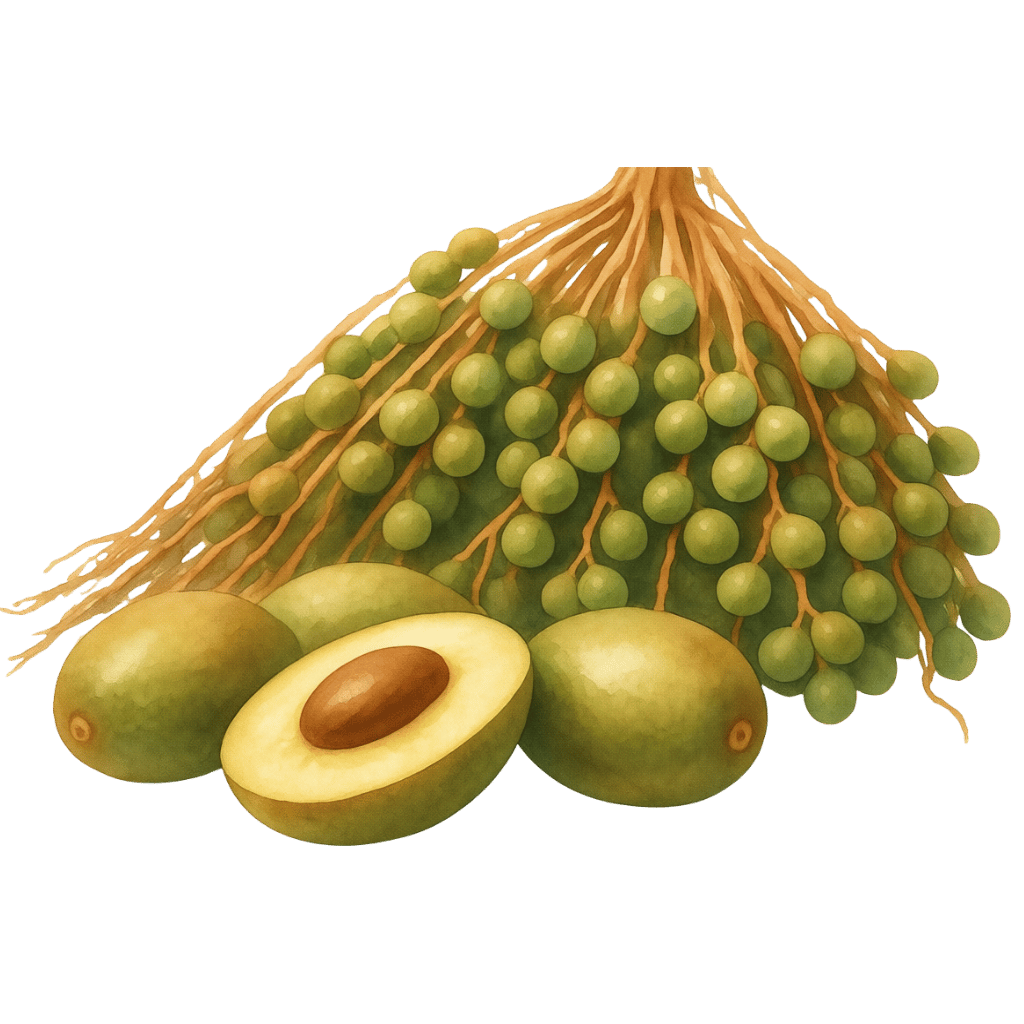
Pataua fruit
Oenocarpus batauaBotanical View
- Leaves are erect, dark green, and arranged divergently, with 8-20 leaves per plant. They are compound and pinnate, 3-10 m long, with a long open sheath that persists on young plants, fibrous margins bearing long, coarse fibers wrapped in a wool-like mass of fine fibers (ligule remnants), and a short petiole that stays in a vertical position for a long time. Leaflets are broad (10-12 cm wide) and regularly arranged in the same plane.
- The stipe (trunk) is single (monocaule), erect, smooth and columnar, 4-26 m tall and 15-54 cm in diameter.
- Roots are fasciculate (fibrous, clustered), visible at the base of the stem.
- The floral branch is infrafoliar, with a prophyll 0.7-1.1 m long and a pendulous, deciduous bract 1.2-2.2 m long (dark brown outside, pale beige inside when freshly opened). The inflorescence itself is interfoliar and pendulous, with a short-to-elongate peduncle and a rachis 20-50 cm long bearing 120-370 rachillae, each 0.7-1.2 m long, cream-colored when fresh and turning reddish over time. Flowers are unisexual and sessile: dozens of staminate flowers occupy the apical third of each rachilla, while the remainder bears triads (one pistillate flower flanked by two staminate flowers), totaling roughly 327 male and 60 female flowers per rachilla. A whole inflorescence carries approximately 94,000 male flowers and 16,000 female flowers (Küchmeister et al., 1998). Male flowers are asymmetric, cream-colored, with three fused basal sepals, three free petals, 7-20 stamens, and occasionally a bifid or trifid pistillode; female flowers are larger than the male flowers, cream-colored, with three distinct, imbricate sepals and three distinct, imbricate petals.
- The species is monoecious, xenogamous and self-incompatible, with marked dichogamy in the form of protandry: each inflorescence passes through a male phase, a neutral (non-sexual) phase, and finally a female phase (Núñez-Avellaneda & Rojas-Robles, 2008, Caldasia).
- Anthesis is nocturnal and the inflorescences are thermogenic, producing floral scent together with a rise in inflorescence temperature; the chemical composition of the floral scent is highly similar (about 92%) between the male and female phases. Pollination is carried out by insects, predominantly Coleoptera (beetles), with inflorescences recorded to be visited by dozens of arthropod species overall (Núñez-Avellaneda & Rojas-Robles, 2008; Küchmeister et al., 1998).
- In the northern Amazon region it grows in humid várzea (floodplain), gallery, and terra firme forests, on sandy or sandy-clay soils. On well-drained terra firme soils it grows as an isolated tree at low density (1-20 plants/ha, limited by shading). On periodically or permanently flooded soils it forms near-pure stands locally called "patauazal," reaching up to 900 young plants per hectare. It also tolerates poor, marginal soils and is considered to have potential for recovery of degraded areas.
- For field planting, holes of 40x40x40 cm are opened, spaced 6x6 m or 7x7 m, with the excavated soil mixed with a shovelful of cattle manure and 50 g of NPK (10-28-20) fertilizer. No formal irrigation regime is documented for the species, which remains undomesticated; it naturally prefers consistently humid sites and high rainfall (1,700-4,000 mm/year).
- Propagation is exclusively by seed (sexual propagation); seeds show recalcitrant behavior. Freshly harvested seed germinates quickly and uniformly, reaching 90-98% germination (Nazário & Ferreira, 2012). Ripe, freshly picked fruits are soaked in warm water for 30-60 minutes and de-pulped; seeds are then sown horizontally with the raphe facing down, at 2 cm depth, in a substrate of washed sand and sawdust (1:1); emergence occurs 35-88 days after sowing. Where a seedbed is unavailable, seeds can instead be kept in plastic bags with moist, cured sawdust. Seedlings are pricked out when they reach the "toothpick" stage (first pair of leaves closed) into black polyethylene bags (17x27 cm) filled with a substrate of soil, sawdust and cured manure (3:1:1), and kept under 50% shade netting or a partially shaded nursery. After 6-8 months seedlings are hardened off to increasing light before being taken to the field, since young plants are susceptible to direct solar radiation.
- Fruits show great variation in weight, size and composition: individual fruits weigh 10-15 g and measure 2.5-4.7 cm long by 2.0-2.5 cm in diameter, with the edible part (epicarp + mesocarp) representing roughly 35-45% (or more) of the fruit. Germplasm accessions evaluated for 29 morphological characters showed significant differences in bunch weight, fruit weight, pulp yield, and fruit shape, size and color; producers report purple-fruited types as more productive than white/green-fruited types.
- The species is not domesticated and no formal cultivars have been developed. Embrapa Amazônia Oriental (Belém, Pará) maintains an active germplasm bank ("BAG-Patauá"), established in 1989 from collecting expeditions (1984-1993) across the Brazilian states of Pará, Amazonas, Roraima, Amapá and Rondônia, originally comprising 195 accessions (currently fewer than 70 due to conservation constraints). Growers informally distinguish purple-fruited ("roxo") from white-fruited ("branco") types.
- The species has not been domesticated. In Brazil, the "Cultivos Pioneiros" program (1980s-1990s) ran the "Banco Ativo de Germoplasma de Patauá" project, with collecting expeditions across the Amazon-region states of Brazil (1984-1993); seedlings from randomly selected wild individuals formed the BAG-Patauá germplasm bank at Embrapa Amazônia Oriental (Belém, Pará), installed in 1989 with 195 accessions. Work continued under the "Banco Ativo de Germoplasma de Palmáceas" project and later under Embrapa Recursos Genéticos e Biotecnologia genetic-resources projects; the bank is registered with Brazil's Conselho de Gestão do Patrimônio Genético (CGEN). Separately, in Colombia in the 1980s a pilot industrial oil-extraction plant was developed at Las Gaviotas (Llanos region) using matrices selected from natural populations, achieving 85-89% extraction efficiency (FAO, 1983), but the initiative was discontinued due to high production costs and low yields.