Back to Fruitpedia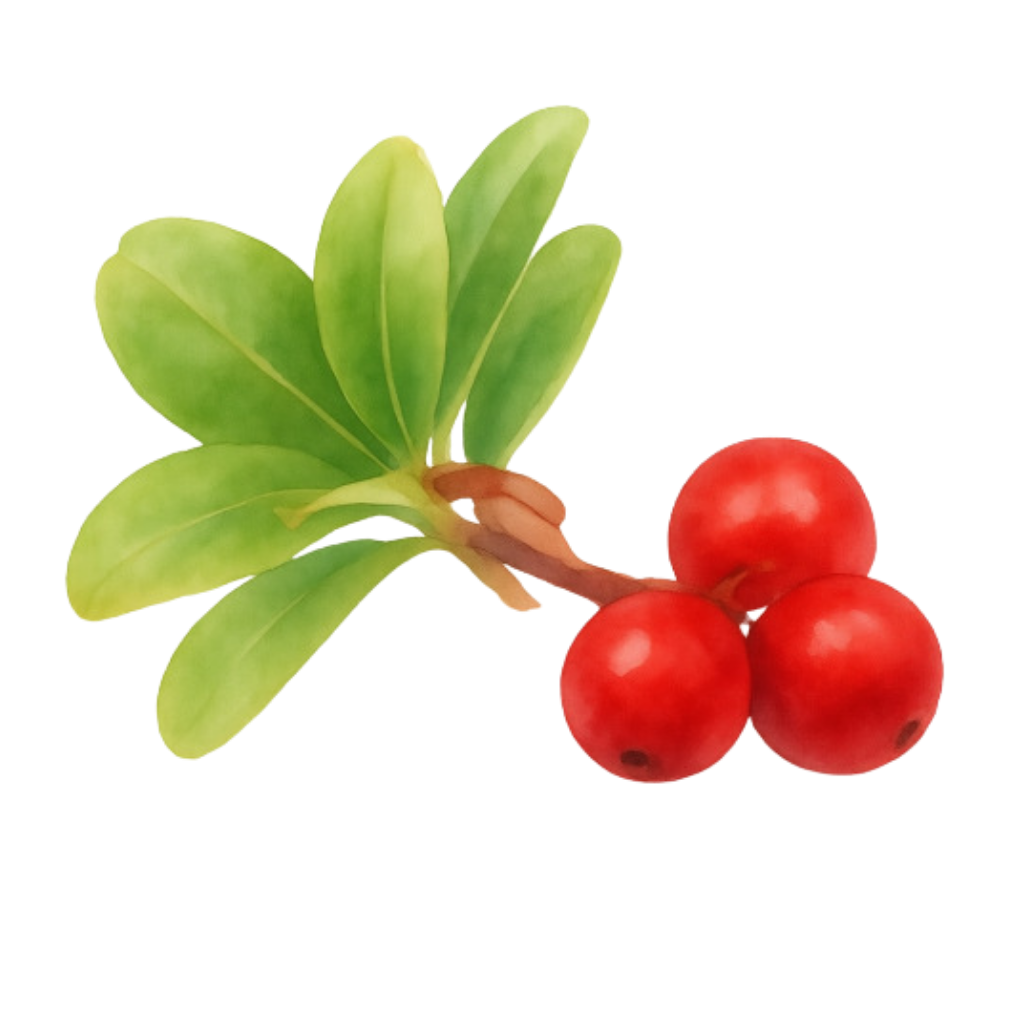
Partridgeberry
Mitchella repensBotanical View
- Leaves are opposite, evergreen, simple and short-petioled, borne in pairs along the stems. The blade is ovate to nearly round (orbicular to somewhat cordate), small — about 1–2 cm long (to roughly ¾ in) — with entire (toothless) margins and rounded apex and base. Surfaces are glabrous (hairless); the upper surface is glossy dark green with a conspicuous pale/whitish midrib and veins.
- Stems are slender, smooth, trailing to slightly ascending and non-climbing, about 15–30 cm (6–12 in) long, creeping prostrate over the forest floor and somewhat woody at the base. They root at the nodes where they contact the ground, branch and re-root repeatedly, and thereby form loose spreading mats and clonal colonies that can extend several yards across.
- Shallow-rooted. Adventitious roots develop at the stem nodes where the trailing stems touch the ground, anchoring the plant and enabling vegetative spread and colony formation.
- Flowers are produced in pairs (twinned) at the stem tips and in leaf axils. Each flower is small (about 1–1.5 cm), funnel- to trumpet-shaped, white and often flushed pink, and fragrant, with a four-lobed corolla whose lobes are densely bearded/pubescent (hairy) on the inner surface, four stamens and one pistil. The two flowers of a pair share a fused (common) ovary and calyx, so a single berry develops from the two flowers.
- Distylous (heterostylous) with heteromorphic self-incompatibility. Two genetically determined floral morphs occur on separate plants: "pin" flowers (long style/pistil, short stamens) and "thrum" flowers (short style, long stamens). Legitimate cross-pollination between the two morphs is required for fertilization — pin flowers need thrum pollen and vice versa — while self- and same-morph pollen are incompatible, making plants effectively self-sterile and obligately outcrossing. Both flowers of the twinned pair must be pollinated for the fused ovary to set its single fruit. The plant also reproduces clonally through stems that root at the nodes.
- Insect-pollinated (entomophilous). Bumblebees (Bombus vagans, B. impatiens) are the principal pollinators, with additional visits by a range of small bees and flies roughly 1–2 cm long. The fragrant flowers emit a monoterpene-dominated floral scent — chiefly α-pinene, verbenone, D-limonene and camphene — and both scent emission and insect visitation decline as the flower ages.
- Grows best in organically rich, humusy, medium-moisture but well-drained soils that are acidic (roughly pH below 6.0) with high organic-matter content — the conditions of a rich forest floor, sandy slopes and stream banks. It tolerates dry soil once established but not waterlogging.
- Prefers consistently moist soil; medium water needs. It tolerates short periods of drought once established but performs best with steady moisture and cannot tolerate waterlogged conditions. No particular fertilization is required — it thrives in naturally organic-rich woodland soils.
- Propagated chiefly vegetatively: by division of rooted stems and by layering, since stems root readily at the nodes, and by softwood cuttings (relatively easy). Seed propagation is difficult and rarely used — seeds require cold stratification, germinate slowly and often only in the second spring, and are dispersed in nature by birds and other wildlife eating the berries. Plantings can be slow and difficult to establish.
- The twin berry (drupe) contains up to eight seeds (bony pyrenes), formed from the fused two-flower ovary. Seeds require cold stratification and show slow, erratic germination, often delayed to the second season. The pin/thrum style morph is inherited as a simple genetic polymorphism (a single "supergene"-type locus).
- No named cultivars or horticultural varieties are documented; the plant is grown as the wild species.
- No formal breeding or cultivar-development program exists; the plant remains essentially wild and undomesticated, grown and propagated as the native wild type rather than as bred selections.