Back to Fruitpedia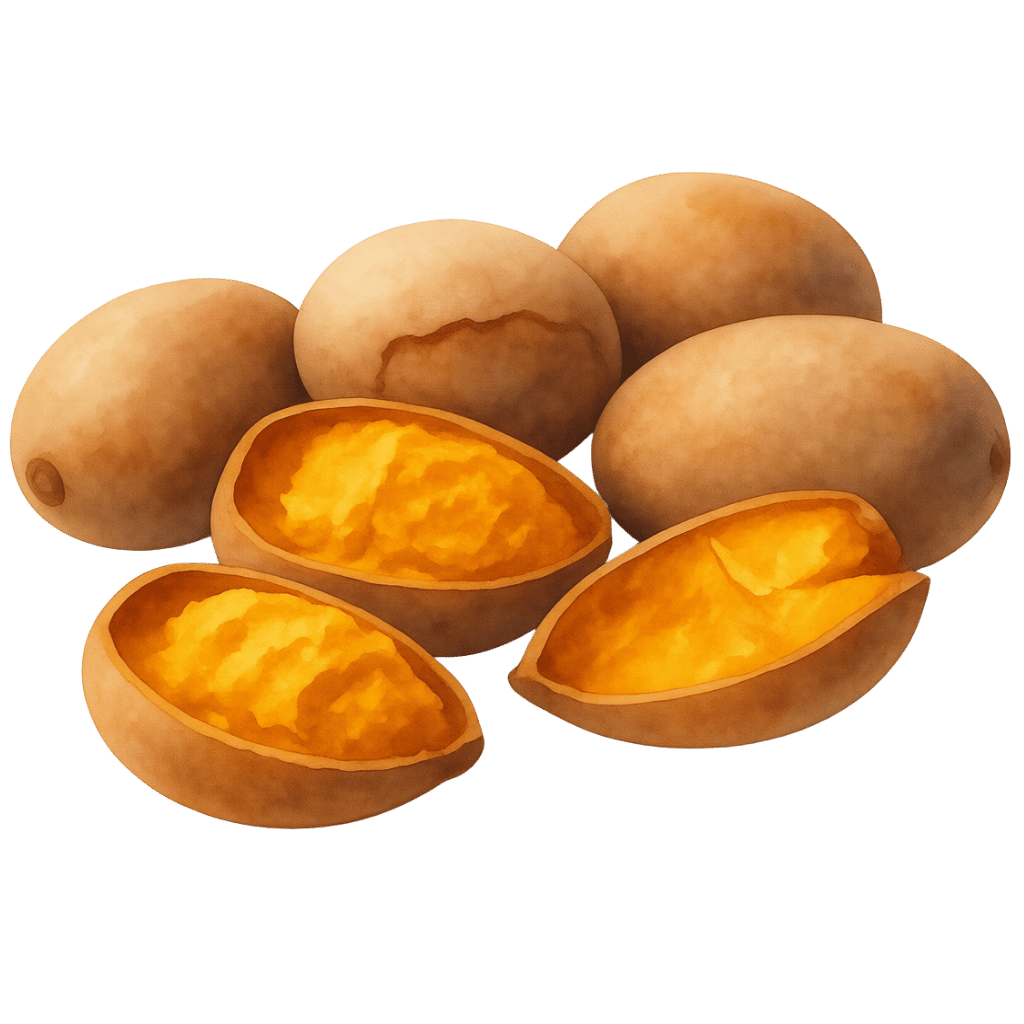
Pajura
Couepia bracteosaBotanical View
- Leaves alternate, simple, petiolate (petiole about 1.5 cm long); blade leathery (coriaceous), ovate-elliptic to oblong, about 20 cm long by 12 cm wide, margin entire, apex acuminate, base rounded, truncate, obtuse or subcordate; upper surface shiny green, lower surface pulverulent and gray-brown. Stipules subulate, caducous (falling early). Source: EMBRAPA Amazônia Ocidental/MMA (2022); Falcão, Lleras & Kerr, Acta Amazonica 11(3), 1981.
- Tree with a trunk (bole) reported as about 30-50 cm in diameter (up to 50 cm in cultivated individuals per EMBRAPA), with thin, rough bark. Overall tree height is 10-20 m when cultivated, with some individuals reaching up to 25 m; a field study near Manaus recorded trunk (bole) heights of roughly 2.5-9 m and total tree heights of about 5.5-23 m on trees estimated at approximately 12-60 years old. The crown is dense and broadly spreading, wide enough that recommended planting spacing is 6 x 6 m. Source: EMBRAPA Amazônia Ocidental/MMA (2022); Falcão, Lleras & Kerr, Acta Amazonica 11(3), 1981.
- Not documented in the government/academic sources reviewed (EMBRAPA/MMA 2022; Falcão, Lleras & Kerr 1981; Kew POWO); no description of the root system architecture was found.
- Inflorescences are terminal, raceme-like (racemiform) panicles. Flowers are small, subsessile, with a cylindrical receptacle, and persistent bracteoles at the base. Source: EMBRAPA Amazônia Ocidental/MMA (2022); Falcão, Lleras & Kerr, Acta Amazonica 11(3), 1981.
- Flowers are hermaphroditic, zygomorphic, apopetalous and dichlamydeous, with 5 free, imbricate, white sepals with ciliate margins; 25-26 stamens with dorsifixed, longitudinally-dehiscent (rimose) anthers; a single carpel with a superior, unilocular ovary bearing 2 anatropous ovules on basal placentation; a basal style and capitate stigma. In a controlled bagging experiment (100 inflorescences enclosed in fine mesh, expected to yield ~120 fruits), zero fruit set occurred, giving a calculated 99.99% probability that fruit set depends on insect pollination — the species is neither self-pollinating nor wind-pollinated. Natural fruit set is nonetheless very low (about 2.96% of flowers), the lowest recorded among four Amazonian fruit species studied with the same protocol, and statistical analysis suggested fruit/flower loss is not random but under some endogenous physiological control. Source: Falcão, Lleras & Kerr, Acta Amazonica 11(3), 1981.
- Entomophilous (insect-pollinated); the species has no single specific pollinator but is serviced by several shared pollinator species. A field study near Manaus recorded 14 insect visitor species (13 Hymenoptera, 1 Lepidoptera). Pollen-load analysis confirmed true pollen vectors were Apidae bees: Eulaema mocsaryi (Friese) and Melipona sp. carried pollen almost exclusively from C. bracteosa, while Xylocopa frontalis Oliv., Eulaema nigrita (Friese) and Xylocopa sp. carried mixed pollen loads including C. bracteosa. Most Hymenoptera visited flowers in the morning (roughly 8:00-13:00), with lower afternoon activity. Ants (Camponotus sp.) were constantly present with a patrolling behavior but carried no pollen and are not considered pollinators. Where C. bracteosa co-occurs with Couma utilis (sorva), the two species were found to share pollinators (notably Eulaema mocsaryi, Eulaema nigrita and Xylocopa frontalis), raising the possibility of pollinator competition, though this could not be confirmed from the data collected. Source: Falcão, Lleras & Kerr, Acta Amazonica 11(3), 1981.
- Occurs naturally on well-drained, non-flooded terra firme soils of Amazonian upland forest, as well as in secondary-growth forest (capoeira/capoeirões); no specific soil texture, pH or fertility requirements for cultivation are documented in the government/academic sources reviewed.
- Not documented in the government/academic sources reviewed (EMBRAPA/MMA 2022; Falcão, Lleras & Kerr 1981; Kew POWO); no fertilization or irrigation protocol for cultivated pajurá was found.
- Propagated by seed. Seeds are placed in individual planting bags and take on average about five months to emerge, with a germination rate of around 70%. Cultivation is typically intercropped with other species in dooryard/home orchards, using a wide spacing (about 6 x 6 m) to accommodate the broad crown. No vegetative propagation method is documented in the sources reviewed. Source: EMBRAPA Amazônia Ocidental/MMA (2022).
- In fruit collected from an EMBRAPA germplasm collection, seeds averaged 71.9 g in weight, 6.7 cm in length, 4.3 cm in width and 4.0 cm in height, representing about 15% of total fruit weight (versus 14% peel and 70.8% pulp). A separate phenological study found seed weight to be highly variable — as variable as whole-fruit weight, unlike some related Amazonian species where seed weight varies less than fruit/pulp weight — with a strong statistical correlation between total fruit weight and seed weight (r = 0.818, p<0.01). Overall fruit productivity is also highly variable between individual trees, ranging from about 30 fruits/tree/harvest up to over 100 fruits/tree/harvest. Sources: EMBRAPA Amazônia Ocidental/MMA (2022); Falcão, Lleras & Kerr, Acta Amazonica 11(3), 1981.
- No named or formally registered cultivars have been developed. The species remains essentially semi-wild/non-domesticated, propagated from seed of local germplasm and maintained as scattered individuals in native forest and dooryard orchards. Small ex situ samples are held in native-fruit-tree germplasm collections in the Brazilian Amazon (including at EMBRAPA), but no cultivar selection or breeding program is documented. Source: EMBRAPA Amazônia Ocidental/MMA (2022).
- No formal domestication or breeding/selection program has been developed for pajurá. It is harvested largely from wild or semi-wild trees in Amazonian terra firme forest and grown in small numbers in dooryard/home orchards, often intercropped with other native fruit species, rather than as a plantation crop. EMBRAPA Amazônia Ocidental maintains a small germplasm collection with some fruit-characterization data (e.g., average fruit weight 470.2 g, length 8.1 cm, °Brix 26), but as of the most recent EMBRAPA assessment (2022) the species remains "little studied from an agronomic standpoint," with agronomic research to establish a production system, nutritional studies and development of agro-industrial products explicitly recommended as future work — indicating no breeding history has yet been established. Source: EMBRAPA Amazônia Ocidental/MMA (2022).