Back to Fruitpedia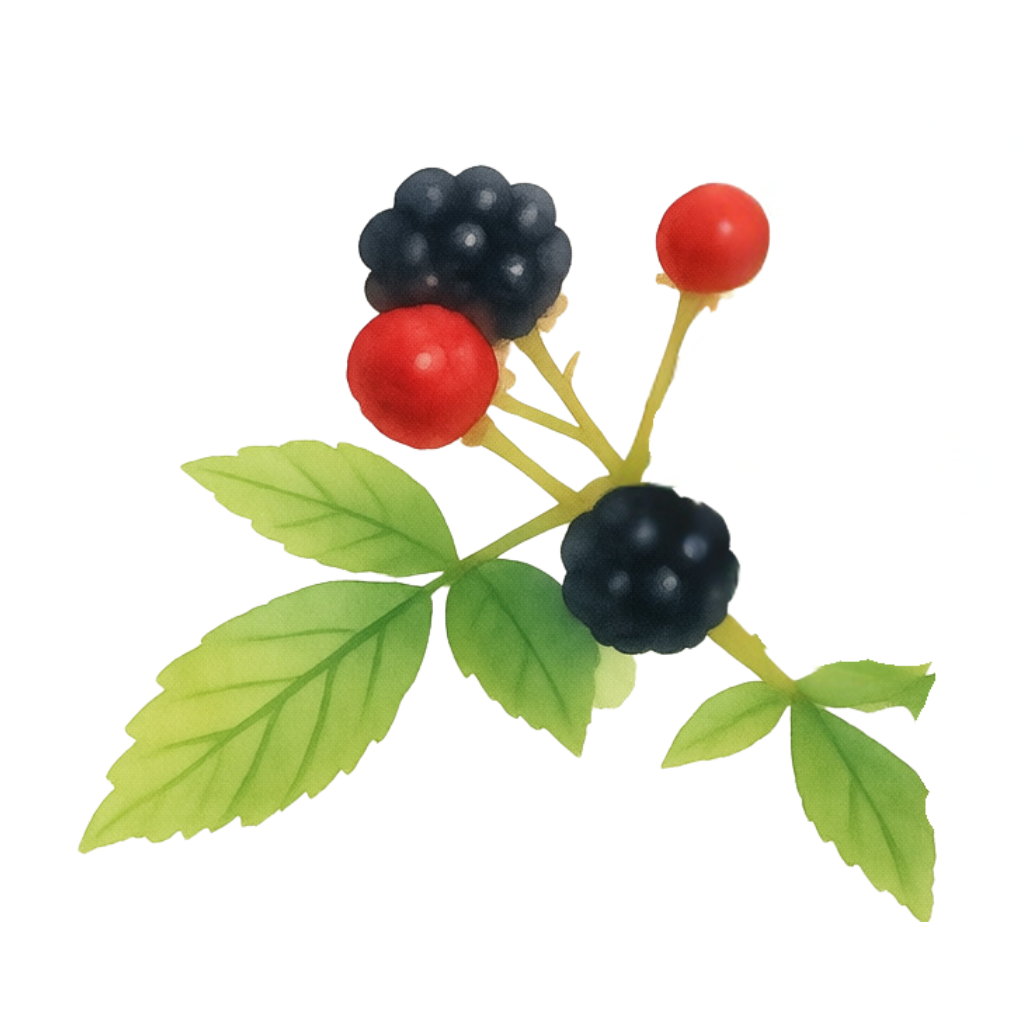
Northern Dewberry
Rubus flagellarisBotanical View
- Leaves are alternate and palmately compound, usually with 3 leaflets (sometimes 5) on vigorous canes. Leaflets are ovate to elliptic, roughly 1-3 inches long and wide, with doubly serrate (finely toothed) margins giving a delicately fringed appearance. They are green and mostly glabrous to sparsely hairy above, paler beneath, borne on prickly petioles. Foliage is semi-evergreen to deciduous depending on climate.
- Stems (canes) are low, trailing to arching and prostrate, sprawling along the ground rather than standing erect, and can reach 2.4-4.6 m (8-15 ft) long; flowering shoots rise up to about 1.2 m (4 ft). Young canes are green and armed with scattered stiff, hooked or hairy prickles; older canes become brown, woody and bear hard prickles. Cane tips readily root where they contact soil.
- The plant has a perennial woody root system (crown) that persists while the aboveground canes are biennial. It spreads clonally: trailing stem tips root on contact with the ground, producing new plantlets (tip layering), and the crown can produce new shoots, allowing colonies to form.
- The inflorescence is terminal (and sometimes on short axillary branches), typically bearing 1 to 5 flowers per flowering shoot, sometimes solitary. Flowers are showy, about 2.5 cm (1 inch) across, with five white petals, numerous stamens and pistils, opening by day. Blooms are followed by black aggregate fruits made of coalescent drupelets.
- Rubus flagellaris reproduces both sexually and asexually. Flowers are hermaphroditic (perfect) and insect-pollinated. Like many Rubus, it can set seed apomictically (seeds formed without sexual fusion), which fixes genotypes; it also reproduces vegetatively by tip rooting, so populations often consist of clonal individuals.
- Flowers are insect-pollinated, attracting a range of bees; recorded visitors include Lasioglossum pectorale, Ceratina and Osmia inspergens. The flowers are also a nectar source for butterflies, notably the endangered Karner blue butterfly (Lycaeides melissa samuelis).
- Grows on a wide range of soils, favoring well-drained sandy loams but tolerating coarse (sandy), medium (loamy/clay) and fine-textured soils. It is well adapted to dry, poor, sandy soils and prefers a slightly acidic to neutral pH of about 5.0-7.0.
- Propagated by seed and, most readily, vegetatively by tip layering, where the trailing cane tips root on contact with soil to form new plants; division of rooted crowns is also possible. Seeds have dormancy and typically require cold stratification (and benefit from scarification) to germinate.