Back to Fruitpedia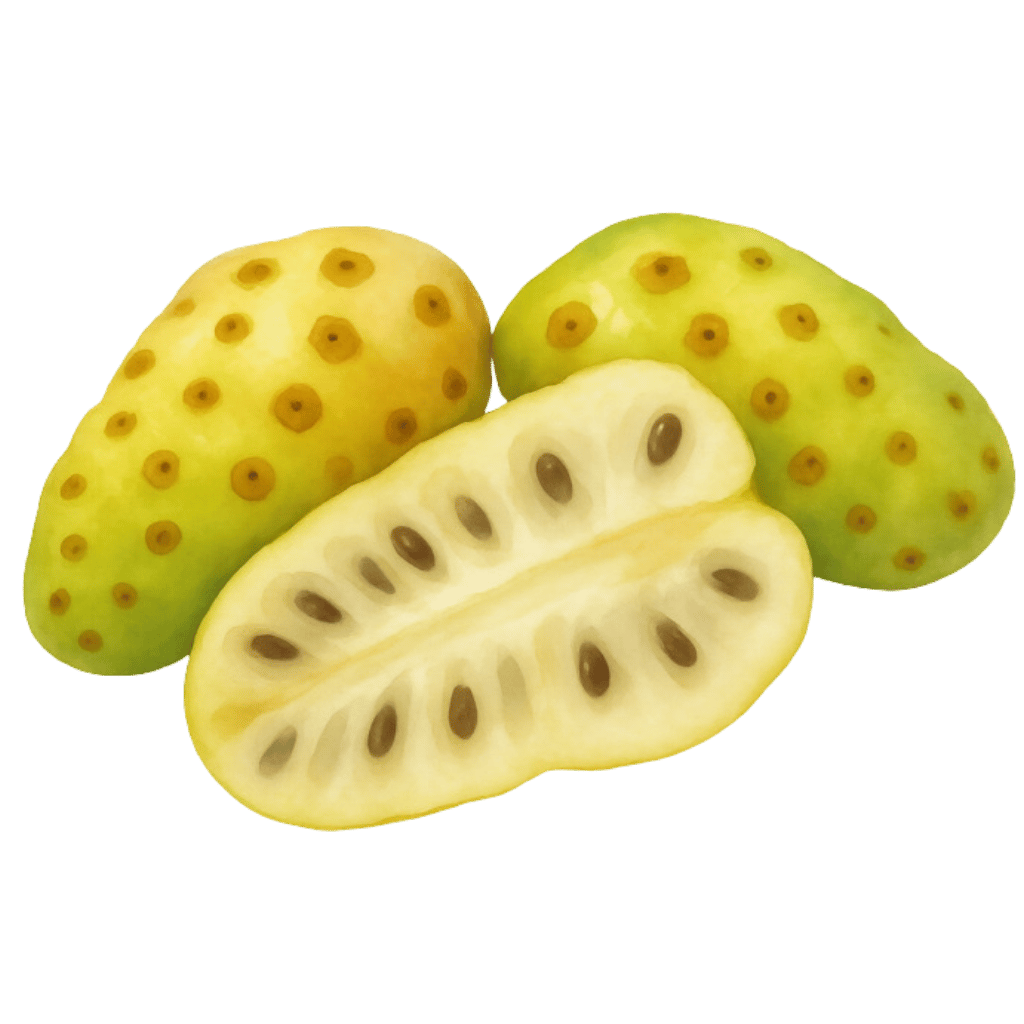
Noni
Morinda citrifoliaBotanical View
- Leaves are opposite, pinnately veined, glossy and glabrous, with membranous, elliptic to elliptic-ovate blades 20-45 cm long and 7-25 cm wide; petioles are stout, 1.5-2 cm long, with connate or distinct stipules 1-1.2 cm long that are entire or 2-3 lobed at the apex (Nelson, University of Hawaii CTAHR Species Profile). Embrapa's technical characterization similarly describes the leaves as large, evergreen ("perenes"), elliptic and dark green (Sousa et al., Embrapa Comunicado Tecnico 157).
- The stem and young branchlets are angular (quadrangular) in cross-section (CABI Compendium datasheet for Morinda citrifolia; Silva et al., PMC botanical review). Wood is yellowish in color. Branches are woody but brittle and may break under heavy fruiting loads or high winds. Growth rate is moderate, about 0.75-1.5 m per year; the plant regenerates readily after severe pruning ("stumping"), can be coppiced from shoots or root suckers, and can be pollarded back to the trunk to promote a dense head of foliage (Nelson, University of Hawaii CTAHR Species Profile).
- Morinda citrifolia develops a taproot system that provides efficient anchorage and deep soil penetration for nutrient and water access (Silva et al., PMC botanical review). Its overall rooting habit is described as similar to that of citrus and coffee, combining an extensive lateral root system with a deep taproot (Nelson, University of Hawaii CTAHR Species Profile). Roots can also produce suckers that allow vegetative regeneration (coppicing) after fire or cutting.
- Flowers are borne in dense, solitary, leaf-opposed heads (capitula) of about 75-90 perfect (bisexual) flowers per head, on peduncles 10-30 mm long. The calyx is a truncated rim; the corolla is white, 5-lobed, with a greenish-white tube 7-9 mm long and oblong-deltate lobes about 7 mm long; there are 5 scarcely exserted stamens and a style about 15 mm long (Nelson, University of Hawaii CTAHR Species Profile). Embrapa's technical description likewise notes the flowers as small and white (Sousa et al., Embrapa Comunicado Tecnico 157).
- Flowers are perfect (hermaphrodite/bisexual), with 75-90 flowers per head (Nelson, University of Hawaii CTAHR Species Profile). After pollination, the ovaries of the flowers within a head fuse and develop together into a single fleshy multiple fruit (syncarp), 5-10 cm long and about 3-4 cm in diameter, yellowish-white, soft and fetid when ripe. Reported chromosome number is 2n = 22, 44 (Nelson, University of Hawaii CTAHR Species Profile, citing Wagner, Herbst & Sohmer, Manual of Flowering Plants of Hawai'i).
- Noni flower nectaries are reported to be very attractive to honey bees, which serve as an important floral visitor ("bee forage") for the species (Nelson, University of Hawaii CTAHR Species Profile).
- The species tolerates a very wide range of soil types and drainage conditions, from acidic to alkaline, including shallow, saline, sodic and infertile soils, though it prefers free, well-drained soils and can also withstand seasonally waterlogged ground (Nelson, University of Hawaii CTAHR Species Profile). Embrapa likewise reports good tolerance of saline soils and drought conditions in cultivation in northeastern Brazil (Sousa et al., Embrapa Comunicado Tecnico 157).
- For nursery production, Embrapa recommends a substrate of tanned cattle manure, carbonized rice hulls and sterilized soil (1:1:1), amended with 500 g of 4-14-8 NPK fertilizer per 20 L of substrate (or, lacking that formulation, 45 g urea + 390 g simple superphosphate + 67 g potassium chloride per 20 L). Seedlings are irrigated daily to keep the substrate moist, with more frequent short irrigations (three to four times daily, 10-15 minutes each) early on, tapering to a single daily irrigation a few days before field transplanting (Sousa et al., Embrapa Comunicado Tecnico 157). In the field, a light top-dressing of slow-release or organic 8-8-8 fertilizer aids seedling growth and development, and heavy fertilization under full-sun monoculture is associated with the highest fruit yields, up to roughly 80,000 kg/ha (Nelson, University of Hawaii CTAHR Species Profile).
- Noni is propagated mainly by seed, and also by stem or root cuttings and air layering (Nelson, University of Hawaii CTAHR Species Profile). Seeds are extracted from fully ripe, soft, translucent fruit by macerating the pulp against a screen under running water; fresh-seed germination can exceed 90%, at roughly 40,000 seeds per kilogram. Without pretreatment, germination is sporadic over 6-12 months; scarification (e.g., briefly pulsing ripe fruit in a blender) shortens and synchronizes germination to about 20-120 days. Embrapa's Brazilian trials found germination beginning about 30 days after sowing, with 70% of germination complete by 60 days and some extending past 120 days; among pre-germination treatments tested (concentrated sulfuric acid soaks, hot-water soaks, a 24-hour room-temperature water soak), none significantly outperformed the untreated control (Sousa et al., Embrapa Comunicado Tecnico 157). Seedlings are grown under about 50% shade and transplanted to the field 60-70 days after sowing once they have 4-6 pairs of true leaves (Sousa et al., Embrapa Comunicado Tecnico 157); stem cuttings of about 20-40 cm can root within roughly 3 weeks and be ready for outplanting in 6-9 weeks (Nelson, University of Hawaii CTAHR Species Profile).
- Noni seeds contain a distinct trapped air chamber that lets them float and remain viable in water for months, aiding natural dispersal by ocean currents and streams (Nelson, University of Hawaii CTAHR Species Profile). There is considerable genetic and morphological variability within the species in fruit size, leaf form, fruit palatability, ripe-fruit odor, and seed number per fruit (Nelson, University of Hawaii CTAHR Species Profile). In Brazilian field material from Trairi, CE, average fruit weight was 166 g (length 101 mm, width 56 mm), pulp yield about 80% and seed yield about 4% by weight, giving roughly 1,200 seeds per kilogram of fruit at an average seed weight of 0.033 g (range 0.023-0.044 g) (Sousa et al., Embrapa Comunicado Tecnico 157).
- Recognized infraspecific taxa are Morinda citrifolia var. citrifolia - the common, morphologically diverse form of greatest economic and medicinal importance across the Pacific, including both large- and small-fruited types with no clearly distinct sub-populations - and M. citrifolia var. bracteata, a small-fruited variety with conspicuous bracts found in Indonesia and other parts of the Indian-Pacific region. An ornamental cultivar, 'Potteri', with green-and-white variegated leaves and small fruit, is distributed throughout the Pacific (Nelson, University of Hawaii CTAHR Species Profile). No formal breeding-derived commercial cultivars comparable to those of mainstream fruit crops are documented; planting stock is generally propagated from selected high-yielding, large-fruited mother plants rather than named breeding lines (Sousa et al., Embrapa Comunicado Tecnico 157).
- Noni has been used by Pacific Islander/Polynesian peoples for more than 2,000 years and was historically propagated from seed by traditional growers rather than through formal breeding programs (Sousa et al., Embrapa Comunicado Tecnico 157, citing Leon & Poveda 2000). No structured breeding or cultivar-development program is documented in the reviewed literature; genetic variation exploited commercially comes from selecting seed off wild or naturalized mother plants with desirable traits (large fruit, vigorous leaf growth) rather than from bred lines (Nelson, University of Hawaii CTAHR Species Profile). Commercial cultivation in Brazil is recent and began informally with growers importing seed from the Caribbean or Polynesia, predating the systematic agronomic/propagation research later carried out by Embrapa Agroindustria Tropical (Sousa et al., Embrapa Comunicado Tecnico 157).