Back to Fruitpedia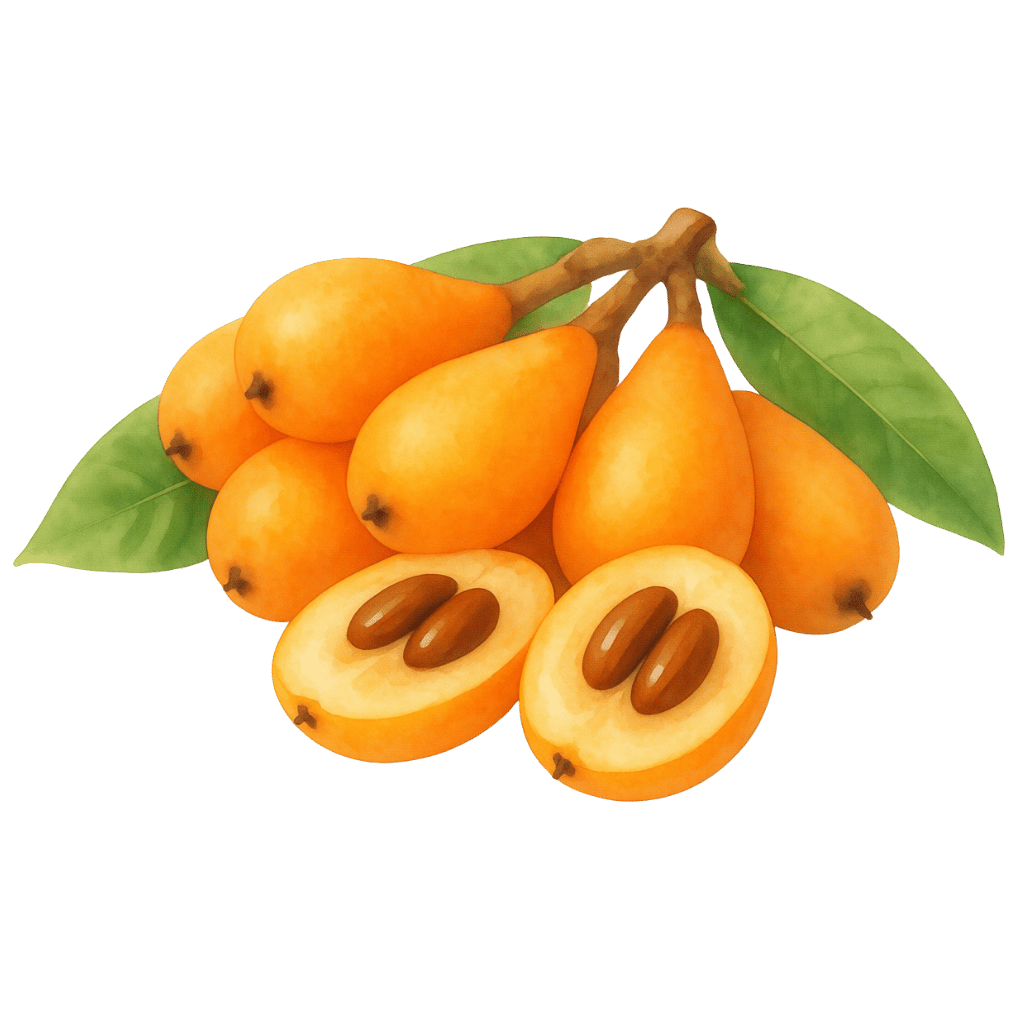
Loquat
Eriobotrya japonicaVarieties
Mizuho
Fukuhara
Tanaka
Centenária
8.3° BrixMizumo
11.8° BrixNéctar de Cristal
Botanical View
- Leaves are alternate, simple, oblong-elliptic to lanceolate, thick and coriaceous (leathery), typically 10-25 cm long. The dark-green upper surface has deeply impressed, quilted-looking veins; margins are entire toward the base and serrate/dentate over the outer two-thirds. The lower surface, along with young shoots and petioles, is densely covered in rusty-brown to yellowish-brown tomentum (woolly hairs). Anatomically, the leaf is hypostomatic (stomata confined to the lower epidermis, with an anomocytic arrangement lacking specialized subsidiary cells); the epidermis is uniseriate under a thick, finely striated cuticle, the mesophyll is dorsiventral, and idioblasts containing calcium oxalate crystals, mucilage and phenolic compounds occur throughout the tissue.
- The tree normally develops a single trunk with gray-brown, somewhat patchy, exfoliating bark, and an unarmed (thornless) canopy. Current-season twigs are thick and densely covered in rusty-brown woolly tomentum, matching the young leaves. Growth is moderate, and branches show reasonable resistance to breakage, though structural pruning is typically needed; branches tend to droop as the tree matures, and mature specimens can reach up to about 10 m, though cultivated trees are usually maintained at roughly 3-6 m.
- Germinating loquat seedlings develop a prominent taproot that can reach up to about 2.5 m deep, anchoring the tree and accessing deeper soil moisture; over time this is complemented by laterally spreading, more superficial fibrous roots. The root system is notably intolerant of waterlogged or poorly aerated soils, which predisposes own-rooted trees to root problems in humid conditions; for this reason growers sometimes graft loquat onto quince (Cydonia oblonga) rootstock, which also tolerates wetter, less-aerated soils and reduces overall tree vigor.
- Flowers are borne in dense, many-flowered (up to roughly 100 flowers) terminal panicles about 10-20 cm long, with the peduncle, pedicels and hypanthium densely covered in rusty-brown tomentum. Individual flowers are fragrant and 1.2-2 cm across, with 5 triangular-ovate, tomentose sepals (2-3 mm) and 5 white, oblong-to-ovate petals (about 5-9 x 4-6 mm). Each flower has roughly 20 stamens and a shallowly cupular hypanthium enclosing an inferior ovary of 2-5 fused carpels/locules (typically 5), each locule with 2 ovules, topped by 2-5 free styles.
- Loquat bears hermaphroditic (perfect/bisexual) flowers and produces a pome fruit, as in other Maleae. Like most pome fruits it possesses a gametophytic self-incompatibility system controlled by a polymorphic S-locus (S-RNase), which normally rejects pollen sharing the same S-allele as the recipient. However, loquat differs from close relatives such as apple and pear in that many cultivars are functionally self-compatible (a subset of studied cultivars show self-compatibility, possibly linked to an S6-RNase mutation), allowing some self-fertilization; nonetheless, cross-pollination between cultivars generally produces earlier, higher and more reliable fruit set.
- Loquat is insect-pollinated (entomophilous), primarily by honeybees (Apis mellifera) and other bees and flies attracted to the fragrant flowers. Because it flowers in autumn/winter when few other plants bloom, it serves as an important nectar and pollen source for bees during that period. Research on the cultivar 'Algerie' found that fruit set and quality depend on adequate pollinator insect activity together with proper placement of pollenizer trees in the orchard.
- Loquat tolerates a wide range of soil textures, including clay, sand and loam, and a wide pH range from acidic to alkaline/high-pH soils, provided drainage is good. It shows moderate tolerance of aerosol salt but is notably intolerant of waterlogged or poorly aerated soils, which favor root problems; on heavier or more humid soils, growers commonly use quince (Cydonia oblonga) rootstock or ensure adequate slope/drainage to move surface water away from the root zone.
- In Mediterranean production areas (e.g., Callosa d'en Sarrià, Spain), loquat requires supplemental irrigation to offset markedly seasonal rainfall, with reported water allocations of roughly 3,000-4,500 m3/ha per year (IVIA). In Brazilian orchards (São Paulo), typical adult-tree annual fertilization is around 3 t/ha of poultry manure (or about 15 t/ha of composted cattle manure) plus 60-120 kg/ha N, 20-90 kg/ha P2O5 and 20-100 kg/ha K2O, adjusted to soil analysis; commercial growers otherwise fertilize according to soil-test results. Overfertilization, particularly excess nitrogen, is discouraged because it increases shoot succulence and susceptibility to fire blight. Regular watering is recommended while trees are establishing and during drought stress, with mulching to conserve soil moisture; established trees show moderate drought tolerance.
- Commercial propagation is done almost exclusively by grafting of selected cultivars, either onto loquat seedling rootstock or onto quince (Cydonia oblonga, e.g., cv. 'Portugal') rootstock, which reduces tree vigor/size and improves tolerance of humid, poorly aerated soils compared with own-rooted trees. Cleft ("whip-and-tongue"/full-cleft) grafting is a standard technique. Propagation from cuttings is possible but has low success (rooting rates up to about 15% reported for herbaceous cuttings) and is not used commercially. Seed propagation is used mainly to raise rootstock seedlings, since seedling trees are highly variable and do not come true to the parent cultivar.
- Loquat seeds are comparatively large and recalcitrant, meaning they do not survive drying and lose viability quickly in storage (viability drops sharply within about 60 days once seed moisture falls to around 25%). Best germination is obtained by sowing seed shortly after extraction from ripe fruit; moist-chilling pretreatment further improves and speeds germination in research trials. Because loquat is propagated from seed only to raise rootstocks (see Propagation), seedling progeny is genetically variable and does not come true to the parent cultivar, so all commercial fruiting cultivars are maintained by grafting rather than seed.
- Numerous regional cultivars exist. Brazil (Instituto Agronômico de Campinas, São Paulo): 'Mizuho', 'Mizumo', 'Mizauto', 'Centenária', 'Precoce de Campinas' (IAC 165-31), 'Precoce de Itaquera' ('Fukuhara'), and advanced selections such as 'IAC 265-66'. Spain (IVIA germplasm bank/breeding program): 'Algerie', 'Alfonso Gregori', 'Cardona', among others bred for extended harvest windows. United States (Florida/California): 'Advance' (heirloom, 1897), 'Champagne' (self-infertile but a good pollenizer), 'Gold Nugget', 'Oliver', 'Premier' (dwarf, container-suitable) and the variegated-leaf ornamental 'Coppertone'. Japan/China (foundational parent cultivars): 'Mogi', 'Tanaka', 'Kusunoki' and 'Zaozhong-6'.
- Loquat originated in southeastern China (Sichuan, Hubei and neighboring provinces) and has been cultivated there for over 1,000-2,000 years. It was introduced into Japan, where it has been grown for more than 1,000 years; loquat seeds are known from Yayoi-period archaeological sites (c. 300 BC-300 AD) and written records date to 762 AD. Superior Chinese cultivars introduced to Japan during the Edo period (1600-1868) were further selected there, giving rise to the key Japanese cultivars 'Mogi', 'Tanaka' and 'Kusunoki', which became the main parents of subsequent Japanese breeding via crossing and bud-sport selection. Loquat reached Europe in 1784 (Jardin des Plantes, Paris) and 1787 (Royal Botanic Gardens, Kew), then spread around the Mediterranean and North Africa; it was introduced to California from Japan around 1867-1899. Modern institutional breeding programs include the Instituto Valenciano de Investigaciones Agrarias (IVIA, Spain), which has maintained a loquat germplasm bank and run a directed-crossing improvement program since 2002 (releasing cultivars such as 'Alfonso Gregori' and 'Cardona'), and the Instituto Agronômico de Campinas (IAC, São Paulo, Brazil), whose selection and grafting trials produced cultivars such as 'Mizuho', 'Mizumo', 'Mizauto' and 'Centenária'. Genome-wide (RAD-Seq) diversity studies group loquat accessions into an East Asian (Chinese/Japanese) cluster and a genetically distinct non-East Asian cluster (Mediterranean, Israeli, American, Vietnamese material), reflecting this separate history of introduction and selection outside Asia.