Back to Fruitpedia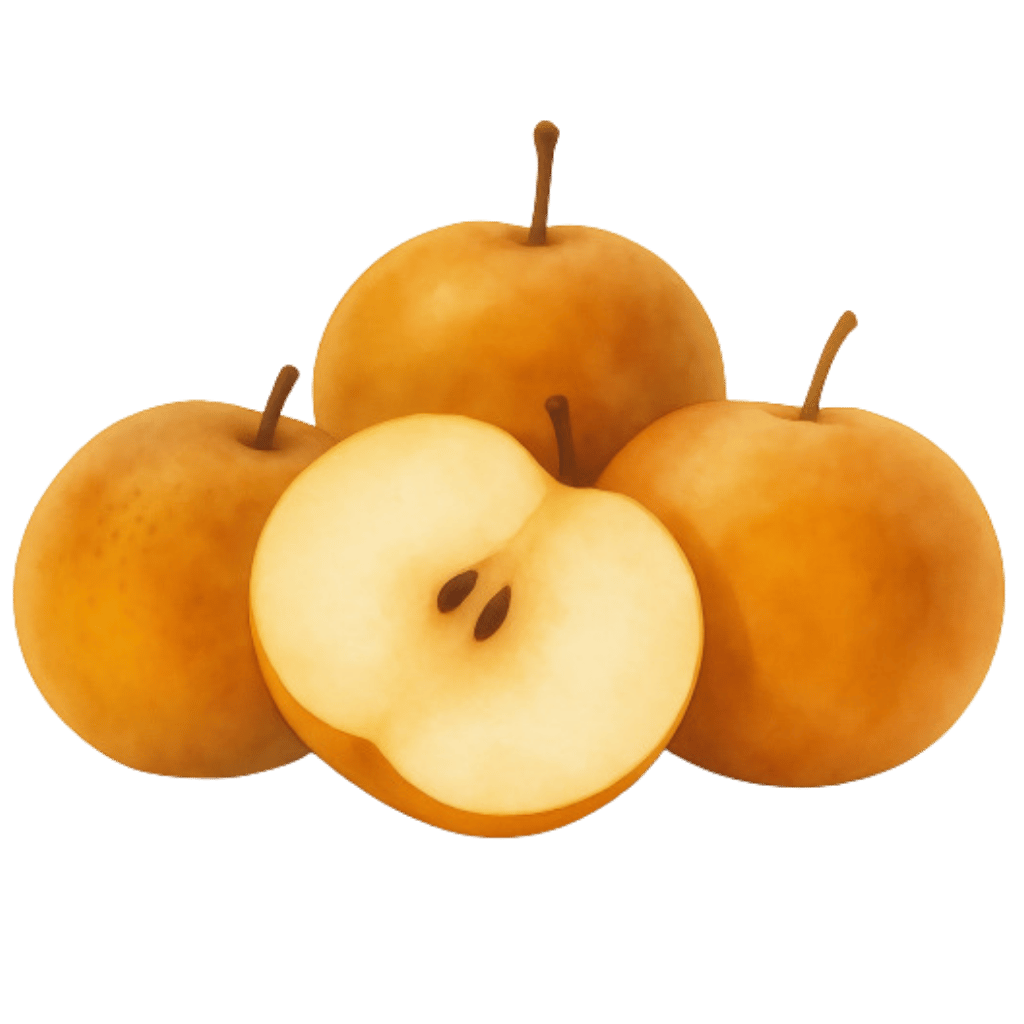
Nashi pear
Pyrus pyrifoliaVarieties
Kosui
12–14° BrixHosui
12–13° BrixNijisseiki
10.5–12° BrixChojuro
11–13° BrixShinseiki
12–14° BrixAkizuki
13–15° BrixBotanical View
- Leaves are alternate, simple, oblong-ovate to ovate, about 7-10 cm (2.75-4 in) long and roughly half as wide, acuminately tapered at the apex, rounded (occasionally slightly cordate) at the base, with margins conspicuously bristle-toothed (finely serrate with awned teeth). Young leaves are hairy beneath, becoming glabrous at maturity. Petioles are stipulate. Foliage is glossy dark green in summer, turning yellow, orange, or red in autumn.
- A tree to about 12 m (40 ft) in the wild, generally 3-5 m in cultivated orchard form depending on rootstock; growth habit dense, often multi-trunked, pyramidal to rounded, and comparatively fast-growing. Branchlets are glabrous or nearly so at maturity and reddish- or purplish-brown; buds are hairless, involute, with imbricate scales, characteristic of the genus Pyrus generally.
- ""
- Flowers are borne on 2-year-old or older spurs, arranged in a loose, umbel-like corymb (raceme) of about 6-9 flowers on pedicels roughly 3-5 cm (1.25-2 in) long, appearing before or together with the new leaves. Calyx lobes are ovate, acute, hairy on the inner surface, with finely toothed margins.
- Flowers are perfect (hermaphroditic), with white (rarely pinkish) obovate petals about 2 cm long, reflexed or spreading sepals, 20-30 pink, red, or purple anthers, and typically 5 free styles constricted at the base, with 2 ovules per locule. As in most cultivated Pyrus, P. pyrifolia is a cross-compatible, self-incompatible diploid: pollen-tube growth in the style is blocked by a gametophytic S-RNase-based self-incompatibility system, so most cultivars require cross-pollination with a compatible pollenizer cultivar for fruit set. Naturally occurring and induced (gamma-irradiation-derived) self-compatible mutants, associated with segmental duplications at the S-locus region (e.g., on chromosome 17), have been identified and used in breeding.
- The species is insect-pollinated (entomophilous). Flowers are visited for nectar and pollen chiefly by honey bees (Apis mellifera), as well as bumblebees (e.g., Bombus ignitus) and various solitary bees and flies; bumblebees show a measurable preference for flowers of male-fertile cultivars, whose pollen has a higher protein/lipid ratio than that of male-sterile cultivars. Because bloom occurs early in spring under often cold, windy, or rainy conditions that limit insect activity, hand (artificial) cross-pollination has been widely practiced in commercial Japanese pear orchards since the 1950s to ensure adequate fruit set.
- Grows best in deep, well-drained soils; it tolerates a range of textures from clay to sandy loam but performs poorly in waterlogged ground. Recommended soil pH is about 5.9-6.5 (slightly acidic to near-neutral).
- Fertilization is typically applied as a balanced N-P-K formulation (e.g., 10-10-10) split between a dose before growth begins in spring and a second after fruit set; young, actively growing trees have a proportionally higher nitrogen demand than mature bearing trees. Excess nitrogen is avoided because it promotes succulent new shoot growth that is more susceptible to fire blight infection. Drip or micro-sprinkler irrigation is preferred over overhead sprinklers, since keeping the canopy and fruit dry reduces foliar and fruit disease pressure; overhead sprinkling is sometimes used only briefly for canopy cooling in summer.
- Commercial cultivars are clonally propagated by budding or grafting onto seedling rootstocks, since the species is an obligate outcrosser and seedlings do not come true to type. T-budding onto field-grown rootstocks in late summer (when bark is "slipping") is standard nursery practice, with chip-budding used when bark is not slipping; whip-and-tongue or cleft grafts are used for top-working established trees. Rootstocks commonly used for Asian pear cultivars include seedlings of Callery pear (P. calleryana) and birch-leaf pear (P. betulifolia), while Ussuri pear (P. ussuriensis) seedlings are used where greater cold hardiness is required; common pear (P. communis) cultivar seedlings (e.g., 'Bartlett') are also used as rootstock in North America. Pyrus is graft-compatible with a number of other Maloideae genera, including Amelanchier, Cotoneaster, Crataegus, Malus, Mespilus, Peraphyllum, and Sorbus.
- Because P. pyrifolia is self-incompatible and cross-pollinated, seedlings are highly heterozygous and do not reproduce the parent cultivar's traits, so seed propagation is used only for generating rootstock or breeding populations, never for cultivar increase. Each fruit contains up to about 10 smooth, blackish seeds with a thin endosperm layer. Reported seed dimensions average about 8.7 mm long by 4.4 mm wide (length/width ratio ~1.98), with roughly 26,000 seeds per kg (about 12,000/lb). Embryos are dormant at harvest and require about 120-170 days of cold stratification at approximately 4 °C before epigeal germination, which then takes about 5-30 days at 20 °C.
- Several thousand cultivars are estimated to exist worldwide, with more than 150 documented in Japan alone during the Edo period (1603-1868). Commercial Japanese pear production expanded rapidly following the chance-seedling discoveries of 'Chojuro' and 'Nijisseiki' ("Twentieth Century") around 1890. Deliberate breeding since the early-to-mid 20th century, including at Japanese prefectural agricultural experiment stations, produced cultivars such as 'Shinseiki' (a 'Nijisseiki' x 'Chojuro' cross released in 1945) and later leading cultivars 'Kosui', 'Hosui', and 'Akizuki'. Cultivars are broadly grouped by skin type into russeted cultivars (e.g., 'Chojuro', 'Kosui', 'Hosui', 'Niitaka') and smooth green- or yellow-skinned cultivars (e.g., 'Nijisseiki'). Cultivars also differ markedly in fire blight susceptibility and in chilling requirement, and Chinese- versus Japanese-type cultivars differ in bloom timing, which affects pollenizer compatibility.
- Pyrus pyrifolia is considered likely the first pear species domesticated for edible fruit, cultivated in China for roughly 3,000 years; pears are mentioned in the Shijing (Book of Odes), an anthology of Chinese poetry from the 11th-7th centuries BCE. Natural hybridization between wild sand pear and wild Ussuri pear in central China, followed by millennia of human selection, is believed to have produced the larger-fruited, edible domesticated types. The species spread to Korea by the Three Kingdoms period and reached Japan by around the 7th century CE (archaeological pear seed finds in Japan have been dated to roughly 200-300 CE), after which regionally independent selection in China and Japan produced genetically and phenotypically distinct cultivar groups. Japan alone documented more than 150 cultivars during the Edo period (1603-1868). The modern Japanese commercial industry expanded rapidly after the chance-seedling discoveries of 'Chojuro' and 'Nijisseiki' around 1890, and organized breeding programs at prefectural agricultural experiment stations subsequently produced cultivars such as 'Shinseiki' (1945) and continue to release new selections (e.g., 'Kosui', 'Hosui', 'Akizuki'). The species was introduced to Western cultivation by plant collector E. H. Wilson, who sent material to the Arnold Arboretum in 1909. Breeding programs outside Asia, such as at the University of Florida, have crossed P. pyrifolia with P. communis to develop low-chill hybrid cultivars suited to subtropical growing regions.