Back to Fruitpedia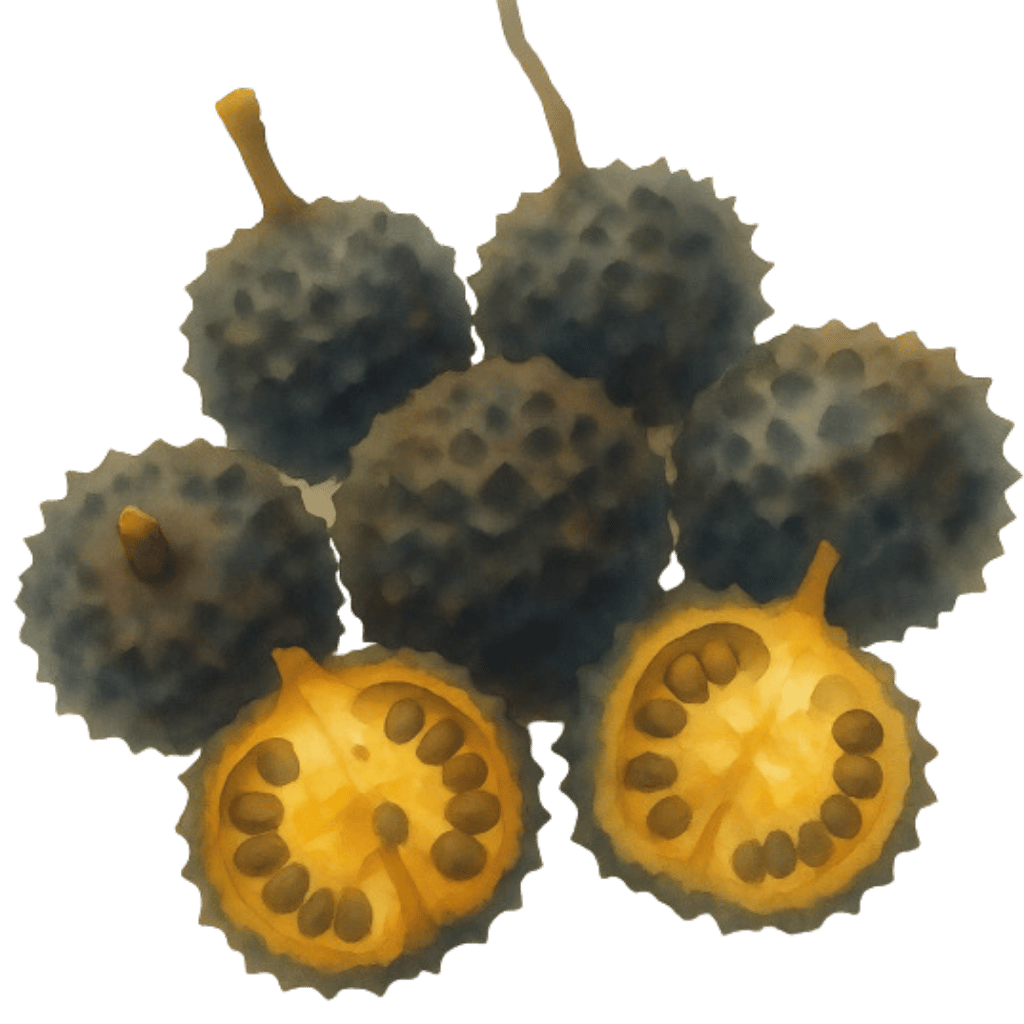
Mutamba
Guazuma ulmifoliaBotanical View
- Leaves are alternate, simple, arranged in two flattened rows along the branchlets, and ovate to lanceolate in outline, 5–18 cm long (occasionally to about 21 cm) by 2–6 cm wide. The blade is membranous, more or less acute at the apex, often somewhat unequal (oblique) at the base, with a finely toothed to crenate margin. The upper surface is scabrous/pilose and the lower surface is tomentose with star-shaped (stellate) hairs, especially dense along the midrib; three, sometimes five, principal veins radiate from the leaf base. Leaves become glabrous and glossy with age. The canopy sheds its leaves only after an extended dry period.
- The trunk is short and straight to slightly tortuous, frequently forked or branched at low height, with a merchantable bole of up to about 12 m. Branching is dichotomous and gives the crown its characteristic dense, broad, umbrella-like form. Bark reaches up to 12 mm in thickness; the outer bark is grayish to dark brown, longitudinally grooved and rough, and peels off readily in rectangular plates or strips, while the inner bark is fibrous, pinkish, and marked with white striations. The wood is moderately dense (about 0.50–0.68 g/cm³), pale yellowish to pinkish-beige with a slight color difference between sapwood (light brown) and heartwood (pinkish-brown), an interlocked grain, fine-to-medium texture, and well-defined growth rings.
- Detailed morphological studies of the root system are not reported in the consulted sources, but several functional traits are documented. Seed-grown plants develop a taproot, whereas plants propagated from stem cuttings do not form a taproot. The species is described as highly dependent on arbuscular mycorrhizal fungi for normal seedling development, and shows only average natural colonization by these fungi in the field. It produces vigorous sprouts from the stump/root crown after cutting (coppices well). Prolonged waterlogging of the planting site has been observed to cause regressive dieback of the crown apex without killing the tree outright, indicating limited tolerance of saturated soils at the root zone.
- The inflorescence is an axillary, branched panicle (described elsewhere as a thyrsiform cyme) borne on peduncles 2.5–5 cm long at the leaf bases, typically bearing up to about 40 flowers per inflorescence.
- Guazuma ulmifolia is described in the Brazilian forestry literature as a monoecious species. Individual flowers are small (5–10 mm long), whitish-yellow to brownish-yellow, slightly fragrant, and five-parted, with a yellowish staminal column bearing roughly 15 anthers. The fruit is a hard, warty (verrucose), subglobose to elliptical woody capsule, 1.5–3.5 cm long, containing on average about 46.6 seeds embedded in a sweet, mucilaginous pulp; in Brazilian populations the capsule splits into five valves at the apex or opens irregularly through pores, while some other regional treatments describe the capsule as indehiscent to only tardily dehiscent. Seed dispersal is essentially zoochorous, mainly by birds and fish, and also by mammals including cattle and possibly horses. Reproductive maturity begins at around 5 years of age, and flowers, immature fruit and mature fruit are frequently present on the same tree simultaneously.
- Pollination is effected essentially by bees, along with a variety of small insects. The flowers are melliferous, producing abundant nectar and are valued in apiculture as a source of a flavorful, high-quality honey.
- The species is not demanding with regard to soil type, growing on both dry and moist sites and most frequently on sandy-textured soils, but also on alluvial and clay soils, and on soils derived from limestone. It is considered a calcicolous species and an indicator of mesotrophic soils in Brazilian phytosociological studies, and is more frequent on soils with pH above 5.5. It is adapted to compacted soils, though growth is slower under such conditions, and it does not perform well in heavily compacted or high-clay soils or where it must compete with invasive vegetation. It tolerates temporary drought once established but is sensitive to prolonged flooding of the root zone.
- Specific field fertilization or irrigation protocols for established plantings are not documented in the consulted sources; mature trees tolerate temporary drought and are generally grown without irrigation once established. For nursery seedling production, recommended substrates are rich in organic matter, including earthworm humus alone or combined with carbonized rice husk and/or fine vermiculite (e.g., 80% earthworm humus + 20% carbonized rice husk, or 60% humus + 20% carbonized rice husk + 20% fine vermiculite), or well-cured cattle manure alone; seedlings can be produced under a light gradient from full sun to about 40% shade.
- Propagation is by seed and, vegetatively, by stem cuttings, root stumps, or bare-root seedlings; coppice (stump) sprouting is vigorous. Seeds are collected directly from the tree when capsules turn brown to black and begin to open spontaneously, or gathered from the ground after natural fall, then sun-dried to ease manual or mechanical breaking of the capsules for seed extraction. Seeds carry a hard-seed-coat (mechanical) dormancy and are coated in mucilage that must be removed for good germination. Effective pre-germination treatments include chemical scarification with sulfuric acid (15–50 minutes) or hot-water treatment (immersion at about 80–90 °C for 1–8 minutes, followed by manual washing to remove mucilage and, in some protocols, a further 12–24 hours of soaking in room-temperature water). Germination is epigeal (phanerocotylar), with the best laboratory results at a constant 30 °C; emergence begins 6–14 days after sowing once dormancy has been broken. Seedlings are sown in shaded seedbeds or directly in polyethylene bags or polypropylene tubes (about 50 cm³) with an organic-matter-rich substrate, and are typically pricked out two to four weeks after germination; they are ready for field planting roughly four months (about 15 weeks in some accounts) after sowing. Homogeneous full-sun plantings at spacings such as 2 m × 2 m can achieve canopy closure within about 12 months, and the species can also be planted in mixed stands or as a single-row or side row in shelterbelts.
- Seeds are ovoid, hard, brown to black, and about 3–5 mm in diameter (reported elsewhere as roughly 2.5–4 mm × 1.8–2 mm). Seed counts per kilogram vary considerably among sources/populations, from about 159,000 to 225,000 seeds/kg. Fruit capsules contain on average about 46.6 seeds. Germination is variable and irregular because a substantial proportion of seeds in any given lot are non-viable, but germination can reach up to 80% with fresh, properly treated seed; germination drops to below 60% with seed one year old or older, even when given the same pretreatment. Seeds are classified as orthodox in storage behavior: germinability remains above initial levels for more than 90 days under ambient storage, and cold storage at 5 °C preserves germination capacity for at least six months, with some lots retaining viability after a year of storage; germination percentage declines only gradually (e.g., from 58% initial to 57–58% after cold or freezer storage in one study).
- No formally named or registered cultivars of Guazuma ulmifolia are documented in the consulted sources. A tree-improvement effort in Brazil (Borges, Kageyama & Geres, 1995, as cited by Embrapa) screened 200 candidate trees across 60 ha of plantings and selected 60 superior "plus trees" (a selection intensity of about 1:500), which showed an average superiority of 30.85% in height (range 23.93–51.18%) and 21.90% in crown diameter (range 0–56.28%) over the general population, establishing a basis for a breeding program, but no named cultivar or clonal line resulting from this work is reported.
- No history of formal domestication as a cultivated crop is documented; Guazuma ulmifolia remains essentially a wild and naturalized multipurpose tree harvested from native vegetation, secondary growth, and pastures across its Neotropical range rather than a bred agricultural crop. Historically it held economic importance during the colonial period in the Antilles as a preferred source of charcoal for gunpowder manufacture (notably in the Dominican Republic to help defend Santo Domingo, and also in Puerto Rico and Guatemala), and it continues to be used regionally for firewood and charcoal. The only documented genetic-improvement effort is the Brazilian plus-tree selection program described above (Borges, Kageyama & Geres, 1995), which identified superior individuals for growth traits as a starting point for a breeding program; no subsequent release of improved cultivars or clonal breeding lines is reported in the consulted sources.