Back to Fruitpedia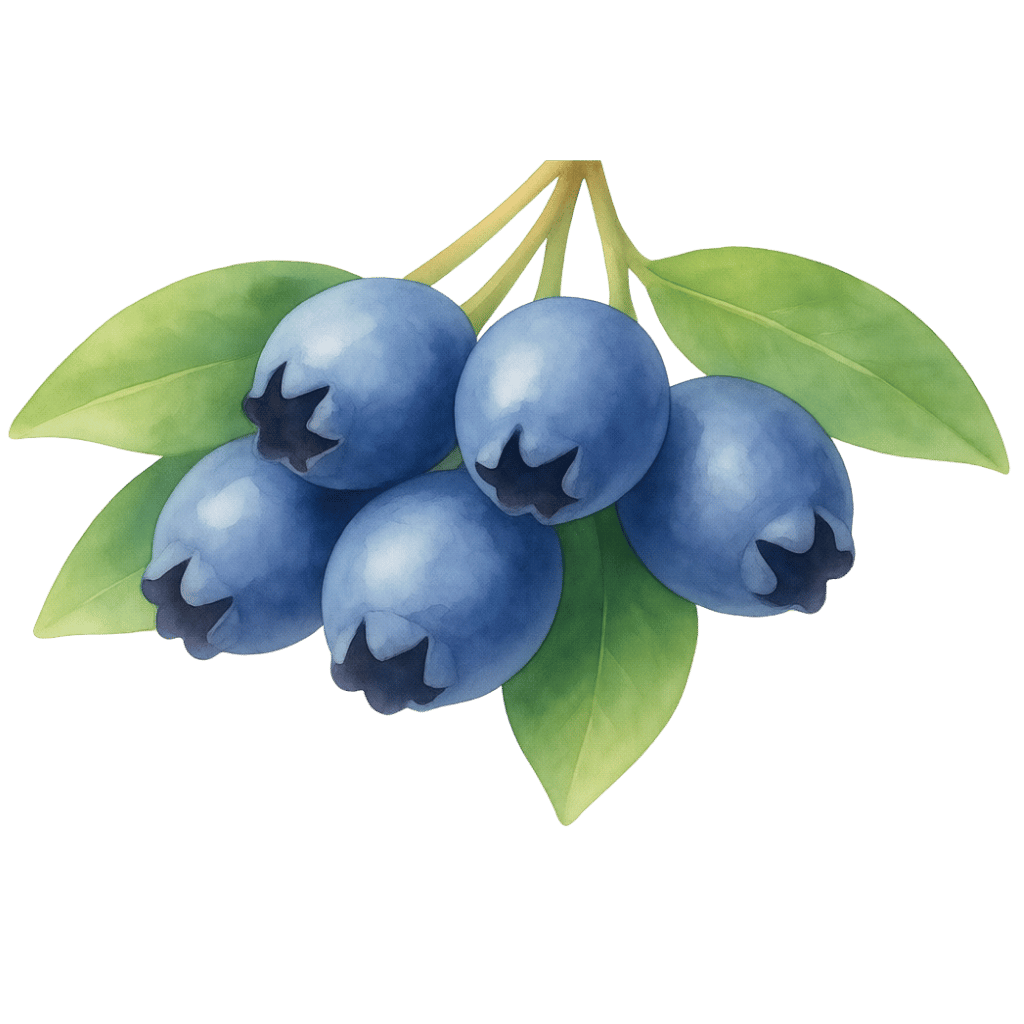
Murta fruit
Blepharocalyx salicifoliusBotanical View
- Leaves are simple, opposite, elliptic to narrowly elliptic, of cartaceous (papery-firm) consistency, dark green and glossy. The leaf blade measures 1.5-7 cm long by 0.4-2.5 cm wide, is puberulent to glabrous, with an acuminate and mucronate apex and a cuneate base; the midrib is sulcate (grooved) on the adaxial (upper) face, and the petiole measures 0.3-0.5 cm. The species shows marked geographic variation in leaf size and shape across its range. Young leaves are never reddish, which, together with the strongly acuminate leaf apex, helps distinguish murta seedlings from similar-looking Myrtaceae such as the pitangueira (Eugenia uniflora).
- The trunk is generally quite straight and cylindrical, with a bole reaching up to 6 m in length. Branching is tortuous and initially thick, with thin, flexible, pendant terminal branchlets reminiscent of a willow (Salix) - the origin of the epithet "salicifolius." The crown is ample and dense. Bark reaches up to 20 mm thick; the outer bark is densely fissured longitudinally and dark brown, resembling the bark of Melia azedarach (chinaberry) but with deeper fissures, and also similar to that of Eugenia rostrifolia (batinga).
- Detailed descriptions of the root system architecture (e.g., taproot depth, lateral spread) were not found in the consulted government/academic sources. Ecologically, the species is noted to occur naturally in moist, compacted soils with fairly slow drainage, suggesting tolerance of periodically waterlogged or poorly aerated substrates, but explicit root-system morphology data are unavailable.
- Inflorescences are dichasia smaller than the leaves, either compound or sometimes simple, axillary or terminal, measuring 3-6 cm in length, with puberulent axes and bearing 3-7 flowers, the central flower being sessile. Flowers are small and fragrant, with white petals (sometimes pink in bud) and numerous small stamens (reported elsewhere at roughly 160-203 per flower). The fruit is a globose berry, dark purple, crowned by a quadrangular scar, measuring 5-6 mm in diameter, containing 1-4 seeds (average 1.64 seeds per fruit).
- The species is monoecious, bearing bisexual (perfect) flowers with functional stamens and pistil on the same individual. Flowering occurs from July to November (varying by region, see Flowering season), and fruit dispersal is zoochoric, carried out principally by birds (avifauna) and the tegu lizard (Tupinambis/Theju tupinamba).
- Pollination vector: essentially bees and various small insects.
- Occurs naturally on Litossolos (shallow, stony Lithosols/Leptosols), in moist and compacted soils, on gently sloping ground (aclive suave) with fairly slow (poor) drainage. A silvicultural growth trial in Rolândia, Paraná, was conducted on a Latossolo Vermelho distroférrico (LVdf, a clayey Oxisol).
- No specific fertilization or irrigation protocol for cultivated planting is documented in the consulted Embrapa literature. The species is recommended for mixed plantings in full sun (pleno sol) and is traditionally used in the Faxinal agroforestry system of southern Brazil; the only reported growth data come from an unfertilized/unirrigated experimental planting (5 x 5 m spacing) on a Latossolo Vermelho distroférrico in Rolândia, PR, which after 4 years showed 100% survival, mean height of 4.06 m and mean DBH of 3.9 cm.
- Propagation is by seed. Fruits are harvested directly from the tree with the aid of a ladder and pruning pole when they change color, then processed by rubbing them through appropriately sized sieves under running water to remove the pulp, after which seeds are shade-dried in a ventilated location. De-pulping is important: depulped seeds achieved germination over 80%, nearly double that of seeds sown as whole (unprocessed) fruit. No pre-germination treatment is necessary. Recommended laboratory germination conditions are 25°C on a vermiculite substrate. For seedling production, sowing is done in seedbeds using vermiculite substrate, with pricking-out 5-7 weeks after sowing into polyethylene bags or medium-sized polypropylene tubes; germination is epigeal and phanerocotylar, with emergence beginning 30-50 days after sowing.
- Seeds are reniform (kidney-shaped), 4-5 mm long, with a recalcitrant storage behavior, beginning to lose germinative capacity 15-20 days after harvest. Reported seed counts range from 55,000 to 64,257 seeds per kilogram across studies. Germinative power (germination rate) is notably variable among studies, ranging from 24.8% to 83%. Fruits contain 1-4 seeds, averaging 1.64 seeds per fruit. The species overall exhibits considerable morphological variability across its geographic range (particularly in leaf size and shape), and the botanical literature records a substantial number of taxonomic synonyms, consistent with this variability.
- No named cultivars or formally selected varieties are documented. Blepharocalyx salicifolius remains an undomesticated native forest species propagated from wild-collected seed for reforestation, agroforestry (Faxinal system) and mixed silvicultural plantings; no genetic improvement or cultivar-development program is reported in the consulted sources.
- Blepharocalyx salicifolius has no documented history of formal domestication or genetic breeding. It is a native Brazilian forest species historically used within traditional land-use systems, notably the Faxinal agroforestry system of southern Brazil, and is recommended by Embrapa for mixed reforestation plantings in full sun and for riparian restoration/recovery plantings along riverbanks and hydroelectric reservoir margins, given that its fruits are highly attractive to birds. The only documented silvicultural growth trial is a single experimental planting (Embrapa Florestas / Fazenda Bimini, Rolândia, PR), evaluated at 4 years of age with 5 x 5 m spacing, 100% survival, mean height 4.06 m and mean DBH 3.9 cm on a Latossolo Vermelho distroférrico soil.