Back to Fruitpedia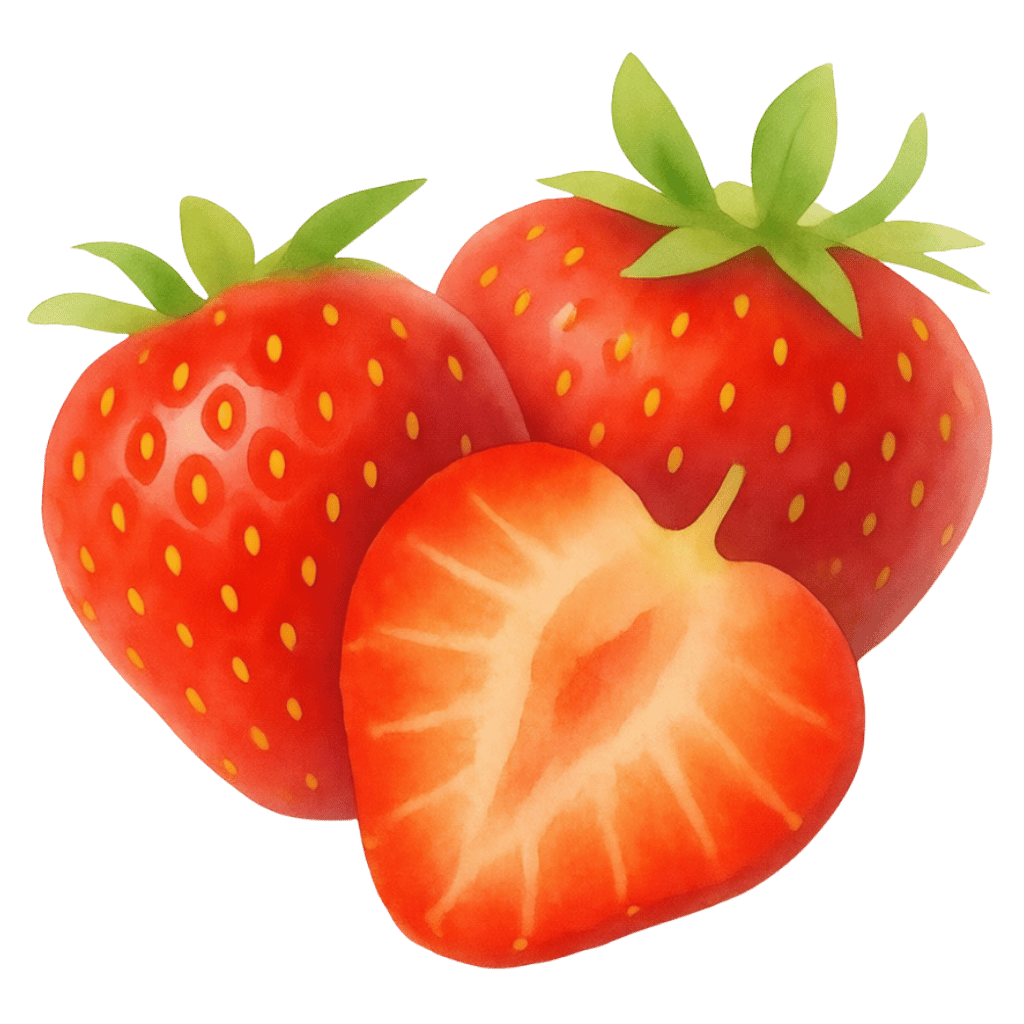
Strawberry
Fragaria × ananassaVarieties
Camarosa
9.8–11.5° BrixCamino Real
6–6.7° BrixAlbion
8–9.1° BrixSan Andreas
Sweet Charlie
8.2–10.1° BrixBRS DC25 (Fênix)
Botanical View
- Leaves are trifoliate (compound, with three leaflets) borne on long petioles that arise directly from the crown in a basal rosette; there is no true above-ground leafy stem. Each leaflet is oval to obovate with a serrated (toothed) margin, a prominent central vein, and a slightly rugose (wrinkled) surface; petioles and the underside of leaflets are typically pubescent (hairy). Leaves are produced continuously from the crown throughout the growing season and are shed/replaced as the plant ages.
- The main stem is a short, thickened, compressed structure at soil level called the "crown," which functions as the plant's perennial storage and growth center: it bears axillary buds that can differentiate into new leaves, branch crowns, flower trusses, or stolons depending on photoperiod and temperature. From the crown, slender horizontal above-ground stems called stolons (runners) extend outward; at nodes along each stolon a new "daughter plant" forms, roots into the soil, and becomes an independent, genetically identical clone, the plant's principal means of vegetative propagation.
- The root system is shallow and fibrous, concentrated mostly in the upper 15-20 cm (about 6-8 inches) of soil, with roughly 50-90% of root mass in this top layer; a smaller proportion of thicker, more penetrating "framework" roots can extend deeper. Roots arise adventitiously from the base of the crown and consist of primary structural roots plus finer secondary "feeder"/"explorer" roots that take up water and nutrients. Root mass fluctuates seasonally, comprising a much larger share of total plant dry weight during the dormant/cool months than during active spring-summer growth.
- The inflorescence is a compound, branched cluster (a cyme, often described as a dichasial or corymbose cyme) borne on a flowering stalk (peduncle/truss) that emerges from an axillary crown bud. A "king" (primary, terminal) flower opens first and typically produces the largest fruit, followed by secondary and tertiary flowers that branch below it and open in succession, giving trusses of several flowers of decreasing size and maturing at different times. Each flower has 5 (sometimes more) green sepals, usually 5 white petals, numerous stamens (~20-30) arranged in rings around a receptacle bearing several hundred separate pistils (carpels), a hallmark of the Rosaceae's superficially simple but multi-carpellate flower structure.
- Fragaria × ananassa is predominantly self-fertile/self-compatible: each hermaphroditic flower carries both functional stamens and numerous pistils and can set fruit through self-pollination without a separate pollen source. However, well-formed, symmetrical fruit depends on thorough pollination of all the many individual pistils on the receptacle; incomplete pollination (whether from self- or cross-pollen) results in small or misshapen ("cat-faced") fruit, since each achene that fails to be fertilized suppresses growth of the adjacent receptacle tissue. Commercial cultivars are propagated clonally via runners, so genetic recombination from sexual reproduction (seed) is used mainly in breeding, not in commercial planting-stock production.
- Pollen transfer is aided by wind but is achieved mainly by insects, principally honey bees (Apis mellifera) and various wild bees, which are considered the primary and most effective pollinators; flowers typically require multiple insect visits to fertilize the many pistils per flower and produce a well-formed, symmetrically shaped berry. Other flying insects (e.g., flies, some beetles) may contribute incidental pollination, but managed or wild bee activity is the main driver of full pollination and fruit quality in commercial plantings.
- Strawberry is demanding with respect to soil physical and nutritional conditions. It performs best in well-drained, sandy-loam to sandy clay-loam soils that are rich in organic matter and have good structure and aeration; heavy, poorly drained soils favor root and crown rots. Recommended soil pH is slightly acidic, approximately 5.5-6.5, with Brazilian production guidance citing an optimal range near 5.5-6.0 and North American guidance citing 6.0-6.5. Good drainage and aeration around the shallow root system are critical, which is why raised beds and, increasingly, soilless/substrate systems are widely used in commercial production.
- Fertilization in modern strawberry production is applied largely through fertigation, delivering water-soluble nutrients via drip irrigation matched to plant growth stage; pre-plant fertilizer is commonly incorporated (e.g., nitrogen sources, phosphorus, potassium) with nitrogen rates kept moderate to avoid excess vegetative growth at the expense of flowering and fruiting. Drip irrigation is the standard method for efficient water delivery and fertigation, while overhead/sprinkler irrigation is used for initial plant establishment and for frost protection during flowering. Irrigation management is especially critical right after transplanting and again during flowering, when water stress or nutrient imbalance most directly reduces fruit set and quality; soilless/substrate systems using recirculating hydroponic solutions are also used in Brazil to control water and nutrient delivery precisely and reduce losses.
- Commercial strawberry planting stock is propagated vegetatively (clonally), preserving the genetic identity of each cultivar, since seed propagation would segregate the complex octoploid genome and not breed true. The main vegetative method is via stolons (runners): daughter plants that form at nodes along runners emerging from the mother crown are rooted, detached, and used as new planting material, distributed commercially as bare-root plants, plug (tray-rooted) plants, or cut-off plants. To ensure planting stock is healthy, growers rely on certified, pathogen-tested ("clean plant") nursery programs, which start from tissue-cultured (micropropagated) and virus-indexed foundation mother plants that are then multiplied through successive certified generations before reaching commercial fields.
- The visible "seeds" on the strawberry surface are achenes, each a true, one-seeded dry fruit resulting from a separate fertilized pistil; because the species is a highly heterozygous allo-octoploid, plants grown from these achenes segregate widely and do not reproduce true to the parent cultivar's fruit size, flavor, yield, or disease resistance. For this reason, seed (achene) propagation is used almost exclusively in breeding programs to generate new genetic variation and candidate cultivars, while all commercial fruiting stock is propagated clonally via runners to maintain uniform, predictable characteristics.
- Cultivars are classified primarily by photoperiod response into short-day ("June-bearing," one seasonal fruiting flush) and day-neutral/long-day types (extended, repeated fruiting largely independent of day length). Widely grown cultivars in Brazilian production include Camarosa, Albion, San Andreas, Aromas, Camino Real, Ventana, Monterey, Portola, Diamante, and Festival, several originating from University of California and University of Florida breeding programs; Embrapa has also released Brazilian-bred cultivars adapted to national conditions, such as BRS Aromas and BRS DC25 ("Fênix"), the latter noted for moderate resistance to powdery mildew, anthracnose, crown rot, and Verticillium wilt. In the United States, common short-day cultivars in the southeastern region include Chandler, Camarosa, Sweet Charlie, Ruby June, Rocco, and Fronteras, while Albion and Monterey are standard day-neutral cultivars for tunnel production.
- The modern cultivated strawberry originated in 18th-century Europe from the chance/deliberate interplanting and hybridization of two New World octoploid species: F. chiloensis, brought from Chile to France in 1714 by the French engineer Amédée-François Frézier, and F. virginiana, from eastern North America. The hybrid origin was documented and studied by French botanist Antoine Nicolas Duchesne, whose 1766 "Histoire naturelle des fraisiers" first described the new hybrid, subsequently named Fragaria × ananassa (after the pineapple, "ananas," for its aroma) by Duchesne, Weston, and Rozier in the late 18th century. Since then, breeding has proceeded almost entirely through controlled crosses and clonal (runner) propagation of selected genotypes rather than through open-pollinated seed lines, given the crop's complex allo-octoploid genome; modern programs (including University of California, University of Florida, and Brazil's Embrapa, among others) continue to develop cultivars for improved fruit quality, yield, photoperiod adaptation, and disease resistance.