Back to Fruitpedia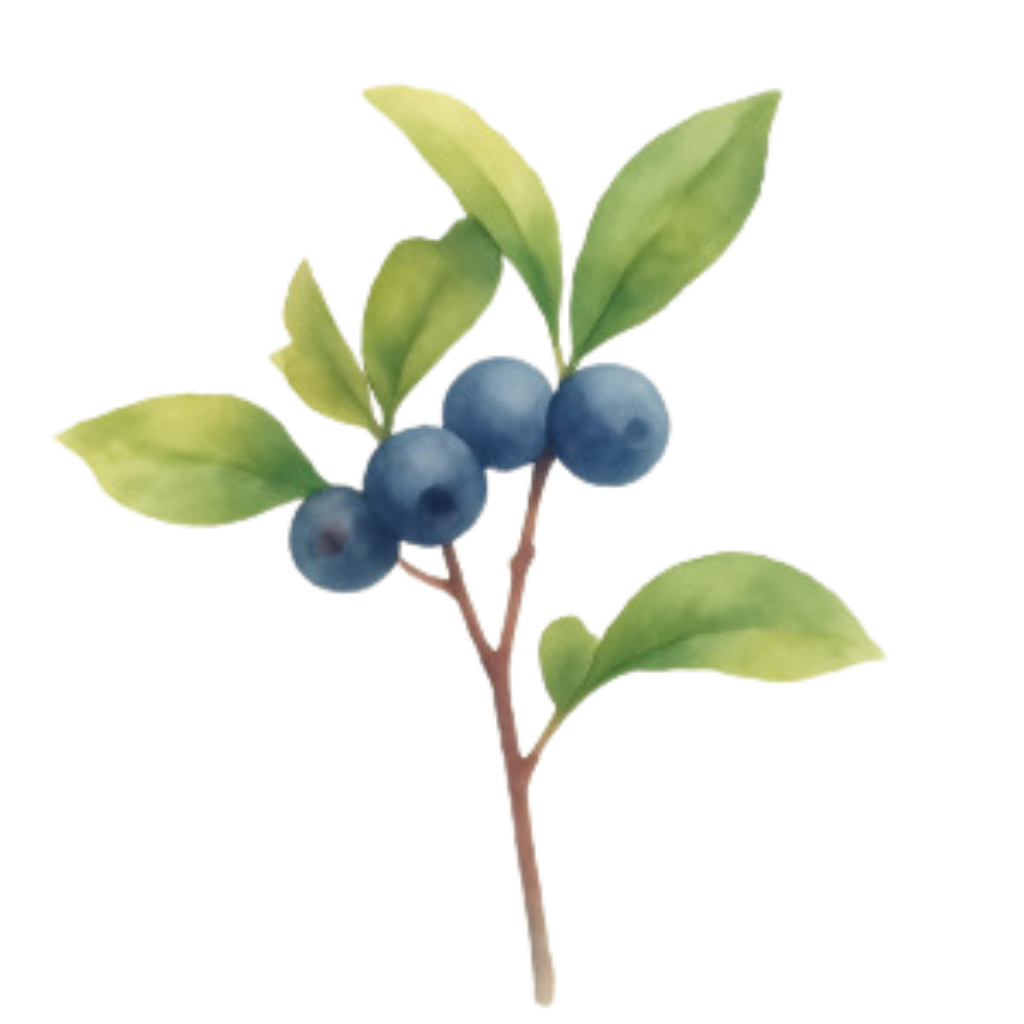
Blueberry
Vaccinium corymbosumVarieties
Bluecrop
11–15° BrixDuke
Elliott
Chandler
10–12° BrixLegacy
Jersey
Botanical View
- Leaves are simple, alternate, elliptic to ovate, about 3.8-8 cm long and 2-3 cm wide, slightly leathery, with entire to finely serrulate, ciliate margins. The upper surface is dark, glossy green; the lower surface is paler and often glaucous. Foliage is deciduous, turning shades of yellow, orange, red or bronze in autumn before leaf fall.
- Woody, erect to semi-spreading shrub with a basitonic branching habit (branching concentrated at the base of the plant, which determines overall plant stature). Young canes are yellowish-green, maturing to brown with exfoliating bark; stems often take on reddish tones in winter. Mature productive canes ("pernadas"/primary branches) are typically retained for up to about 6 years before being renewed through pruning.
- Fibrous, shallow (superficial) root system that characteristically lacks root hairs, which limits the plant's efficiency in absorbing water and nutrients from the soil. This trait explains the species' requirement for well-aerated, evenly moist, highly acidic soils and its sensitivity to compaction, poor drainage and waterlogging. Roots commonly form symbiotic associations with ericoid mycorrhizal fungi (and dark septate endophytes), which substantially improve nutrient and water uptake in a root system otherwise poorly equipped to do so on its own.
- Flowers are borne in axillary racemes on one-year-old wood, concentrated in the terminal six to eight buds of each fruiting shoot. Individual flowers are perfect (hermaphroditic), with a sympetalous corolla of 4-5 fused lobes, urn- or bell-shaped (urceolate to campanulate), white to pale pink. There are 8-10 stamens (usually twice the number of corolla lobes), with elongated, hollow, tubular anthers that release pollen through a terminal pore; the style is single and filiform, ending in an undifferentiated stigma. Pollen is shed as tetrads (groups of four fused grains).
- Flowers are perfect (bearing both functional stamens and pistil). Highbush-type cultivars are largely self-fertile, but cross-pollination between cultivars produces larger, better-set fruit; a fruit set of at least 80% of flowers is required for satisfactory commercial yield. Rabbiteye-type cultivars show a marked degree of self-incompatibility, so at least two compatible cultivars must be interplanted for adequate pollination. Because the corolla shape causes pollen to fall away from the stigma rather than onto it, effective pollination in both types depends almost entirely on pollinating insects rather than wind or gravity.
- Blueberry flowers require "buzz pollination" (sonication) by bees to release pollen from the poricidal anthers, so insect pollinators are essential to fruit set. Managed honey bees (Apis mellifera) are the main commercial pollinator, with roughly five hives per hectare recommended once about 25% of flowers are open. Wild bees are also important and often more efficient: bumblebees (Bombus spp.) and the oligolectic southeastern blueberry bee (Habropoda laboriosa) are documented as more effective pollinators of cultivated blueberry flowers than honey bees, with individual female H. laboriosa visiting tens of thousands of flowers per season.
- Requires strongly acidic soil, with a water pH ideally between 4.5 and 5.0 (tolerable range about 4.0-5.5); soils above pH 5.5 require elemental sulfur amendment, and correction becomes impractical and uneconomical above pH 6.0. Preferred textures are sandy or sandy-loam, not overly deep, with low native fertility but high organic matter, good aeration and drainage combined with good water retention; heavy clay soils and waterlogged sites are unsuitable because the shallow, hairless root system is highly susceptible to root rot. A broader soil pH tolerance (about 2.7-6.6) with tolerance of low nitrogen and phosphorus levels has also been reported for the species.
- Annual macronutrient extraction follows the order N > Ca > K > P > Mg. Because of the shallow, hair-less root system, blueberry is fertilized at roughly half the nutrient concentration used for other fruit crops, and young plants are especially prone to fertilizer-toxicity damage. Nitrogen must be supplied in ammoniacal or urea form, never as nitrate (which is toxic to blueberry), split into at least two annual applications timed at flower-bud opening and full bloom; optimal foliar nitrogen is 1.80-2.10%. Irrigation (surface, micro-sprinkler or drip) is considered essential, particularly during the first two establishment years and during fruit development: moderate water deficit can reduce yield by about 20%, while severe deficit can cut yield by 31-49% depending on phenological stage, mainly through reduced fruit size; the plant tolerates soil waterlogging only during winter dormancy.
- Propagated sexually by seed (mainly for breeding purposes, since seedlings segregate widely) or, commercially, asexually by cuttings or micropropagation. Highbush types are generally propagated from 15-20 cm dormant hardwood cuttings taken during winter rest, rooted at a substrate temperature of 18-21°C. Rabbiteye types, better suited to milder-winter regions, root more successfully from softwood (herbaceous) cuttings (10-15 cm, with two to three retained upper leaves) taken mainly in spring and rooted under intermittent mist with IBA or NAA rooting-hormone treatment (about 2,500 ppm). Root formation begins 30-45 days after sticking, and rooted cuttings are transplanted into individual containers after about 90-120 days, then grown on for roughly a year before field planting. Tissue-culture (micropropagation) is also used commercially, allowing large numbers of plantlets to be produced from a single explant, though these require careful hardening off before being taken to the field.
- Commercially important traits (fruit size and firmness, ripening uniformity, flavor, chilling requirement, disease and pest resistance) are polygenic and highly heterozygous in blueberry, so seedlings grown from seed show wide phenotypic variability and do not reproduce the parent cultivar true-to-type. This variability is exploited directly in breeding: much of Embrapa Clima Temperado's own blueberry germplasm descends from open-pollinated seed of the cultivar 'Bonita', from which thousands of seedlings were raised and evaluated, yielding productive selections (e.g., Sel. 74, 103, 110, 123) that were subsequently propagated clonally for further testing.
- Commercial blueberry types are grouped into five main classes: Highbush (plants over 2 m, needing about 650-850 chilling hours, predominantly V. corymbosum and V. australe); Half-high (0.5-1.0 m hybrids of V. angustifolium x V. corymbosum with lower chilling needs); Southern highbush (low-chill, subtropical-adapted V. corymbosum-based hybrids); Rabbiteye (V. ashei/V. virgatum, hexaploid, plants 2-10 m, vigorous, drought- and heat-tolerant, low chilling requirement); and Lowbush (under 0.5 m, mainly V. angustifolium). Cultivars evaluated and grown at Embrapa Clima Temperado (southern Brazil) include the rabbiteye types 'Aliceblue', 'Bluebelle', 'Bluegem', 'Briteblue', 'Climax', 'Delite', 'Powderblue', 'Woodard', 'Bonita', 'Tifblue', 'Premier' and 'Beckyblue', and the (southern) highbush types 'Misty', "O'Neal", 'Sharpblue', 'Star', 'Georgiagem', 'Bluecrop', 'Bluecrisp', 'Millenia', 'Jewel', 'Sapphire' and 'Emerald', selected for traits such as fruit size, soluble solids content, firmness, low chilling requirement and disease tolerance.
- Formal domestication of blueberry began in the United States at the turn of the 20th century. F.A. Card began selecting native plants for propagation trials in Rhode Island in 1898, and similar early work occurred in Maine, New York and Michigan. Frederick Coville began systematic selection and controlled crossing in 1906, starting from a wild highbush selection named 'Brooks'; in 1911 he made the first successful highbush x lowbush cross ('Brooks' x the lowbush selection 'Russell', made in 1909). By the time of Coville's death in 1937, his program had produced roughly 70,000 hybrid seedlings and released 15 cultivars. USDA breeding continued at Beltsville, Maryland (G.M. Darrow and collaborators), producing widely grown cultivars such as 'Bluecrop' (from a 1934 cross) and parent material behind later rabbiteye releases like 'Powderblue'. Blueberry breeding subsequently spread to the Netherlands, Germany, Canada, Ireland, Italy, Finland, the former Yugoslavia, England, Denmark and Scotland, and later to Florida's low-chill southern highbush program (source of cultivars such as 'Misty', "O'Neal", 'Sharpblue', 'Star', 'Emerald', 'Millenia', 'Jewel' and 'Sapphire'). In Brazil, Embrapa Clima Temperado (Pelotas, RS) introduced the first rabbiteye cultivar collection from the University of Florida in 1983, followed in subsequent years by open-pollinated seed of 'Bonita', from which local selections (Sel. 74, 93, 103, 110, 123) have been advanced within an active Brazilian breeding program.