Back to Fruitpedia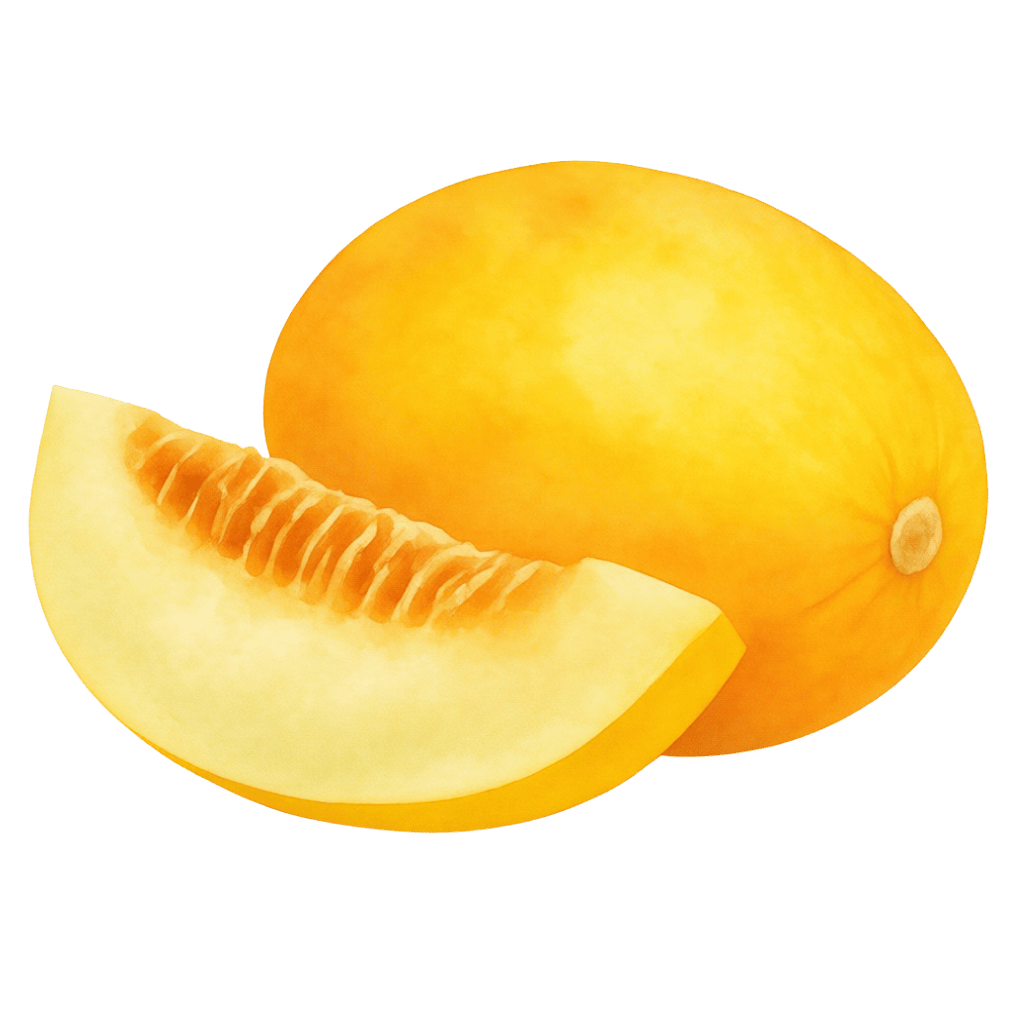
Canary melon
Cucumis meloVarieties
BRS Araguaia
12° BrixBRS Anton
12° BrixCamposol
13–14° BrixBrilliant
13–14° BrixHalo
12–13° BrixHibrix
14.7° BrixBotanical View
- Leaves are simple, alternate, borne singly at each stem node, and palmately three- to five-lobed with a strongly cordate (heart-shaped) base; the blade and petiole are covered in stiff hairs giving a rough texture. Leaf color, shape and size vary considerably among cultivar groups. Unbranched coiling tendrils arise at the nodes alongside the leaves and function as climbing/anchoring organs for the trailing vine (Virginia Tech Cooperative Extension; Kew POWO).
- The main stem is near-cylindrical to angular with longitudinal ridges and variable pubescence (fine hairs) depending on genotype. Growth habit is a prostrate, trailing vine that can extend several meters, producing new lateral stolons from the leaf axils along the main axis; modern compact/bush cultivars with shortened internodes also exist. Nodes bear leaves, tendrils and flowers (Virginia Tech Cooperative Extension; Embrapa Semiárido).
- The root system is typically superficial, but in deep, well-aerated soils it can reach considerable depth. A strong, vigorous pivoting (tap) main root produces abundant secondary/lateral roots that generally extend beyond the above-ground canopy; maximum rooting depth ranges from about 0.8 m to 1.5 m (2.6-5 ft) depending on genotype, soil type and growing conditions. Because of this rooting pattern, Embrapa recommends deep (80 cm or more), well-drained, medium-textured soils to maximize root development (Embrapa Semiárido; Virginia Tech Cooperative Extension).
- Flowers are solitary and axillary, funnel/campanulate-shaped, yellow, and relatively small (roughly 1 inch/2.5 cm wide). The species is andromonoecious, bearing both staminate (male) flowers and perfect (hermaphrodite, bisexual) flowers separately on the same plant. Male flowers appear first, 18-25 days after germination; hermaphrodite flowers follow 3-5 days later, after which the plant carries both flower types simultaneously. Anthesis (flower opening) occurs at about 6:00 a.m. and flowers close (senesce) from about 4:00 p.m. onward on the same day, giving each flower a lifespan of roughly 10 hours (Embrapa Semiárido; Virginia Tech Cooperative Extension).
- Cucumis melo is andromonoecious, producing male (staminate) flowers and hermaphrodite (perfect) flowers on the same individual plant rather than separate male and female flowers. Most commercial Brazilian cultivars share this floral system. Fruit set requires insect-mediated transfer of pollen to the hermaphrodite flowers (the species is not effectively wind-pollinated), and higher air temperatures (above 35°C) shift the flower ratio toward more male flowers (Embrapa Semiárido; Virginia Tech Cooperative Extension).
- Honeybees (Apis mellifera) are the principal pollinating agents and are essential during flowering to ensure fruit set, increase yield, and reduce the incidence of malformed fruit. Agronomic guidance (Embrapa) recommends placing one to two beehives per hectare near the crop only during the flowering period when natural pollinator visitation is insufficient, and avoiding agrochemical spraying in the morning hours when bee activity is highest.
- The crop adapts to a wide range of soils but performs poorly in poorly drained, waterlogged lowland soils and in very sandy, shallow soils. Deep (80 cm or more), fertile, medium-textured soils (sandy-loam to loam-clay) with good porosity are preferred, allowing root development, water infiltration and easy drainage and helping avoid future salinity problems. The crop does not tolerate acidic soils; the ideal soil pH range is 6.0-6.5, the range in which most required nutrients remain available. The species is sensitive to salinity: yield reductions of about 25% occur at a soil electrical conductivity (EC) of 4 dS/m (25% loss reported at EC 5.7 dS/m soil / 3.8 dS/m irrigation water per FAO data cited by Embrapa) and about 50% at 6 dS/m soil EC (9.1 dS/m soil / 6.1 dS/m water per FAO), with total crop loss above roughly 16 dS/m (Embrapa Semiárido).
- The crop responds strongly to organic fertilization, particularly on sandy soils, with roughly 30 m3/ha of well-cured manure (or an equivalent organic amendment) commonly applied, in addition to mineral N-P-K fertilization based on soil-test results. Drip (localized) irrigation combined with fertigation is the preferred system in major Brazilian production regions because it improves water- and fertilizer-use efficiency, reduces nutrient leaching, and limits weed and disease pressure by keeping foliage dry. Total crop water requirement from planting to harvest ranges from about 300 mm to 550 mm depending on climate and cultivar. Irrigation scheduling follows four crop stages (initial, vegetative, fruiting and maturation); the fruiting stage is the period of maximum water demand and is most sensitive to both water deficit (reduces fruit set and size) and excess (favors disease and nutrient leaching), while irrigation should be reduced during fruit maturation to avoid diluting soluble solids and lowering fruit sweetness/quality.
- Cucumis melo is propagated from seed, either by direct field seeding (about 11,000-22,000 seeds/ha, generally one seed per planting hole because of high seed cost and germination rate) or by transplanting seedlings raised in trays with an appropriate substrate and transplanted to the field about 10 days after sowing, a method used especially for hybrid seed. Optimal germination occurs between 25°C and 30°C (viable range 18-45°C), and temperatures below 20°C delay sprouting. Typical field spacing is about 2.0 m between rows and 0.2-0.5 m between plants (10,000-25,000 plants/ha), with closer double-row spacing sometimes used to produce smaller export-sized fruit (Embrapa Semiárido; Virginia Tech Cooperative Extension).
- Commercial melon cultivars, including most modern disease-resistant, high-°Brix hybrids grown in Brazil, are F1 hybrid seed produced by controlled crosses between parental lines; seed from harvested hybrid fruit segregates in the next generation and does not reproduce true to type, so growers are advised to purchase certified seed each season rather than save seed. Germplasm surveys of melon accessions in northeastern Brazil illustrate the wide variability present within the species/cultivar groups: main-vine length 1.50-4.70 m, fruit weight 0.1-6.5 kg, fruit length 4.5-41.0 cm, fruit width 4.0-19.5 cm, and total soluble solids 3.5-15 °Brix.
- Cucumis melo encompasses numerous horticultural/cultivar groups. The Canary melon belongs to the Inodorus group (smooth or lightly wrinkled, non-netted rind; non-climacteric; low aroma; long postharvest storage), the same botanical group as the "Amarelo" (Yellow) and "Piel de Sapo" market types that dominate Brazilian and Spanish production; other major groups include Cantalupensis (Cantaloupe, Charentais - aromatic, ribbed/warty rind, orange-salmon flesh), Reticulatus (netted-rind melons), and Galia types. Within Brazil's Inodorus/Amarelo type, Embrapa lists numerous F1 hybrids bred for Fusarium oxysporum and powdery mildew (Podosphaera xanthii) resistance and export-grade °Brix, including "Hibrix," "Natal," "Iracema," "Gold Mine," "Goldex," "Gladial," "Mandacaru," "Soleares" and "Tropical (10/00)," among others - illustrating the intensive breeding effort applied to this cultivar group to which the Canary melon belongs.
- Genomic and archaeobotanical evidence indicates melon was domesticated independently at least twice, once in Africa and once in Asia, from genetically distinct wild lineages. The oldest known African melon seed remains, from Lower Egypt, date to about 3700-3500 BC, predating the oldest confirmed Asian melon remains, which date to roughly 3000 BC in China and 2300-1600 BC in the Indus Valley. The Asian domestication lineage is the ancestor of essentially all widely commercialized melon cultivar groups grown today (Cantaloupe, Galia, Honeydew and Inodorus/Piel de Sapo types, including the Canary melon), while the African lineage persists mainly in Sudanese landraces. Within the modern Inodorus/Amarelo group to which Canary melon belongs, twentieth- and twenty-first-century plant breeding (documented in detail for Brazil by Embrapa) has produced numerous F1 hybrids selected for resistance to Fusarium oxysporum races and powdery mildew (Podosphaera xanthii) races, for higher soluble-solids content, firmer flesh and longer postharvest shelf life suited to export markets.